It’s my contention that both hierarchical and egalitarian behaviour are equally “natural” to human beings. These two methods of interacting with others in a group have co-existed in all human societies, from the earliest stages of our evolution as a species. It is also my contention that, while there is a limited place for hierarchical thinking and behaviour in a good society, it is egalitarian thinking that has created civilization and morality. Any society that is dominated by hierarchy is essentially backward, self-destructive, and immoral. Read more »
Category Archives: A - BLOG - Page 44
FIFTH MEDITATION ON DEMOCRACY (written Monday, November 5, 2007)
Posted by Phil Paine
on November 5, 2007
No comments
Image of the month: Kluane glacial merge, St. Elias Range, Yukon, Canada
Posted by Phil Paine
on November 1, 2007
No comments

Wednesday, October 17, 2007 — Some Thoughts On Burma
Posted by Phil Paine
on October 17, 2007
No comments

Neighbourhood in Yangon, Burma — Burma (also called Myanmar) is considered one the most economically mismanaged countries on earth.
The greatest shame and degradation for human beings is to be ruled by an aristocracy. Whether one is reduced to abject slavery, or merely forced to submit to graded snobberies and unearned privilege, it all comes down to the same truth. Aristocratic government is a violation of fundamental morality, and an intolerable insult to human dignity. It follows that the heroes of our species are those who defy, resist, and overthrow aristocracy, and strive for the only morally acceptable arrangement of human politics: democracy. It also follows that those who seek to impose or preserve dictatorship over human beings are the palpable villains. And as for those who stand by while others risk their lives for freedom, encourage their oppressors, and rush to trade and socialize with the tyrants ― well, no language is vivid enough to describe their cowardice and treachery.
It’s not hard to pinpoint who are the current heroes and villains. Read more »
FOURTH MEDITATION ON DEMOCRACY (written Saturday, September 22, 2007)
Posted by Phil Paine
on September 22, 2007
No comments
Recently, two Canadian high school students did a remarkable thing. It was remarkable enough to generate a large amount of comment in the blogosphere. According to the original news item in the Halifax Chronicle Herald [1], a grade 9 student “arrived for the first day of school last Wednesday and was set upon by a group of six to 10 older students who mocked him, called him a homosexual for wearing pink and threatened to beat him up.” Anyone who has attended high school knows the usual outcome of such situations. But in this case, it was different. Two senior students, Travis Price and David Shepherd, were disgusted by this crude bullying. “It’s my last year. I’ve stood around too long and I wanted to do something,” David explained. The two students bought 75 pink tank-tops and, rallying students through the internet, persuaded half the student body to wear them, or to supply their own. When the bullies next came to school, they were confronted by an ocean of pink solidarity. “The bullies got angry,” said Travis. “One guy was throwing chairs (in the cafeteria). We’re glad we got the response we wanted.”
The protest rapidly spread to thirty other Nova Scotia schools, then across the rest of Canada. High schools are no longer isolated, self-contained, stratified, and despotic mini-societies. Social networking media like Facebook and MySpace are enabling rapid, fluid and democratic communication, not only between students in the same school, but linking them to every other school in the world. Read more »
Image of the month: Alternating Currents
Posted by Phil Paine
on September 1, 2007
No comments
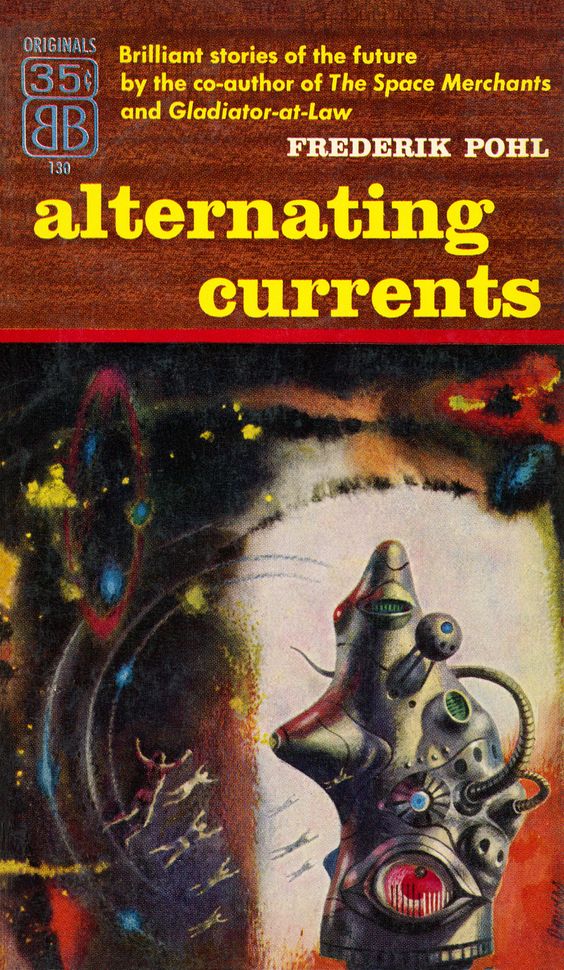
1956 Ballantine paperback of Frederik Pohl’s short story collection Alternating Currents. The cover art is by the inimitable Richard Powers.
THIRD MEDITATION ON DEMOCRACY (written Saturday, August 18, 2007)
Posted by Phil Paine
on August 18, 2007
No comments
Western Europe, and lands culturally derived from it, have made some relatively successful approximations of democracy and civil society, and combined them with noticeable prosperity. People both inside and outside this favoured zone wonder why, and they have often sought the answer in two particular areas: religious traditions, and the dramatic intellectual era called “the Enlightenment”. As someone who has written about the universal aspects of democracy, I’ve often felt some annoyance at what I consider parochial views of history, and dubious ideas of causality. I feel great sympathy for people outside the favoured zone, who are hopeful that they can have a democratic future, but are discomfited by the “second-banana” status that it seems to imply for their cultural heritage. This is especially true in the Islamic world, where past cultural glories and present embarrassments combine to make the search for democratic reform a touchy subject. I think that an excessively cartoonish view of the Enlightenment, and of the relationship between religion and democracy, is part of the problem.
I recently read two articles by Tassaduq Hussain Jillani, a supreme court justice in Pakistan. Though Pakistan has millennia of cultural achievement — it was one of the earliest centers of urban civilization — and it has a well educated population, it languishes under a crude military dictatorship. It has experienced much strife from conflicting religious factions. While its economy is a shambles, the military thugs who run the place take pride in their possession of nuclear weapons. Read more »
SECOND MEDITATION ON DEMOCRACY (written Monday, August 7, 2007)
Posted by Phil Paine
on August 7, 2007
No comments
“Civilization is the process in which one gradually increases the number of people included in the term ‘we’ or ‘us’ and at the same time decreases those labeled ‘you’ or ‘them’ until that category has no one left in it.” — Howard Winters, an American archaelogist who studied ancient settlement and trade patterns [quoted by Anne-Marie Cantwell in Howard Dalton Winters: In Memoriam]
“Voice or no voice, the people can always be brought to the bidding of the leaders. That is easy. All you have to do is to tell them they are being attacked, and denounce the pacifists for lack of patriotism and exposing the country to danger. It works the same in any country.” — Hermann Wilhelm Göring, second in command to Adolf Hitler.
What most tellingly distinguishes democratic from non-democratic thought is its respect for human beings. By this, I don’t mean respect for some nebulous abstraction called “humanity” or “the people”, which is all too easily transformed into a mystical collectivism. It’s a respect for real-life individual human beings, who live, fall in love, have children, and struggle to find security and happiness. In democratic thought, the wellbeing of individual human beings is the purpose and measure of political choices. Wellbeing, to the democrat, is defined first in terms of what matters most to conscious beings — liberty, self-respect, dignity, control over their own lives. The physical necessities of life, such as food and shelter, are meaningless to human beings except within the context of those values. We are not cattle. Read more »

Friday, July 13, 2007 — Cheering News
Posted by Phil Paine
on July 13, 2007
No comments
Three very pleasant items in tonight’s news.
Criminal financier Conrad Black, who is also a member of the British House of Lords, has been found guilty on four counts (racketeering, obstruction of justice, money laundering, and fraud) in a Chicago court, and may face prison time. While he is probably not a big name in the United States, and the trial drew only moderate coverage from American media, it was followed with great interest in Canada, where he has been despised by most decent people for decades. Read more »