A fabulous night of music and conversation. An assortment of local musicians at the village pub called Sterenn Roz (The Rose Star). These “session trad” have been held here for at least a quarter century. Young and old, playing in different combinations throughout the evening. No stage, just a comfortable mix of musicians and clientele. People switching instruments, dropping in or dropping out of a song as the spirit moved them, glances exchanged between players who found a common groove. The Celtic way. There were accordions; guitars, bagpipes, and a couple of reed instruments resembling a medieval shawm which they called a bombarde. Call-and-response, knees and feet catching the tempo. The style of performance, the rhythms and melodies bore a strong resemblance to Canadian folk music (It’s no accident that the acknowledged regional heart of Canadian folk is Cape Breton, Nova Scotia). But the fiddle, the workhorse of Canadian music, played no part. So the effect was a bit weird to me, as if someone played bluegrass with no banjo. Read more »
Category Archives: C - LISTENING - Page 18
First-time listening for March 2014
22842. (Jean-Philippe Rameau) Pygmalion [complete opera; d. Leonhardt; Elwes, van der
. . . . . Sluis, Vanhecke, Yakar]
22843. (Yeah Yeah Yeahs) Mosquito
(Kiri Te Kanawa) Solo e Amore — Puccini Arias:
Read more »
La Mer and the Garden of Fand
Debussy’s La Mer is so familiar that it’s easy to forget how revolutionary a piece it was when it was finished in 1905. After a gazillion performances, it still remains fresh. We are accustomed to think of it as a pure example of “expressionism”, a kind of musical equivalent of Monet’s fuzzy lily pads and flowers, and it is indeed that. But at the same time, it exhibits a strict classicism in its structure, and romantic dynamism in that a “story” unfolds as each section develops from hints in previous sections, and it travels through the emotions as much as any high romantic symphony. In fact, it is fair enough to call it a symphony, if you think more in terms of the last Sibelius symphony than of Beethoven or Schubert. So it gives us the best of three worlds. Like most people who listen to classical music, I sometimes neglect to listen properly to “concert chestnuts” like this. In fact, it had been quite some time since I had given La Mer any thought. What triggered a return to it was listening to another impressionist work about the sea, much less well-known, Arnold Bax’s The Garden of Fand.

Fand leaves her lover Cu Chulainn (Manannan MacLir in the middle casts a spell of oblivion upon his wife, Fand) — Illustration by Yvonne Gilbert
Arnold Bax (1870–1953) was an English composer who became obsessed with Irish music, poetry and mythology. He is best known for a series of tone poems on celtic themes, of which Tintagel (1917) is the best known, and The Garden of Fand (1913–16) is the best. I’ve loved this piece for most of my life, though for a long time could only find a single recording of it. Fortunately, it was by Adrian Boult, the most sympathetic and able Bax interpreter. Bax had little fame or success during his lifetime. The early tone poems had a modest success, but his seven symphonies dropped into oblivion. However, Sibelius felt his work was first-rate, and the two men formed a lasting friendship. It was the advocacy of Adrian Boult that slowly brought Bax back into view, though most of his works were not available on record until the 1980s. Sibelius’s influence is visible in his work, but not obviously so. Debussy’s influence is more obvious, with the Frenchman’s parallel thirds shifting by whole tones, and sparkling woodwind ornaments. But Debussy tends to evoke nature with dispassion, while Bax invokes a more supernatural, even creepy sensibility. The Garden of Fand is based on an ancient Irish epic from the Ulster Cycle tale, Serglige Con Culainn (The Sickbed of Cúchulainn). Fand is a Celtic sea goddess, associated with the transition to the other world, faerie. The perennial Irish hero, Cúchulainn, tangles with her, to his peril. What has always appealed to me about the piece is it’s sinuous, shape-shifting melody, which has stuck in my mind far more than most. Around it, Bax weaves no end of dramatic surprises. It’s a fabulously inventive piece, with sudden changes of tempo and surprising effects. Little twinkling figures transform into sinister fortissimos. Like Celtic myth, the piece is deceptive, nothing ever remaining the same for long, and nothing being quite what if first appears to be… in short, it’s like the sea.
First-time listening for February 2014
22742. (Henry Purcell) Dido and Aeneas [complete opera; d. Pinnock; von Otter, Varcoe,
. . . . . Rogers]
22743. (Fuck Buttons) Slow Focus
22744. (Tomasso Albinoni) Double Oboe Concerto, Op.7 #11: Adagio
22745. (Tomasso Albinoni) Double Oboe Concerto, Op.7 #2: Adagio
Read more »
JB Lenoir
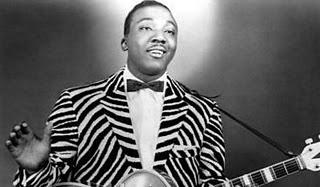 It would be interesting to imagine what would have happened to bluesman JB Lenoir if he had lived beyond his span of 38 years, cut short by an automobile accident. Unlike most blues artists of the fifties, he was politically oriented. One of the three albums I have, Eisenhower Blues (1954), is a satirical stab at that President’s policies. He was active in the Civil Rights movement. Another album I have, a compilation put together to accompany Martin Scorcese’s film history of the blues, draws heavily from Eisenhower Blues and other Chess recordings from the 1950s. So does a 1993 Charly label compilation I just found, Mama Watch Your Daughter. During this period, despite some chart success with songs like “Don’t Dog Your Woman”, Lenoir had to support himself working in kitchens. It’s in the sixties, just before his sudden death, that he achieved real recognition. Down In Mississippi, issued posthumously in 1970, dates from that period.
Lenoir sang in falsetto, his voice floating like a bubble on waves of rhythm guitar, and the arrangements were closer to early Rock ‘n’ Roll than to traditional blues. He affected garish suits, and otherwise fit well into the Rock ‘n’ Roll esthetic. His later work was electric boogie, and he should really be seen as having a prominent place in the history of Rock. Certainly, a number of prominent rock artists were familiar with, and were influenced by his work — John Mayall, for example. Perhaps, if he had lived past 1967, that would now be the case.
Although you will usually see his name printed as “J. B. Lenoir”, his first name was actually “JB”, which was not initials for anything. His surname was pronounced in the French manner.
First-time listening for January 2014
22715. (John Field) Piano Concerto #1 in E‑f, H.27
22716. (John Field) Piano Concerto #2 in A‑f, H.31
22717. (Olivier Messiaen) Huits préludes pour piano (1928–29)
22718. (Booker T & The MGs) Green Onions
Read more »
First-time listening for December 2013
22640. (Magnus Þór Sigmundsson) Íslandsklukkur
22641. (Giuseppe Verdi) Alzira [complete opera; d. Luisi; Mescheriakova, Vargas, Gavanelli]
22642. (Wilhelm Friedemann Bach) Harpsichord Concerto in F, F.44/BR.C13
Read more »
First-time listening for November, 2013
22593. (Giuseppe Verdi) I Lombardi alla prima crociata [complete opera; d. Levine; An-derson,
. . . . . Pavarotti, Ramey]
22594. (Boards of Canada) The Campfire Headphase
22595. (Peter Maxwell Davies) St. Thomas Wake: Foxtrot for Orchestra
Read more »
First-time listening for October, 2013
24044. (Gioacchino Rossini) Demetrio e Polibio [complete opera; d. Carraro; Gonzales, Surjan]
24045. (Giacomo Puccini) Manon Lescaut [complete opera; d. Rahbari; Gauci, Kuladov, Saudinero]
24046. (Social Distortion) Mommy’s Little Monster
24047. (El Ten Eleven) Every Direction Is North
24048. (Giuseppe Verdi) La traviata [complete opera; d. Toscanini; Albanese, Peerce, Merrill] Read more »
First-time listening for September, 2013
(Hespèrion XX) El Cancionero de Palacio, 1474–1516 — Música en la corte de los Reyes
. . Católicos:
. . . . 22419. (Francisco de la Torre) Danza Alta [instrumental]
. . . . 22420. (Gabriel Mena) Aquella Mora Garrida
. . . . 22421. (Francisco de Peñalosa) Por las sierras de Madrid
Read more »