18962. (Franz Josef Haydn) Symphony “A” in B‑flat [1762]
18963. (Franz Josef Haydn) Symphony “B” in B‑flat [1765]
(Ruth Golden, soprano) Silent Noon: Songs of Ralph Vaughan Williams
. . . . 18964. (Ralph Vaughan Williams) House of Life, Six Songs to Poems of Dante Gabriel
. . . . . . . . Rossetti for Baritone and Piano [arr. for soprano and piano] [see original at 16063]
. . . . 18965. (Ralph Vaughan Williams) Four Last Songs to Poems of Ursula Vaughan Williams
. . . . 18966. (Ralph Vaughan Williams) “Linden Lea”, song for voice & orchestra (“In Linden Lea”;
. . . . . . . . “A Dorset Song”) [arr. voice & piano]
Read more »
Monthly Archives: August 2008
First-time listening for August, 2008
Posted by Phil Paine
on August 31, 2008
No comments
READING – AUGUST 2008
Posted by Phil Paine
on August 31, 2008
No comments
16395. (Thomas T. Allsen) The Royal Hunt in Eurasian History
16396. (Philip K. Dick) The Zap Gun ― Being that Most Excellent Account of Travails and
. . . . . Contayning Many Pretie Histories By Him Set Foorth in Comely Colours and
. . . . . Most Delightfully Discoursed Upon as Beautified and Well Furnished Divers
. . . . . Good and Commendable in the Gesiht of Men of That Most Lamentable Wepens
. . . . . Fasoun Designer Lars Powderdry and What Nearly Became of Him Due to
. . . . . Certain Most Dreadful Forces
16397. (Charles Allen) God’s Terrorists ― The Wahhabi Cult and the Hidden Roots of
. . . . . Modern Jihad
16398. (Peter Ackroyd) Thames ― Sacred River
16399. (Michael H. Shuman) The Small-Mart Revolution ― How Local Businesses are
. . . . . Beating the Global Competition
16400. (Robert McCloskey) Homer Price
16401. (David K. Wyatt) Thailand, a Short History
16402. (Edward Schneier) Crafting Constitutional Democracies ― The Politics of Institutional
. . . . . Design
16403. (Jana Švábová & Tomáš Rygl) Prague
16404. (Jonathan Jarrett) [in blog A Corner of Tenth-Century Europe] Interdisciplinary
. . . . . Conversation: Vegetable Barter [article]
16405. (Steve Muhlberger) [in blog Muhlberger’s Early History] The Pennsic War [article]
(Rich Coad –ed.) Sense of Wonder Stories ― Issue Zero, February 2007 [zine]
. . . . 16406. (Rich Coad) What This Country Needs [preface]
. . . . 16407. (Bruce Townley) Model Citizen [article]
. . . . 16408. (Rich Coad) The Built a Crooked Universe [article]
. . . . 16408. (Rich Coad) Spung! [article]
. . . . 16409. (Ian Maule) I Dood It ! [article]
(Rich Coad –ed.) Sense of Wonder Stories # 1, 2007 [zine]
. . . . 16410. (Rich Coad) Wondertorial [preface]
. . . . 16411. (Randy Byers) The Early Days of a Better Genre [article]
. . . . 16412. (Bruce Townley) The Shadows Out of Space [article]
. . . . 16413. (Robert Lichtman) Lovecraft In The Real World [article]
. . . . 16414. (Bill Burns) Thomas Edison and the Electric Pen [article]
. . . . 16415. Letters from Chris Garcia, Mark Plummer, Harry Bell, John Purcell, Jerry
. . . . . . . . Kaufman, Claire Brialey, and Cy Chauvin [letters]
(Rich Coad –ed.) Sense of Wonder Stories #2, July 2008 [zine]
. . . . 16416. (Rich Coad) Wondertorial [preface]
. . . . 16417. (Bruce Gillespie) The Good Soldier: George Turner as Combative Critic [article]
. . . . 16418. (Bruce Townley) A Dream Flight [article]
. . . . 16419. (Peter Weston) Heresy, Maybe? [article]
. . . . 16420. (Graham Charnock) J. G. Ballard, A Journey of Inference [article]
. . . . 16421. Letters from Robert Lichtman, John Purcell, Eric Mayer, John Nielsen-Hall, Jim
. . . . . . . . Linwood, Mog Decarnin, James Bacon [letters]
16422. (Eric L. Jones) Cultures Merging ― A Historical and Economic Critique of Culture
(Robert A. Heinlein) The Unpleasant Profession of Johnathan Hoag:
. . . . 16423. [3] (Robert A. Heinlein) The Unpleasant Profession of Jonathan Hoag [story]
. . . . 16424. [3] (Robert A. Heinlein) The Man Who Traveled in Elephants [= The Elephant
. . . . . . . . Circuit] [story]
. . . . 16425. [4] (Robert A. Heinlein) “All You Zombies—” [story]
. . . . 16426. [2] (Robert A. Heinlein) They [story]
. . . . 16427. [2] (Robert A. Heinlein) Our Fair City [story]
. . . . 16428. [2] (Robert A. Heinlein) “—And He Built a Crooked House” [story]
16429. (Marjorie Mandelstan Balzer) The Tenacity of Ethnicity: A Siberian Saga in Global
. . . . . Perspective
(Yaron Matras, Peter Bakker & Hristo Kyuchukov –ed.) The Typology and Dialectology of Romani:
. . . . 16430. (Peter Bakker & Yaron Matras) Introduction [preface]
. . . . 16431. (Peter Bakker) Athematic Morphology in Romani: The Borrowing of a
. . . . . . . . Borrowing Pattern [article]
. . . . 16432. (Viktor Elšik) Towards a Morphology-based Typology of Romani [article]
. . . . 16433. (Yaron Matras) The Typology of Case Relations and Case Layer Distribution in
. . . . . . . . Romani [article]
. . . . 16434. (Vít Bubeník) Object Doubling in Romani and the Balkan Languages [article]
. . . . 16435. (Norbert Boretzky) Suppletive Forms of the Romani Copula: “ovel / avel”
. . . . . . . . [article]
. . . . 16436. (Milena Hübschannová & Vít Bubeník) Causatives in Slovak and Hungarian
. . . . . . . . Romani [article]
. . . . 16437. (Birgit Igla) The Romani Dialect of the Rhodopes [article]
. . . . 16438. (Petra Cech & Mozes F. Heinschink) The Dialect of the Basket-Weavers
. . . . . . . . [Sepečides] of Izmir [article]
. . . . 16439. (Victor A. Friedman) Linguistic Form and Content in the Romani-language Press
. . . . . . . . of the Republic of Macedonia [article]
. . . . 16440. (Ian F. Hancock) George Borrow’s Romani [article]
16441. (Steve Muhlberger) [in blog Muhlberger’s Early History] Exciting Views on Scholarship
. . . . . [article]
16442. (Michael Drout) [in blog Wormtalk and Slugspeak] A Model ―But Would it Work if it
. . . . . Were Generalized? [article]
16443. (Michael Drout) [in blog Wormtalk and Slugspeak] Method: Push the Metaphor Until it
. . . . . Breaks ― or, Mocking “Imbricated” Yet Again [article]
16444. (Tu Thanh Ha, Bill Curry & Anne McIlroy) Inspectors Failed to Adopt More Rigorous
. . . . . U.S. Measures [article]
16422. (Eric L. Jones) Cultures Merging ― A Historical and Economic Critique of Culture
Posted by Phil Paine
on August 27, 2008
No comments
“Culture” is a slippery concept, used in many different ways by historians, anthropologists and economists. Jones’ book is more a survey than the critique implied by the title, but it is an extremely useful and well-presented survey. I prefer this, since it is best to start off with some idea of who has thought and said what about the subject before plunging into debates. Presumptions about culture, especially about whether it determines how people act economically, or merely shapes itself on the basis of how people must act economically, underlie all sorts of theories and descriptions in the three fields. Usually these presumptions are shared by some group of thinkers without them being explicitly stated. Arguments between different groups, with different presumptions, usually result in confusion. But a number of works, in all three disciplines, either illustrate or make explicit particular ideas of culture’s relation to behaviour and economies. Scholars have taken their cues from these seminal works, and policy-makers adhered to any of several contradictory attitudes generated by them. Some have been downright silly (such as “the end of history” and “clash of civilizations” tom-foolery). Jones presents most of them fairly dispassionately, but he is obviously impatient with the stupider ones, and does not hide it. Of special interest to me is his sensible discussion of the “Asian Values” mystique, promoted by many East Asian economists and politicians, and often uncritically accepted elsewhere. (He cites Steve Muhlberger and myself in this discussion, so I could hardly fail to find it interesting.) On the whole, Jones gets the horse in front of the cart rather than the other way round. He plumps for common-sense causation when it is possible, and holds back his conclusions when causation cannot be discerned, rather than appeal to enigmatic collective properties.
(Rich Coad –ed.) Sense of Wonder Stories #0–2, Feb-July 2008 [zines]
Posted by Phil Paine
on August 24, 2008
No comments
In the jargon of science fiction fandom, Rich Coad is publishing a “sercon fanzine” — an amateur publication that emphasizes serious discussion of science fiction literature and issues, rather than social chatter, autobiographical writings, or in-group humour. Long before the existence of blogging or the web, fanzines were the vehicle that carried much of the same functions and sensibility. A few science fiction fanzines of the old-fashioned print-on-paper variety still survive, but fewer still are “sercon”. There’s a special pleasure in holding the stuff in your hands, and my hat goes off to Rich for facing the daunting barriers of high postal rates and computer-generation apathy. Read more »
Classical Composition in Early 19th Century Canada
Posted by Phil Paine
on August 23, 2008
No comments
When it comes to formal composition in Canada, before 1860, I know of nothing that was composed outside of Québec, the only part of the country with anything resembling an urban culture. There was, of course, plenty of folk fiddling, folk singing, tavern ballads, and hymn singing going on in Ontario, the West, and Atlantic Canada, but only Montréal and Québec City could support professional composers. Most of their work is unobtainable, but a sampling has been put together by l’Ensemble du Nouveau Québec under the title Anthologie de la musique historique du Québec, vol.1 ― l’époque de Julie Papineau, 1795–1862. As you might guess, it is pretty tame, provincial stuff, polkas, mazurkas and art songs of modest ambition. The most ambitious piece seems to have been Joseph Quesnel’s comic opera Lucas et Cécile (c. 1808), of which only the vocal parts survive. The two excerpts on the album display some panache, but they would have been old-fashioned in style at the time of their composition. All the works, by Quesnel, Frédéric Glackemeyer, Théodore Molt, Charles Sabatier, Ernest Gagnon, Célestin Lavigueur, and Antoine Dessane have the charm of small drawing-room compositions in a backwoods environment. They are most vigorous when they draw on folk material and local themes. However, the environment wasn’t entirely unsophisticated: Dessane made a setting of Alphonse Lamartine, at the time an avant-guarde poet. Nothing on the album, however, comes close to the impact of its best track: Antoine Gérin-Lajoie’s “Un Canadien Errant”. Strictly speaking, Gérin-Lajoie merely wrote evocative (and, at the time, politically charged) lyrics for a traditional folk song, but these lyrics are so perfect ― an exiled patriot, after the Rebellion of 1837, wanders the world, shedding tears of homesickness ― that earlier folk versions were entirely supplanted. The song has been performed by an astonishing variety of artists, ranging from Nana Mouskouri to Paul Robeson, as well as virtually every Canadian folksinger.
16400. (Jana Švábová & Tomáš Rygl) Prague
Posted by Phil Paine
on August 15, 2008
No comments
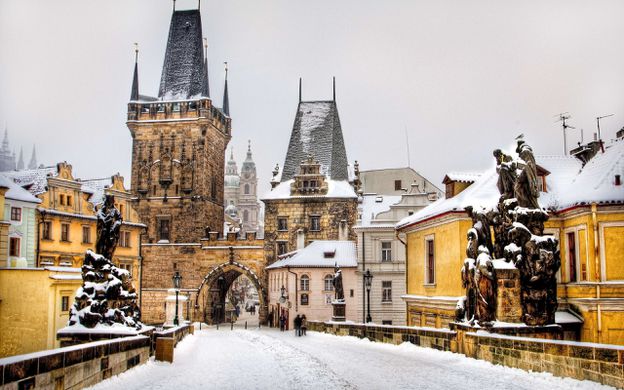
When I returned from up north, I found this book in the mail — a wonderful gift from my friend Filip Marek in Prague. It’s a beautiful, highly detailed guide to the medieval, renaissance and baroque architectural treasures of Prague. Filip knows how much I love those buildings, and how much this is a treat for me. The above photo is from elsewhere, but it gives you some idea of Prague’s charms, if you haven’t been there.
16397. (Robert McCloskey) Homer Price
Posted by Phil Paine
on August 11, 2008
No comments
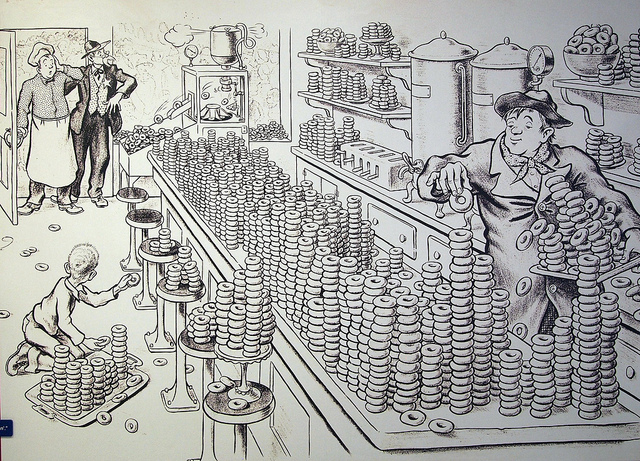
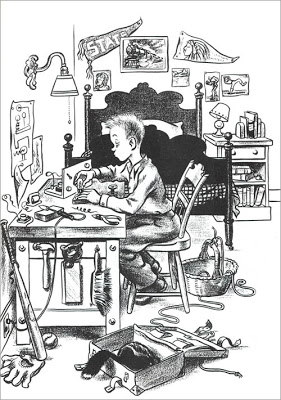
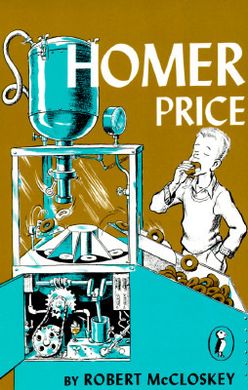 This was one of the “children’s classics”, written in 1943, that I had glanced at as a child, but never actually read. A pity. McCloskey was a gentle humorist with a charming style and great human empathy, who chose to write for children rather than, say, subscribers to the New Yorker. He was also a talented artist, in a style reminiscent of Ernie Pyle. The world he writes about now seems so far away that a contemporary child might have some problems interpreting it. It would seem exotic, rather than comfortingly familiar. But if you are an adult with any feeling for North American social history, the child-viewpoint stories about pet skunks, donut machines, and giant balls of string will be fascinating.
16396. (Michael H. Shuman) The Small-Mart Revolution ― How Local Businesses are Beating the Global Competition
Posted by Phil Paine
on August 10, 2008
No comments
I would like to see everyone involved with urban reform and with democratic activism to read this book. There is a powerful undercurrent of change going on in both the United States and Canada, definitely something moving up from the grass roots and ignored by both the media and the elite political drones. It’s something far more creative and significant than a mere flaky fashion for “anti-globalism” demonstrations, with which the reader might at first confuse it. It’s the fact that people — ordinary people — are starting to question the orthodoxies they have been taught about how things “have to be”, and realizing that their self-interest, as well as their future, depends on re-invigorating local economic and political power. You would never guess it from following the media, but Americans and Canadians are starting to shake off the passivity and morbid fatalism that their rulers have energetically cultivated. They’ve begun to notice that Wal-Mart moving into your neighbourhood produces poverty, not prosperity, that North American society has been rapidly hemoraging cash into a “global” empire of multinationals-kings-dictators, and that if they don’t do something about it they are going to become helpless paupers. Shuman describes some of the things that people have been doing, mostly in small scale entrepreneurial and social action, to turn the tide. His analysis of the issues and processes is not entirely accurate — he still suffers from the confusion of categorical terminology, such as the idiotic “left-right” concept, that cripples reform thinking — but he is definitely on the right track. Read more »
(Anderson 1995) Mortal Kombat
Posted by Phil Paine
on August 9, 2008
No comments
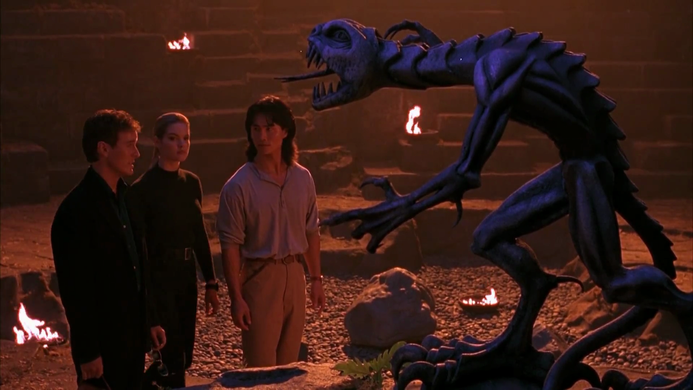
My rationale: Somebody went to the trouble to get sufficiently stoned to make this movie. I felt that I owed it to them to get sufficiently stoned to watch it.
16390. (Thomas T. Allsen) The Royal Hunt in Eurasian History
Posted by Phil Paine
on August 5, 2008
No comments
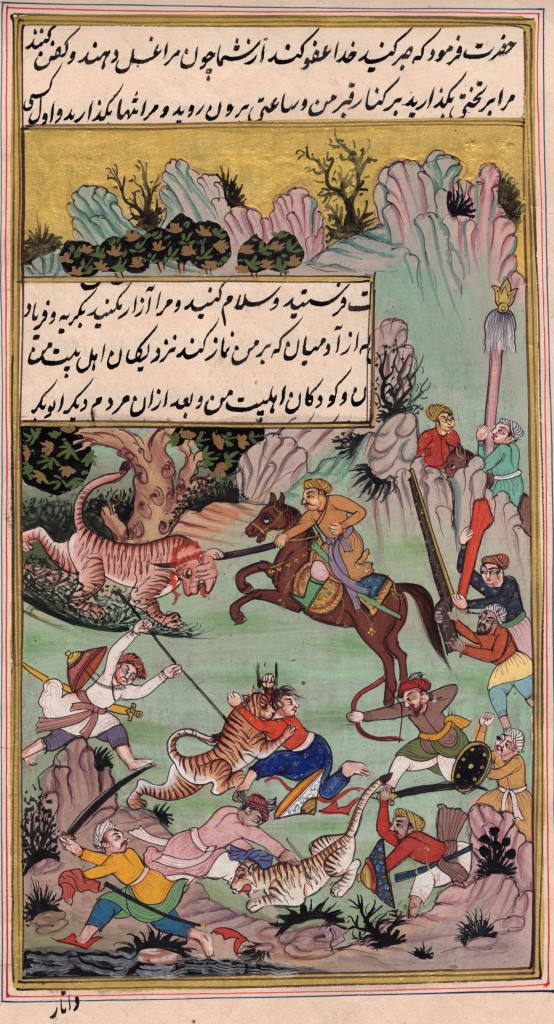 This is an excellent book, which demonstrates that historians do not have to be sequestered in continental ghettos. Allsen is able to cite the Armenian and Georgian Chronicles, the classics of Indian and Persian literature, and the vast bureaucratic documentation of China with the same ease and familiarity as when he cites standard European sources. “Eurasia” actually means something to him. In other words, the man is modern. With this kind of attitude, he is capable of addressing a phenomenon that other historians have ignored: the Royal Hunt. This institution — which often called up an impressive chunk of a society’s resources — persisted as a continuously interconnected phenomenon from the earliest antiquity to near-modern times. It demonstrates that the whole supercontinent of Afro-Eurasia has been a cultural continuum throughout recorded history, with ideas and customs traveling back and forth from end to end to end. Allsen tries to get some sort of handle on how and why the rulers of states engaged in spectacular collective hunting expeditions and maintained vast “game parks”, a custom which transcended all the barriers of empire, language, ecosystem, and religion. His work has no “theory” behind it, only a relentless curiosity and a respect for the sources. The only deficiency that I found was that he seemed to never ask the question “what happened to the meat?”. It’s my hunch that he could have reached a more complete understanding of the phenomenon if he had explored the issues of who got to eat the vast quantities of meat that these hunts produced, how it was distributed, and how this distribution served social and political ends. I’ve noticed that there is a similar absense of the question in studies of Rome’s “games”.