(Hitchcock 1928) Champagne
(Graves 2014) Game of Thrones: Ep.38 ― The Mountain and the Viper
(Duffer 2016) Stranger Things: Ep.7 ― The Bathtub
(Dante 2014) Trailers from Hell: Joe Dante on Mr. Arkadin
(Welles 1955) Mr. Arkadin
(Duffer 2016) Stranger Things: Ep.8 ― The Upside Down
(Brooks 1974) Young Frankenstein
Read more »
Author Archives: Phil Paine - Page 43
FILMS – FEBRUARY 2018
Posted by Phil Paine
on February 28, 2018
No comments
First-time listening for February 2018
Posted by Phil Paine
on February 28, 2018
No comments
24995. (Ahmed Adnan Saygun) Variations on the Folk Song “Kâtibim” for Chorus from Op.22
24996. (Five Day Week Straw People) Five Day Week Straw People
24997. (Frank Zappa) Uncle Meat
24998. (Leoš Janáček) Osud [Destiny aka Fate] [complete opera, sung in Czech; d. Jílek;
. . . . . Pribyl, Hajossyova]
Read more »
READING — FEBRUARY 2018
Posted by Phil Paine
on February 28, 2018
No comments
23819. (Michael Wolff) Fire and Fury: Inside the Trump White House
23820. (Natascha Mehler et al) The Elusive Norse Harbours of the North Atlantic: Why they
. . . . . Were Abandoned, and Why they Are so Hard to Fing [article]
23821. (Siân Ellen Halcrow & Stacey Maree Ward) Children in Bioarchaeology and Forensic
. . . . . Anthropology [article]
Read more »
First Meditation on Democracy [written Wednesday, July 25, 2007] REPUBLISHED
Posted by Phil Paine
on February 10, 2018
No comments
 In the beginning years of this blog, I published a series of articles called “Meditations on Democracy and Dictatorship” which are still regularly read today, and have had some influence. They still elicit inquiries from remote corners of the globe. They are now buried in the back pages of the blog, so I’m moving them up the chronological counter so they can have another round of visibility, especially (I hope) with younger readers. I am re-posting them in their original sequence over part of 2018. Some references in these “meditations” will date them to 2007–2008, when they were written. But I will leave them un-retouched, though I may occasionally append some retrospective notes. Mostly, they deal with abstract issues that do not need updating.
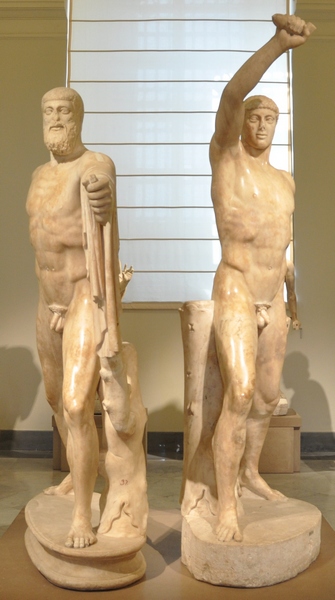
Harmodius and Aristogeiton, the gay couple whom the Athenians regarded as the founders of their democracy
All philosophies stand on choices that cannot be justified by proof. Any amateur Socrates can demonstrate that I can’t prove that two and two are four, or that freedom is desirable, or even that I exist. Ultimately, ideas, no matter how passionately held, rest on assumptions that cannot be known with absolute certainty. It does not follow from this that we should avoid acting on significant assumptions, or that we should abandon the analysis of ideas. If I’m standing in the middle of the street, and see a twelve-ton truck hurtling in my direction, I don’t stand there, paralyzed by epistemological uncertainty. I jump out of its way. Later, seated on a comfortable couch, with a cold beer in my hand, I might indulge in the luxury of reflecting that the truck may have been an illusion, or that I cannot prove with certainty that being hit by a truck is worse than not being hit by a truck. All of us must choose our basic assumptions, either in a conscious process, guided by reason, or unconsciously.
This is a meditation on democracy, and democracy only becomes a coherent idea when it rests on the assumption that human beings have rights. This, in turn, rests on the assumption that there is a moral dimension to the universe. Outside of these assumptions, political thought becomes arbitrary. If individual human beings have no rights, then whatever happens is self-sufficiently justified, and any state of affairs that human beings find themselves in is as desirable as any other. Effectively, if there is no moral dimension to the universe, then it is a matter of indifference what happens. Events just come to pass ― say, the Holocaust, or the Slave Trade, or Abu Graib ― and there is no point in discussing them. It is pointless to seek justice or defy injustice, because the very idea of justice depends on the assumption of a morality that rests upon something more substantial than custom or whim. In the absence of moral choice, people seek some sense of order in human affairs through some amoral organizing principle. Loyalty to a group, obedience to authority, or the familiarity of ritual become substitutes for ethical conscience. Read more »
The Rough Guide to the Music of the Sahara / North African Groove
Posted by Phil Paine
on February 5, 2018
No comments
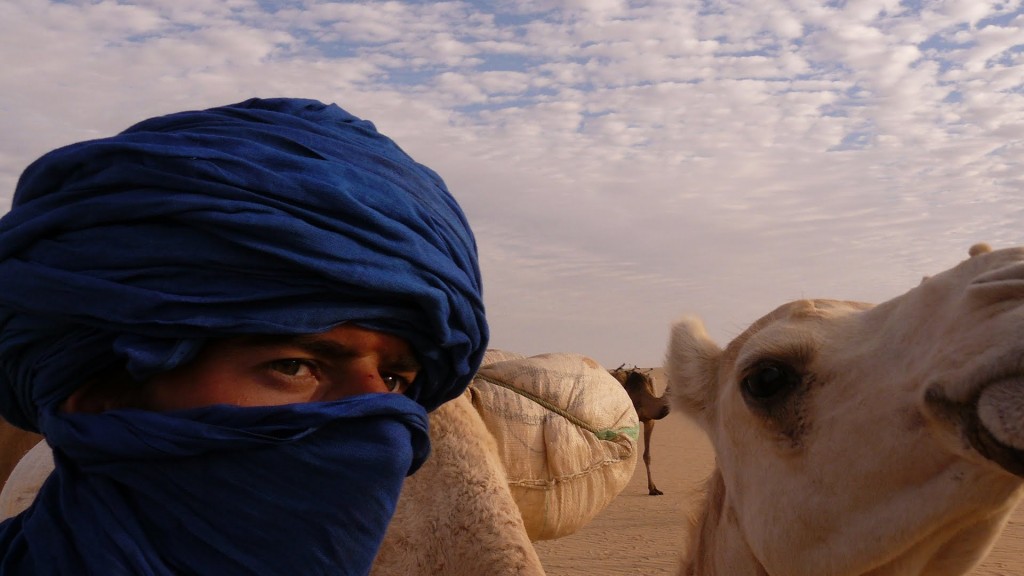
These two albums form a fine introduction to a world of music which is now familiar to Europeans, but still hidden from most listeners in North America. The Sahara Desert has often been compared to a sea ― blending influences and stimulating the disparate cultures along its shores. The sailors are the tribes of the desert: the Tuareg, the enigmatic Teda, and the various “arab” tribes, such as the Ikoku Nemadi, Bithan, and Shewa (these last all speak varieties of Arabic incomprehensible to standard Arabic speakers, and even to the speakers of colloquial Maghribi Arabic in Morocco or Algeria. Culturally and biologically, they are of the Sahara, like the Tuareg, not merely transplanted badawī [ بدوي ] from Arabia.).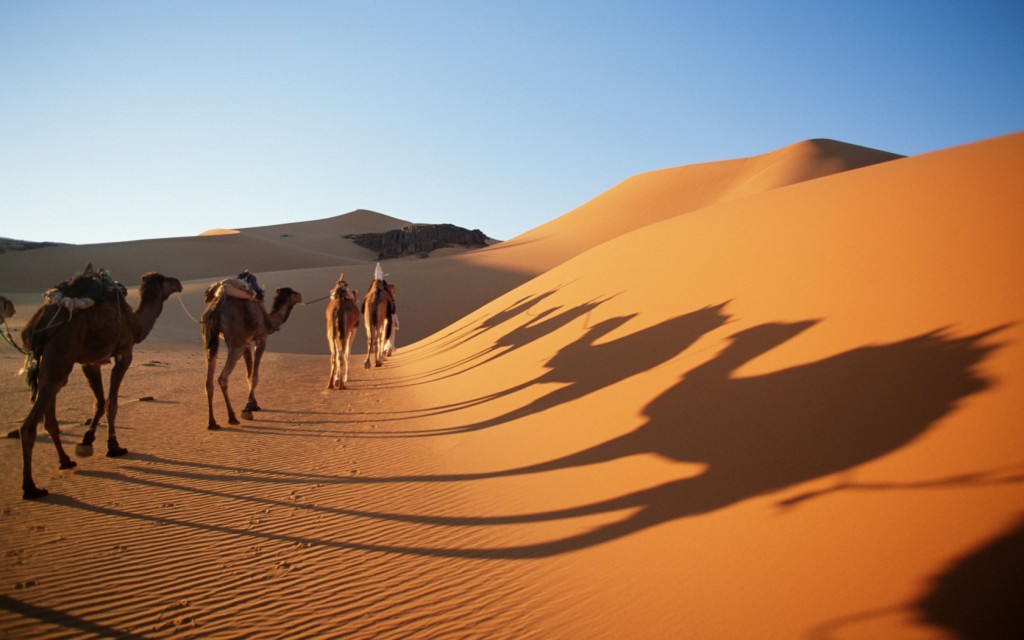
If you have read Frank Herbert’s Dune, you can get some notion of the Tuareg. The Fremen tribes in that novel were patterned on them. They speak languages in the Berber family, dimly related to Ancient Egyptian. “Berbers” refers to the sedentary people who inhabit ancient towns and cities of North Africa (St. Augustine was the most famous Berber), but the desert Tuareg are related to them linguistically. Nothing can really convey the stark severity, and the poetry of life among the “people of the blue veil”, but you can get a hint of it from the band Tinariwen, who abandoned desert warfare with the ceasefire at Timbuktu to start a recording career in the late 1990’s. Other Tuareg groups, Chet Féwer, Kel Tin Lokienne, and the Tartit Ensemble, are also present on the album. They represent tribes far distant from each other. Some of the “Arab” tribes are present, as well. The towns on the shore of the sand are represented by a variety of groups and singers (Malouma, Compagnie Jellouli, Sahraoui Bachir), and there is one singer in the Songhai language from Timbuktu, Seckou Maïga. The remote Teda of the Tibesti are not represented ― a sad lack, because their evocative “call and answer” odes, between female singers and male players of the stringed keleli are hauntingly beautiful. But the Teda have not been drawn into the global community in the way that the Tuareg have suddenly been, and still remain inaccessible.
All this stuff is much more exotic than the Raï music and the Egyptian pop music on the Putamayo World Music collection North African Groove. Discos all over Europe have become filled with Raï’s wonderful back-beat-heavy combination of traditional North African musics with American funk, salsa, French cabaret, and everything else imaginable. Superstars such as Cheb Mami (singing the delightful “Viens Habibi”) and Khaled are represented on this album, and it is a good introduction to the North African pop scene.
If you listen to these two albums one after the other, you will get a sense of the intricacy and historic depth of this musical landscape. It would be like playing an archaic mountain dulcimer ballad from West Virginia, “Saint James Infirmary”, “City of New Orleans”, Chuck Berry’s “Roll Over Beethoven”, and a Hendrix solo, one after another.
Image of the month: John Brunner — Ace paperback
Posted by Phil Paine
on February 1, 2018
No comments

FILMS – JANUARY 2018
Posted by Phil Paine
on January 31, 2018
No comments
(Pal 1960) The Time Machine
(Tarantino 2012) The Universe: Ep.72 ― How Big, How Far, How Fast
(Trelfer 2017) Undead 32: Merry Christmas ― Basically a Lot of Mindless Chatter
Read more »
First-time listening for January 2018
Posted by Phil Paine
on January 31, 2018
No comments
24971. (5 Seconds of Summer) Sounds Good Feels Good
24972. (Giacomo Meyerbeer) Clarinet Concerto in E‑flat
24973. (Amadou and Mariam) Sou ni tilé
24974. (Jean-Joseph Cassanéa de Mondonville) Harpsichord Sonata #1 in G Minor
24975. (Jean-Joseph Cassanéa de Mondonville) Harpsichord Sonata #2 in F
Read more »
READING — JANUARY 2018
Posted by Phil Paine
on January 31, 2018
No comments
23794. (Greg Delanty & Michael Matto –ed.) The Word Exchange: Anglo-Saxon Poems in
. . . . . Translation
23795. (William A. Parkinson et al) A Landscape of Tells: Geophysics and Microstratigraphy at
. . . . . Two Neolithic Tell Sites on the Great Hungarian Plain [article]
23796. (Nasar Khan et al) A Co-relational Study of Family Income and Poor Parenting in Child’s
. . . . . Educational Performance in District Dir Lower, Pakistan [article]
Read more »
PREFACE TO THE MEDITATIONS [republished from 2010]
Posted by Phil Paine
on January 26, 2018
No comments
The extended blog entries called “Meditations” have proven to be the most popular items on this website. While some of these essays have some scholarly trappings (citations, etc.), they are primarily personal documents, and thus may contain colloquial prose, profanity, or other non-academic elements.
Anyone is entitled to reprint these pieces, as long as they are not altered, and credit is given.
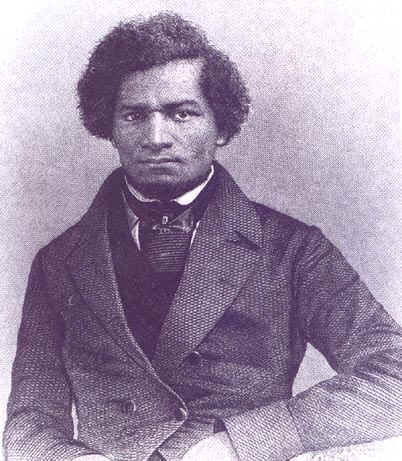 [Frederick Douglass (1818–1895), born a slave in Maryland, U.S.A., secretly taught himself to read, and successfully escaped slavery in 1838. His autobiography catapulted him to prominence in the anti-slavery movement. Widely known as the “Sage of Anacostia”, Douglass was the most prominent and influential African-American of his century, and one of the greatest philosophers of freedom in human history. In both word and deed, he struggled for the freedom and equality, not only of African-American males like himself, but for women, native Americans, immigrants, and all other human beings. One of his favorite quotations was: “I would unite with anybody to do right and with nobody to do wrong.”]
From A Narrative of the Life of Frederick Douglass, an American Slave (1845):
Very soon after I went to live with Mr. and Mrs. Auld, she very kindly commenced to teach me the A, B, C. After I had learned this, she assisted me in learning to spell words of three or four letters. Just at this point of my progress, Mr. Auld found out what was going on, and at once forbade Mrs. Auld to instruct me further, telling her, among other things, that it was unlawful, as well as unsafe, to teach a slave to read. To use his own words, further, he said, “If you give a nigger an inch, he will take an ell. A nigger should know nothing but to obey his master–to do as he is told to do. Learning would spoil the best nigger in the world. Now,” said he, “if you teach that nigger (speaking of myself) how to read, there would be no keeping him. It would forever unfit him to be a slave. He would at once become unmanageable, and of no value to his master. As to himself, it could do him no good, but a great deal of harm. It would make him discontented and unhappy.” These words sank deep into my heart, stirred up sentiments within that lay slumbering, and called into existence an entirely new train of thought. It was a new and special revelation, explaining dark and mysterious things, with which my youthful understanding had struggled, but struggled in vain. I now understood what had been to me a most perplexing difficulty–to wit, the white man’s power to enslave the black man. It was a grand achievement, and I prized it highly. From that moment, I understood the pathway from slavery to freedom.
elsewhere, Douglas said:
To make a contented slave it is necessary to make a thoughtless one. It is necessary to darken the moral and mental vision and, as far as possible, to annihilate the power of reason.
From Thomas Paine’s The Rights of Man:
Man has no property in Man.
These meditations are constructed with a particular discipline. Every effort will be made to ensure that their terminology is consistent and meaningful. The reader will probably notice the conspicuous absence of some terms that are elsewhere accepted. The terms “capitalism” and “socialism”, for example, are not used anywhere because I consider them to be buzzwords without identifiable meaning. The terms “left” and “right”, supposedly representing a “political spectrum” of ideas and practice, have never been used in my work. This classification of political ideas is pernicious nonsense, and its use reduces any political discussion to incoherent gibberish. Instead, I will rely on a rational classification of political movements and ideas. The terms “West” and “Western”, along with their revealingly tendentious correlate “Non-Western”, are also renounced. They are embarrassing remnants of a narrow-minded past, still used with annoying imprecision and capriciousness. Worst of all, they came into use because of a profound misunderstanding of the world’s mosaic of societies. My reasons for these judgments will be expounded in an appendix to the Meditations.
Apart from this discipline, I’ll avoid creating an idiosyncratic jargon of my own. I prefer plain language. When I use a word or a phrase in some way that differs from general custom, or the reasonable expectations of readers, I will make every effort to make my meaning clear. However, language being a slippery thing, I can expect to fail at this now and then.
Works of serious thought are not written without an implied audience. The writer cannot avoid having some mental image, however vague, of who is likely to be reading their words. Often it can be easily recognized, for example, that a given writer assumes that the reader resides in their own country, or is of the same gender, or has a similar social or educational background. The more serious the subject matter, the more narrow this assumed audience is likely to be. Occasionally, a “we” or an “us” will appear in a work that makes it plain that the author assumes that “we” or “us” excludes most of the human race. This is not one of those works. It’s intended for all human beings, everywhere on the planet. If I had my druthers, I would prefer it to be simultaneously written in every language. Unfortunately, I can only write expressively and precisely in one language, English. Fortunately, that language is the world’s most widely distributed, and a work written in English can find it’s way into the hands of a diverse readership, scattered across the globe. I am more concerned that my ideas reach people in places like Papua New Guinea, Transylvania, Bourkina Fasso, or Burma than that I gain popularity among my own compatriots. I have friends and acquaintances in all these places, and the mental picture of a reader that hovers in my mind, as I write, includes them. They have bigger problems to deal with than my own countrymen. The subjects I discuss are more urgent for them. I live in the astonishingly lucky country called Canada. Compared to most places in the world, it has no serious political problems to speak of. I will try not to forget that, and I will try not to glibly dismiss the experience of people for whom the definition and application of democracy are life-and-death issues.