Category Archives: A - BLOG - Page 29
Sunday, October 23, 2011 — Protests, Unreal and Real
Posted by Phil Paine
on October 23, 2011
No comments
I’ve passed by the “Occupy Toronto” campsite a few times, this week. Normally, I’m not much impressed by political demonstrations. In North America, they have proven woefully ineffectual over the last generation. The people who organize them are usually far more interested in the pastime of demonstrating that in accomplishing any goals. In fact, they are mostly counter-productive, because the Powers That Be long ago figured out how to turn them to their own advantage. So I always wince when I see the usual band of scruffy teenagers wearing circle-As, the aging hippies, the predictable “political theatre” stunts, the meaningless slogans, and the dreary chants. Those in power love these people, especially the self-styled “anarchists,” because they re-inforce authority, rather than threaten it. Nothing discredits real opposition in the eyes of the public more effectively than a few seconds of TV footage showing a teenager with his face painted, screaming unintelligeable slogans. They see what appears to them to be a mob of brainless pranxters. The issues can then be safely buried by the media. Read more »

Friday, September 10, 2011 — Mycenae, Nafplios, Corinth
Posted by Phil Paine
on September 10, 2011
No comments
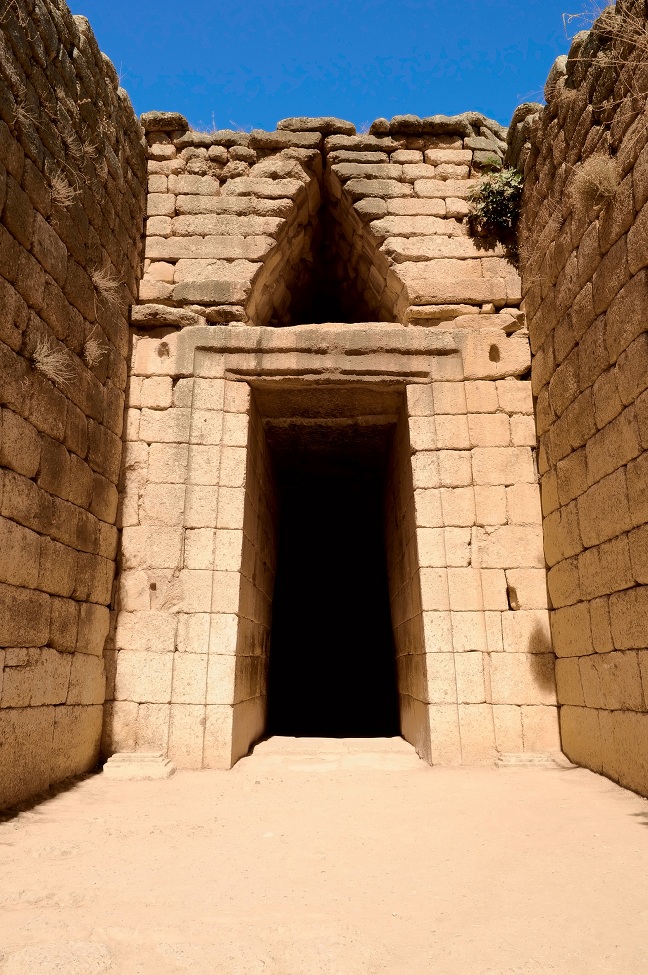 We chose to visit Mycenae during our limited time on the mainland. As the Mycenaeans were the successors (and perhaps conquerors) of the Minoans, their most impressive ruins of were a fitting choice. They are dramatically located on a steep hill, flanked by a deep canyon, from which you can see the entirety of the Argolid plain, and even a fleet approaching by sea would have been visible. The “cyclopean” walls are extremely impressive, many of the blocks weighing over twenty tons. I thought the famous “Gate of the Lions” would be one of those iconic images that disappoints in real life, but it lives up to its reputation. It was visible in historic times without excavation. The excavations and very cautious reconstructions by Greek archaeologists have not involved the laisse-majesté practiced by Evans at Knossos. What you see is largely the citadel as it was in Late Helladic IIIa (circa 1250–1200 BC), open to the public with only enough reconstruction, pathways, fencing and educational plaquing to make it comprehensible to the public and yet keep it from being destroyed by visitors. Read more »
Thursday, September 9, 2011 — West Crete Gallery
Posted by Phil Paine
on September 9, 2011
No comments
Thursday, September 9, 2011 — Before the gates of Excellence.…
Posted by Phil Paine
on September 9, 2011
No comments
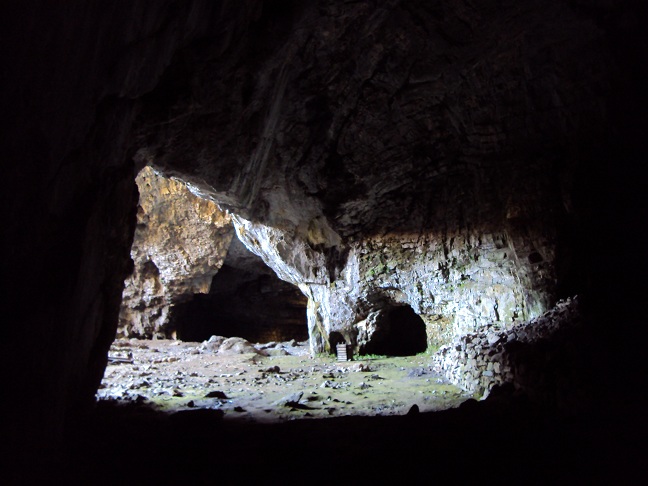
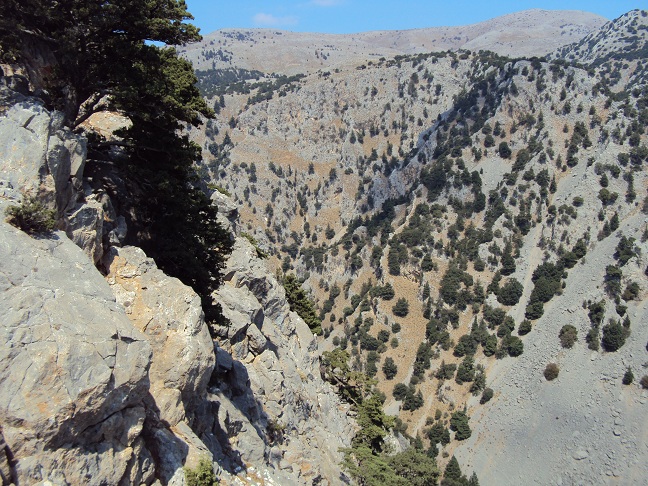
The Idaean Cave on Mt. Koussanas
… the Gods have placed sweat.
Long is the road thereto and steep and rough at first.
But when the height is won, then is there ease,
Though grievously hard in the winning.
- Hesiod
Wednesday, September 8, 2011 — A Central Crete Gallery
Posted by Phil Paine
on September 8, 2011
No comments
Wednesday, September 8, 2011 — Sleeping in Graveyards
Posted by Phil Paine
on September 8, 2011
No comments
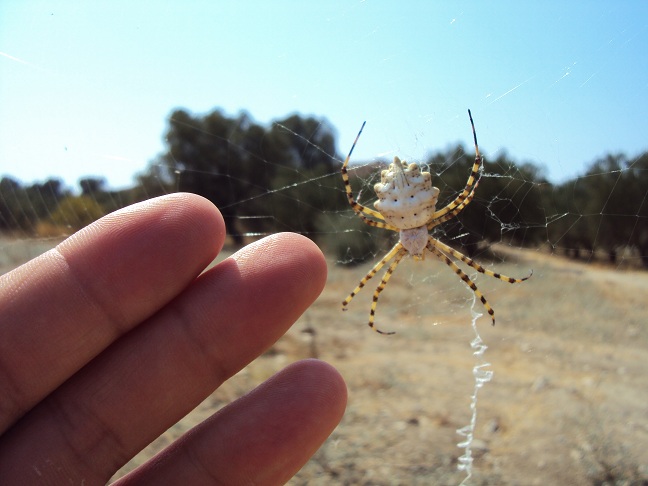
A lovely Argiope Lobata we came across. It’s venomous, but not dangerous. Filip’s fingers (I think) show the scale.
We left Aghia Pavlos with only a vague plan to explore West Crete. We settled on using a mixture of main and back roads. The Cretan landscape is extraordinarily complex and varied. Within minutes you can switch from something that looks like Afghanistan to something that looks like Bohemian or Southern Ontario woodland. Nothing can be reached in a straight line. A road between two villages, marked as a few kilometers long, will be precipitous climb by multiple switchbaks, or descend into a maze-like complex of canyons, and yet appear on the map in the “plains” region. Historians wonder if the complexity of Knossos’ floor plan inspired the myth of Theseus and the Labyrinth. Well, anything Cretan might have inspired it, because the whole land is a natural labyrinth, and any given patch of it is a labyrinth within a labyrinth, and every village is a labyrinth within a labyrinth within a labyrinth. Read more »
Tuesday, September 7, 2011 — An Aghia Triada Gallery
Posted by Phil Paine
on September 7, 2011
No comments