
Category Archives: A - BLOG - Page 41
Sunday, April 27, 2008 — Canadian Delusions of Global Glory: It’s Time to Wake Up and Grow Up
Posted by Phil Paine
on April 27, 2008
No comments
Those Canadians who imagine that Canada’s role in global politics is both important and successful need to have some of their balloons punctured.
Our politicians are constantly repeating to us how much the world admires us for our “peace keeping tradition”, and how important our international commitments are. The truth is that almost nobody outside of Canada has heard about them, and even fewer care. I once checked out a published history of U.N. peacekeeping. It contained no reference to the activities of any Canadian forces at all. Outside of Canada, I have never encountered any press or personal discussion by anyone about Canada’s supposedly famous peace-keeping activities, or of any Canadian military actions or commitments. Even in countries where we are, in fact, doing peacekeeping work, only the blue U.N. uniforms are recognized by the local belligerents, and they don’t care whether we are Canadians or Martians. Far from caring about what Canada does on the global military scene, few people outside of Canada know that we have an army at all. If we are fighting anywhere near Americans, it is taken for granted that we are Americans, or that, if we are not, the distinction is of no importance. I hate to break it to misty-eyed fans of our glorious military, but this is especially true in Afghanistan, where we are engaged in our largest military project since the Korean War. Read more »
Wednesday, April 16, 2008 — Who Wrote Don Giovanni?
Posted by Phil Paine
on April 16, 2008
No comments
There is a consistent pattern, among those who describe societies and economies, past and present, to reverse cause and effect in significant events. I would like to dub this the Emperor Josef Wrote Don Giovanni Syndrome. This is the tendency to shift attention from those who create to those who rule, sometimes bluntly, sometimes subtly, until one has the vague impression that those who rule are the ones who create.
This, of course, begins at the crudest level when historians casually assert that something that happened to come into existence during the reign of a king, or an emperor, or a pharaoh was “made” by them or “built” by them. The historian may retreat to the excuse that this is a conventional form, understood by all to mean its opposite, but this leaves unexplained why there should be any need to have a formulaic phrasing so misleading and perverse. In fact, it is usually easy enough to tell from the context that the author does not really contradict or qualify, in his mind, the conventional phrase, and really does believe that a ruler is the creative force, in every sense, behind whatever admirable achievements happen to be known from his reign. The more distant the events are in time, the more this prevails. No historian can get away with claiming that the Emperor Joseph II was the composer of Don Giovanni, but that is because the events are recent, and approaching the time when composers were beginning to be be perceived as important people. However, those who know Mozart know that it was a close call. He was a celebrity as a child, because of his precocity, but anyone who understands the era knows that the aristocracy of the Austro-Hungarian empire thought of him as nothing more important than a servant, and when he left their brief attention span, he died in poverty. His body vanished into an anonymous pauper’s grave. If his reputation had not been relentlessly championed by musicians who knew him, his named would have been forgotten. Read more »
Monday, April 14, 2008 — Jeune Afrique 8 avril 2008 AFP: Les députés modifient la Constitution pour juger Hissène Habré — A Personal Ghost Comes Back in a Brief News Report
Posted by Phil Paine
on April 14, 2008
No comments
It seems that a relentless treadmill of events forces me to write, in this blog, about nothing but dictators, famines, and wars. For those of you who are tired of it, let me confess that I am, too. I wanted to devote a new entry to one of my real passions ― landscape, music, reading, nature, erotic pleasure, the exquisite freedom of the road. But an article forwarded to me unleashed a flood of memory and opened up private boxes that I’ve generally kept shut. And it was about a dictator. Now, I write a lot about dictators, and the observant among you will notice that I don’t much like them. But, in most cases, this is the result of studying history. Dictators are people I’ve mostly encountered in books. But there is one exception. There is a dictator with whom my relationship is more concrete, and has nothing to do with books. He is one of the “small-fry”. His crimes are monstrous, but his numerous victims were people the world cared nothing about. The slaugther and horror took place right next door to the current slaughter in Darfur, and was on the same scale, but in those pre-internet days it might as well have taken place in another solar system. The man I’m talking about is Hissène Habré.
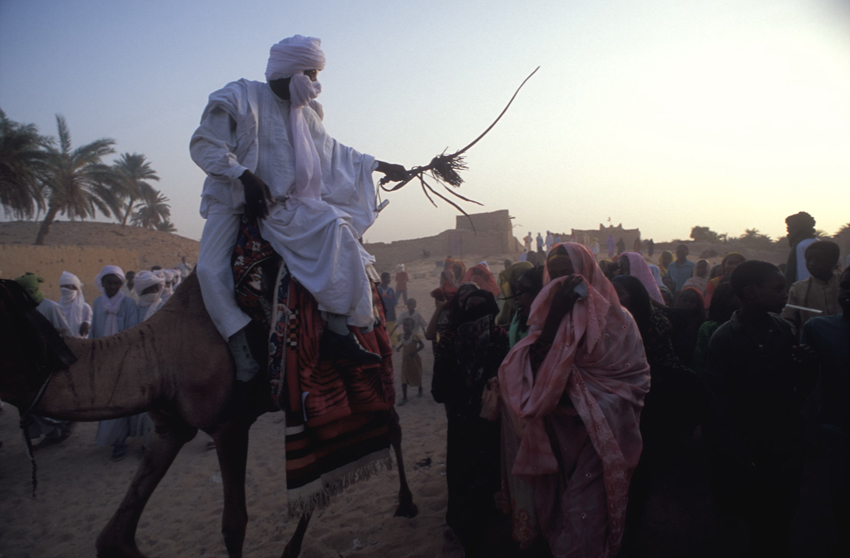
A mounted Dazaga (Gourane).… not quite a match for the more remote (and seldom photographed) Teda.
16106. (David Matas & Hon. David Kilgour) Bloody Harvest: Revised Report into Allegations of Organ Harvesting of Falun Gong Practitioners in China [report]
Posted by Phil Paine
on April 11, 2008
No comments
David Kilgour has been one of Canada’s longest serving Members of Parliament (27 years), as a Cabinet Minister, and as Secretary of State for Asia-Pacific Affairs. Few Members of Parliament are as widely respected. One journalist has written: “in the past 25 years, no Canadian could take this kind of moral time-test and pass with such flying colours as David Kilgour.” — and no Canadian politician comes even close to him as a consistent and principled advocate of human rights. He has published four books on varied subjects, ranging from Espionage to Canadian-American relations. David Matas is a lawyer and lecturer on constitutional law, international law, and civil liberties. He was in the Canadian Delegation to the Stockholm International Forum on the Holocaust, and since 1997 has been the Director of the International Centre for Human Rights & Democratic Development. Read more »
Wednesday, April 9, 2008 — Tibetan Freedom Movement: Beware of Slimy Fellow-travelers
Posted by Phil Paine
on April 9, 2008
No comments
It has been wonderful to see the public protests against the 1936 Berlin Olympics soon to be held in Beijing. For once, an instinctive revulsion against totalitarianism is driving a global movement of protest. But every legitimate protest movement attracts slimy elements, who seek to cash in on a human rights issue to cover up their anti-human-rights agenda. Both the Civil Rights movement and the Anti-War movements in the 1950s and 1960s were infiltrated by totalitarians, seeking to exploit a just cause for their own nefarious purposes. Read more »
Wednesday, April 2, 2008 — Distinguishing Between Fake and Real Human Rights Issues
Posted by Phil Paine
on April 2, 2008
No comments
A friend of mine has been complaining about a much-publicized legal case, where a Sikh employee at a lumber yard is demanding that he be exempted from new safety laws, which require a hard helmet when working with lumber. There is no question of the employer using the law to further prejudice or racism. Sikhs are highly respected in the community. The employee has been there for years, and the company wanted to solve the problem by shifting him to an indoor position, where there would be no conflict. In the distant past, there have been several legal squabbles where it was obvious that regulations were being used to further intolerant agendas. However, there have been none of those kind of things, to my knowledge, for decades, and this certainly is not one. Is this a “human rights” issue, as many claim? No, it is not. Read more »
Image of the month: art of Hans Memling
Posted by Phil Paine
on April 1, 2008
No comments
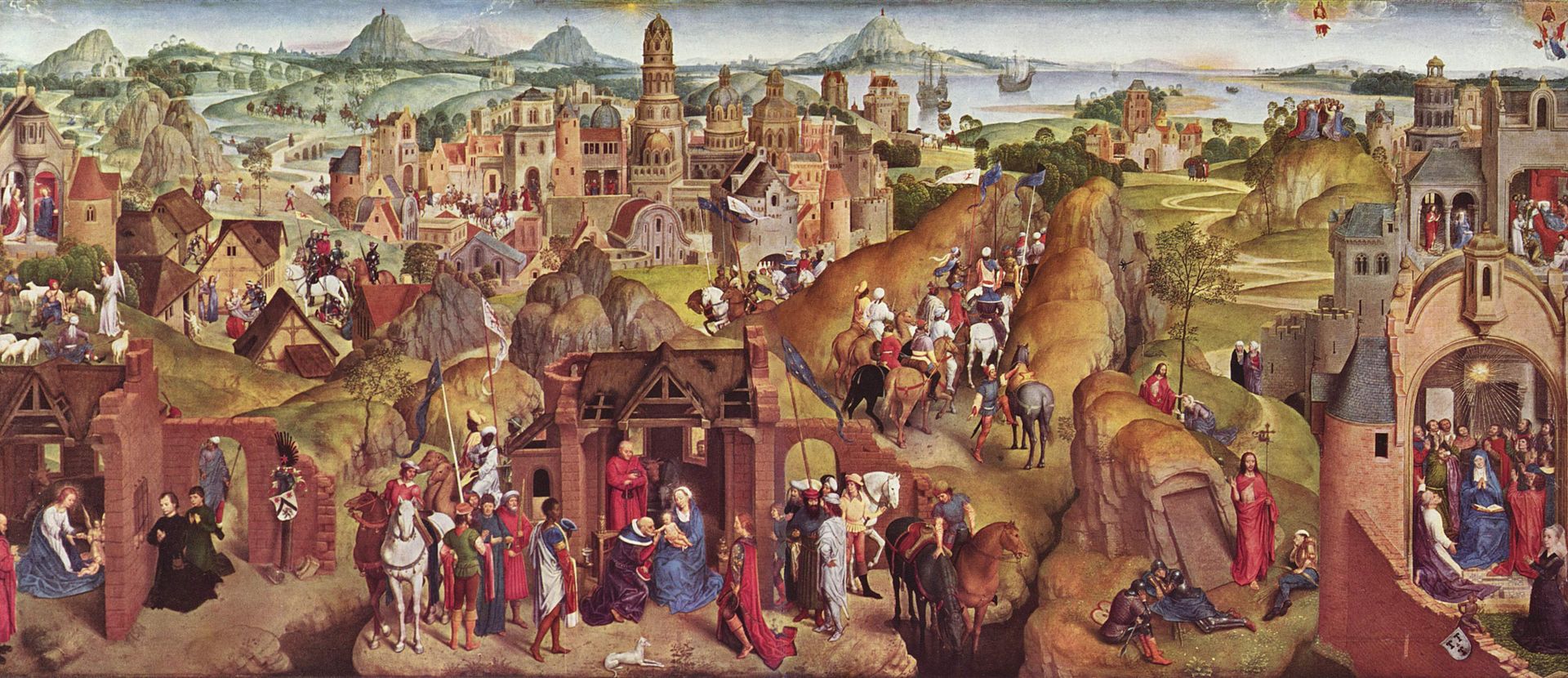
Hans Memling: Advent and Triumph of Christ (1480) oil on wood 81 × 189 cm
Saturday, March 29, 2008 — The Poisoning of a People
Posted by Phil Paine
on March 29, 2008
No comments
I just saw an old movie from the early 1980’s called Testament. It was an attempt to show the lives of the people of a small American town after a nuclear war. It’s a very simple film. In it, the nuclear war happens off-stage. It portrays a California town, far from targets. As it gradually loses contact with the rest of the world, its citizens do the best they can to maintain their families and community, while radiation sucks away their lives. The film was made with respect for its audience. The people in it seem to come from another America, one where you would expect that people would do their best, even in the most hopeless conceivable situation. A few exploiters, a few look-out-for-number-one assholes turn up, to be sure, but most people are ready and willing to behave like free and civilized men and women, even when faced with this ultimate test.
I recognized the film’s basic truth, because I knew those people. Decent, hard-working Americans, who generally treated each other with mutual respect. There were millions of them, across the country. The film was set in Northern California, a place I had lived, and knew well. A few years later, there was a devastating earthquake, there. Those same kind of people were everywhere, behaving with both competence and decency. Read more »
Monday, March 24, 2008 — What Alika Lafontaine Tells Us About Ourselves
Posted by Phil Paine
on March 24, 2008
No comments
There is an interesting television contest here in Canada. It’s called Canada’s Next Great Prime Minister. People between the ages of 18 and 25 are asked to submit a five-minute Youtube presentation in which they address one current political issue. Ten finalists are chosen, and brought to a “political boot camp”. From these, four are selected to be voted on by the audience. They not only present their views, but are subjected to an intense grilling from a panel of three former Canadian Prime Ministers and one Provincial Premier (yes, in Canada, Prime Ministers appear on game shows, and even on comedy skit shows). There is a $50,000 prize. Read more »