Category Archives: AS - Blog 2008 - Page 5
Thursday, February 28, 2008 — Oops! I Missed That Angle
Posted by Phil Paine
on February 28, 2008
No comments
Skye Sepp points out to me that the Conservative budget is not as innocuous as I believed. I find his objection entirely convincing, and hereby change my mind. He focuses on the “tax-free $5,000 account” program, which looks very attractive on the surface. But, on closer examination, it turns out to be a swindle, aimed at neutralizing the progressive income tax system, so that the rich pay less while the poor and average Canadians pay more. In the program, Individuals will be able to put only $5,000 a year into accounts to earn tax-free interest and/or capital gains. In their first full year of operation, this will cost the federal treasury only $50 million in lost tax revenue. That’s why it didn’t leap out of the budget with glaring warning lights. In fact, it looked rather warm and fuzzy. The small initial sum makes it look like a measure aimed at Canadians with modest savings. The Conservatives keep repeating that it would “help someone buy a car” — which is nonsense on the face of it, as you would have to have very large amounts in savings for it to be useful for that. Read more »
Bird Songs of Eastern and Central North America
Posted by Phil Paine
on February 27, 2008
No comments
I love Goodwill stores. Where else are you going to find a vinyl pressing of Bruce Willis’ rock band, or a biography of Telly Savalas? And you occasionally find something that’s actually valuable or useful. Yesterday, I paid fifty cents for a two-disk recording of the calls of about three hundred birds of my region, keyed to the page numbers of Peterson’s Field Guide, the bible of birding on this continent. I was surprised at the number of calls that I recognized. But I was disappointed to find the Whiskeyjack (Wiisagejaak, in Cree) missing. How could they ignore the impudent trickster? It’s distinctive song is usually described as “whee-ah, chuck chuck”. It also whistles and screeches on occasion, or sings a charming “whisper song” when mating.
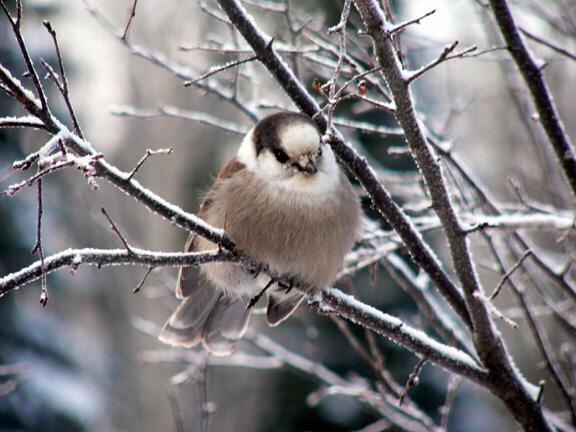
[Photo of a Whiskeyjack taken by Aarre Ertolahti in Lappe, fifteen miles west of Thunder Bay. Originally published in Canadian Sanomat, a Finnish-language newspaper in Northern Ontario.]
Tuesday, February 26, 2008 — Two Depressing News Items
Posted by Phil Paine
on February 26, 2008
No comments
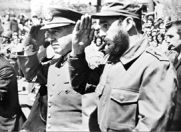
Fidel Castro with Chilean dictator Augusto Pinochet, in 1977, celebrating the triumph of Pinochet’s torture regime. Pinochet ultimately faced a mild punishment and repudiation, but it looks like Castro will get away with his atrocities.
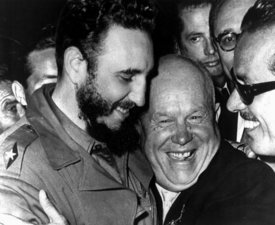
Castro with Soviet dictator Nikita Khrushchev. Among other crimes, Khrushchev masterminded racist pogroms and orchestrated planned famines.. Together, C and K nearly brought the world to a nuclear holocaust.
 Castro with Ethiopian dictator Mengistu Haile Mariam. Castro’s behind-the-scenes scheming brought Mariam to power, with Soviet support. Castro’s admiration for Mengistu, who started his reign with a bloodbath, was unbounded. In May of 1977 the Swedish general secretary of the Save the Children Fund stated that “1,000 children have been killed, and their bodies are left in the streets and are being eaten by wild hyenas … You can see the heaped-up bodies of murdered children, most of them aged eleven to thirteen, lying in the gutter, as you drive out of Addis Ababa.” [1] Castro enthusiasticly applauded the action. Mariam subsequently undertook one of the century’s larger genocides, in which many millions died. Castro’s support for this genocide continued until Mengistu’s fall.
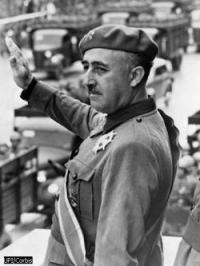
Spanish dictator Francisco Franco. Franco and Castro were life-long friends and mutual admirers. Castro modeled his speaking style and swaggering mannerisms on Franco’s. Castro’s “ideology” was Spanish Fascism (Falangism) until it suddenly became Marxism… a “change” that is meaningless, as it involved no change.
Friday, February 22, 2008 — A Shameful Display of Contempt for Democracy From General Hillier
Posted by Phil Paine
on February 22, 2008
No comments
I have lost all respect for General Rick Hillier, Canada’s Chief of Defense Staff (the highest ranking military officer in the country). He may be very competent in running military operations, but he cannot be trusted in the fundamental area of proper public behaviour for someone in his post. He has done something which is extremely offensive to a free people in a democratic nation. He has used his office to try to muzzle democratic debate in Canada about our role in Afghanistan. By claiming that our free democratic debate “helps” the Taliban, he is demonstrating that he, himself, is infected with the vilest ideology of the Taliban. His “shut up, don’t think, and do what you’re told” attitude to the Canadian people is profoundly offensive. He should be removed from his post at once.
The ruling Conservative party is rife with kind of Taliban-like mentality. We should be working to get rid of them, too.
Thursday, February 21, 2008 — How Far Could They Paddle?
Posted by Phil Paine
on February 21, 2008
No comments
A reader asked me why I assumed that late mesolithic and early neolithic peoples could undertake long river and coastal journeys.
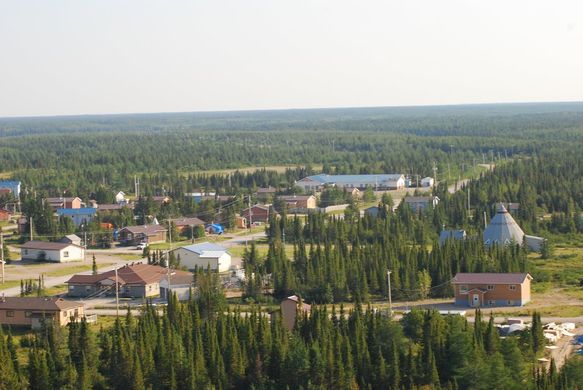 Let me tell you about a little place in northern Canada called Peawanuck. I have written about it elsewhere, because it has sentimental importance to me. It also has some importance to the outside world, because, since 2000 it has been the site of the Peawanuck Neutron Monitor. This is part of a global network of neutron monitors strategically located to provide precise, real-time, 3‑dimensional measurements of cosmic ray angular distribution activity. If your main interest is history, you may not know why this is important, but trust me, it is. Other monitors are located at the South Pole, Mawson and McMurdo Sound stations in Antarctica; at Inuvik, Fort Smith, Nain, and Goose Bay in Canada; at Thule in Greenland; on Svalbard (the arctic island which appears in The Golden Compass); and Apatity in northern Russia. These locations share an obvious characteristic: remoteness. Read more »
Monday, February 18, 2008 — More About Fish ― More Than You Probably Want to Know
Posted by Phil Paine
on February 18, 2008
No comments
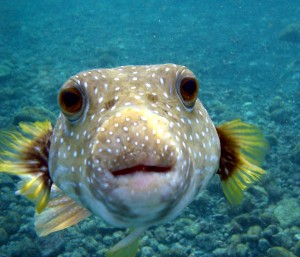 For the last fifteen years, I’ve been complaining to everyone I know about the peculiar absence of fish from historical writing and analysis. Go into any university library, and you will find the stacks filled with massive collections of books and journals about every conceivable aspect of farming, animal husbandry, and nomadism. Urban studies from every region and era have been undertaken. Controversies and debates about the precise relationships between all these activities flash like summer lightning storms. But where is fishing? Try to even find historical studies of fishing and fishing communities in a university library. One immediately plummets from banks of shelving units to a tiny cluster on a single dusty shelf. Very little of this is historical in outlook. Read more »
FIRST MEDITATION ON DICTATORSHIP (written Thursday, February 7, 2008)
Posted by Phil Paine
on February 7, 2008
No comments
We are so hamyd,
For-taxed and ramyd,
By these gentlery-men!
― The Wakefield Second Shepherds’ Play, c.1425–1450 [1]
We are men the same as they are:
Our members are as straight as theirs are,
Our bodies stand as high from the ground,
The pain we suffer’s as profound.
Our only need is courage now,
To pledge ourselves by solemn vow,
Our goods and persons to defend,
And stay together to this end…
Robert Wace, Le roman de la Rou et des ducs deNormandie, 1160–70s [2]
On my return to Prague, last year, after tramping in Hungary and Transylvania, my friend Filip Marek took a day off for some more explorations of the Bohemian countryside. This turned out to be the most emotionally charged day in my travels, and I’ve delayed describing it because of its personal importance to me.
The landscape around Prague is not much different, at first glance, from that of Southern Ontario. It’s rich farmland, gently rolling hills, and patches of mixed forest similar to those around Toronto. Most of it was so pleasant that I couldn’t help replaying snatches of Dvořák, Smetana and Janáček in my head as the car rolled under the dappled sunlit trees, past fields and villages that seem to be both ancient and brand new at the same time. However, our quest was to extract something incongruously disturbing and tragic from Bohemia’s woods and streams.[3] We were going to see two places that do not loom large in the history books, but loom large in the kind of history that I am concerned with. The first was the Vojna Hard Labour Camp, in the forest near the village of Příbram, and the second was the site of Lidice, a village that no longer exists. Read more »
Image of the month: The Turning Road
Posted by Phil Paine
on February 1, 2008
No comments
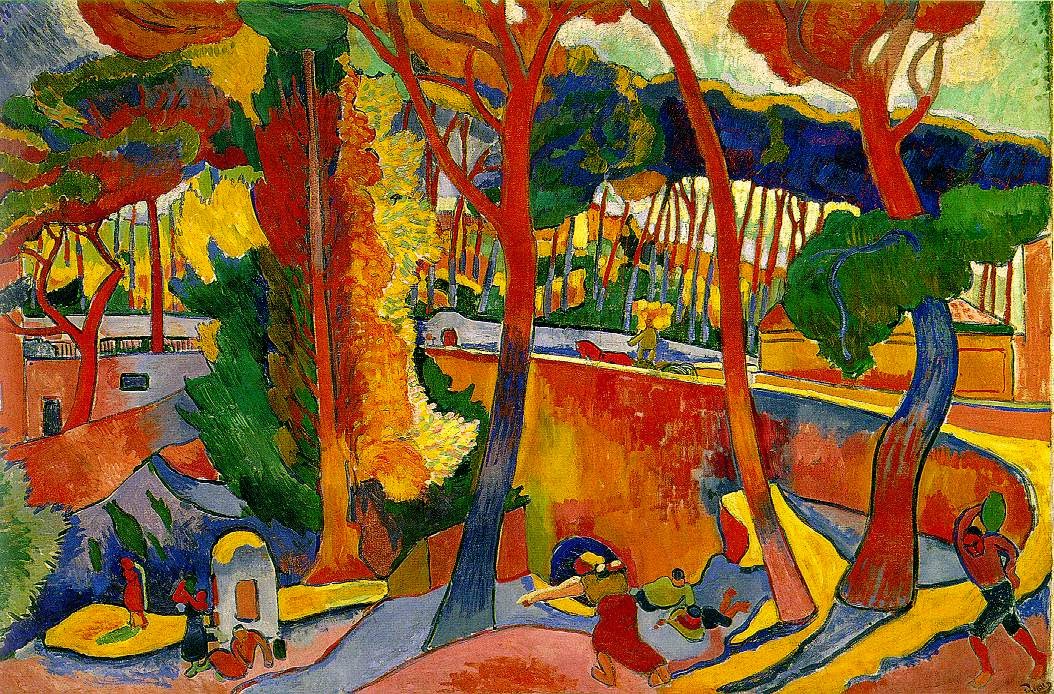
André Derain (1880–1954) : L’Estaque, route tournante (1906) oil 129.5 cm x 195 cm
Wednesday, January 30, 2008 — Canada in Afghanistan ― Ottawa Releases a Puff of Hot Air
Posted by Phil Paine
on January 30, 2008
No comments
Canada’s armed forces have been in Afghanistan since 2002, at a cost of 79 deaths (78 soldiers and one diplomat), and a large, though very difficult to assess monetary cost. Like most Canadians, I supported sending troops to Afghanistan, feeling that the people of that long-suffering land deserved to be defended against further humiliations. Most of the Afghan-Canadians I spoke to were supportive of the enterprise. I knew perfectly well that the initial reason for our being there was a kind of indirect blackmail from Washington. Joining the NATO operation in Afghanistan was probably the only way that Paul Martin’s administration could get away with our refusal to participate in the disastrous war on Iraq. But I felt there was a chance that we could do some good there, as long as we managed to avoid operating under the thumb of U.S. forces. Read more »