Both compact and comprehensive, this is the first book you should read to enter into the interesting science of cognitive ethology. Bekoff summarizes the reductionist strictures that ethologists had to confront when the field began to form, and intelligently discusses the moral and social implications of the science. The book, in effect, provides a case study of the cult of “scientism”, which often infected science in the twentieth century. This occurred when fake poses of objectivity, spurious quantification, and epistemological confusion led to nonsensical, but irritatingly tenacious orthodoxies.
Category Archives: B - READING - Page 33
16140. (Marc Bekoff) The Emotional Lives of Animals
Posted by Phil Paine
on April 23, 2008
No comments
(Nathaniel Hawthorne) The Celestial Railroad and Other Stories
Posted by Phil Paine
on April 22, 2008
No comments
Hawthorne’s allegorical short stories were, in some ways, the ancestors of some of the grimmer Twilight Zone episodes. This collection includes stories written between 1832 and 1851, and includes the most famous ones, “Young Goodman Brown” , “Ethan Brand”, “Rappaccini’s Daughter”, and “Dr. Heidegger’s Experiment”. All fine stories, but the one that tickled my fancy was the less well known “The Maypole of Merry Mount”. It’s a sort of 1836 version of The Wicker Man, except that the Puritans, not the Pagans, triumph. It is all the more interesting because Hawthorne seems to have been well aware of things that would not be part of common knowledge until James Frazer published The Golden Bough. Read more »
Sibelius’ Kullervo, Op.7
Posted by Phil Paine
on April 15, 2008
No comments
Kullervo is the darkest character in the Kalevala, the epic of Finnish mythology that had a profound effect on me in childhood. His story is told in runos 31 through 36 of the epic. Enslaved and abused as a child, Kullervo’s life is dominated by the quest for revenge, which leads him to commit horrifying crimes, including the rape of his own sister. The most striking part of the story is his death, where he asks his sword if he should kill himself, and the sword bursts into song:
 “Mieks’en söisi mielelläni,
söisi syylistä lihoa,
viallista verta joisi?
Syön lihoa syyttömänki,
juon verta viattomanki.”
“Why, if I desire it,
should I not kill you,
swallow up your wicked blood?
I have consumed innocent flesh,
and swallowed up guiltless blood.”
This little sequence was borrowed by Poul Anderson in The Broken Sword, and by Michael Moorcock in one of his Elric tales. Väinämöinen, the wise central character of the Kalevala, remarks that Kullervo’s fate proves that children should never be mistreated, since an abused child will grow up without wisdom or honour. Read more »
Monday, April 14, 2008 — Jeune Afrique 8 avril 2008 AFP: Les députés modifient la Constitution pour juger Hissène Habré — A Personal Ghost Comes Back in a Brief News Report
Posted by Phil Paine
on April 14, 2008
No comments
It seems that a relentless treadmill of events forces me to write, in this blog, about nothing but dictators, famines, and wars. For those of you who are tired of it, let me confess that I am, too. I wanted to devote a new entry to one of my real passions ― landscape, music, reading, nature, erotic pleasure, the exquisite freedom of the road. But an article forwarded to me unleashed a flood of memory and opened up private boxes that I’ve generally kept shut. And it was about a dictator. Now, I write a lot about dictators, and the observant among you will notice that I don’t much like them. But, in most cases, this is the result of studying history. Dictators are people I’ve mostly encountered in books. But there is one exception. There is a dictator with whom my relationship is more concrete, and has nothing to do with books. He is one of the “small-fry”. His crimes are monstrous, but his numerous victims were people the world cared nothing about. The slaugther and horror took place right next door to the current slaughter in Darfur, and was on the same scale, but in those pre-internet days it might as well have taken place in another solar system. The man I’m talking about is Hissène Habré.

A mounted Dazaga (Gourane).… not quite a match for the more remote (and seldom photographed) Teda.
16106. (David Matas & Hon. David Kilgour) Bloody Harvest: Revised Report into Allegations of Organ Harvesting of Falun Gong Practitioners in China [report]
Posted by Phil Paine
on April 11, 2008
No comments
David Kilgour has been one of Canada’s longest serving Members of Parliament (27 years), as a Cabinet Minister, and as Secretary of State for Asia-Pacific Affairs. Few Members of Parliament are as widely respected. One journalist has written: “in the past 25 years, no Canadian could take this kind of moral time-test and pass with such flying colours as David Kilgour.” — and no Canadian politician comes even close to him as a consistent and principled advocate of human rights. He has published four books on varied subjects, ranging from Espionage to Canadian-American relations. David Matas is a lawyer and lecturer on constitutional law, international law, and civil liberties. He was in the Canadian Delegation to the Stockholm International Forum on the Holocaust, and since 1997 has been the Director of the International Centre for Human Rights & Democratic Development. Read more »
15976. (Timothy Findley) Famous Last Words
Posted by Phil Paine
on April 1, 2008
No comments
This was Timothy Findley’s fourth novel, and it attempts to get into the morbid world of the celebrities and intellectuals who cosied up to the Nazis and the Italian Fascists. This was identical, psychologically, to the coterie of celebrities who cosied up to the Communists. It was a loathsome time, in which there were very few voices who spoke for anything good. Everyone was some kind of sleazy creep. Ezra Pound, the Duke and Duchess of Windsor, Harry Oakes, Rudolf Hess, and von Ribbentrop appear as characters, among others, all seen through the eyes of a fictional Hugh Selwyn Mauberley (the persona of some of Pound’s poems), whose frozen corpse is found in an Alpine hotel, with a testament scrawled in pencil on the walls of three rooms. It’s a good and intriguing read, but the absence of any character that one can feel any sympathy for left me feeling worn out by the end. But that has always been my response to the intellectual world between the two World Wars. Frankly, I don’t care about the fact that people like Ezra Pound of Bertolt Brecht were talented writers — they were disgusting little pieces of shit, and no amount of cleverness or artistry makes them admirable. The Nazi-Communist-Fascist mentality was the lowest ebb of the human mind, when geniuses degraded themselves into moronic savages. There is probably no way to write about it, or read about it, without feeling ill. We are still suffering the aftereffects of that intellectual holocaust.
READING – MARCH 2008
Posted by Phil Paine
on March 31, 2008
No comments
15738. (Unto Salo) Ukko, The God of Thunder of the Ancient Finns and His Indo-European
. . . . . Family
15739. (Émile Benveniste) Les valeurs économiques dans le vocabulaire indo-européen
. . . . . [article]
15740. (Bernard Wailes) The Origins of Settled Farming in Temperate Europe [article]
15741. (Bernice Morgan) Cloud of Bone
15742. (Edgar Polomé) Germanic and Regional Indo-European [article]
15743. (William F. Wyatt, Jr.) The Indo-Europeanization of Greece [article]
Read more »
15956. (Timothy Burke) [blog Easily Distracted] Competency as a Cultural Value [article]
Posted by Phil Paine
on March 29, 2008
No comments
This is an interesting discussion of the psychological reality of American politics, and why Democrats from a professional background don’t connect with it. However, it makes unwarranted assumptions about the rationality and “procedural savvy” of the social group the author sees himself as belonging to. In my experience, they have demonstrated exactly the same degree of susceptibility to superstition, magical thinking, and irrational mumbo-jumbo as any of the proles that he contrasts them to. You rarely see this kind of discussion in Canada. We really do live in different worlds, now. It is a good article, making some good observations, despite the patronizing tone, and the annoying use of the silly neologism “competency” in place of the English word “competence”. Available at Burke’s blog Easily Distracted, or through Brad DeLong’s site..
15821. (Anon. attr. to Damiq-ilišu of Isin, ruled 1816–1794 BC) Weidner Chronicle, ABC 19 [aka Esagila Chronicle] 15822. (Anon. late third millennium BCE, Ur III period) Sumerian King List based on version G, an octagonal prism from Larsa
Posted by Phil Paine
on March 26, 2008
No comments
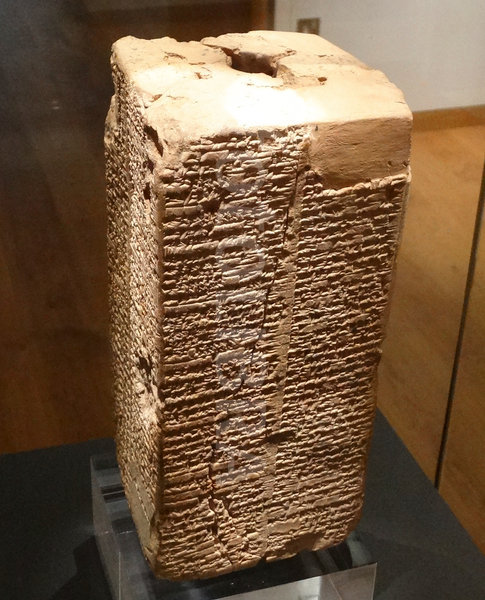 The earliest known historical document is a Sumerian king list, of which there are 16 extant copies. It is somewhat mythical in tone (the second king, Alalgar, is said to have ruled for 64,800 years. But many of the kings seem to have been real, and some seem to have had humble origins, which the chronicle is careful to point out. We are told that “The divine Dumuzi, the shepherd, ruled for 36,000 years”, that “Etana, the shepherd, who ascended to heaven and put all countries in order, became king; he ruled for 1,500 years”, and “The divine Lugal-banda, the shepherd, ruled for 1200 years”. Not only shepherds aspired to kingship: “The divine Dumuzi, the fisherman, whose city was Ku’ara, ruled for 100.” He was the king just before Gilgamesh, of epic fame, who is generally thought to have been a real person. Other tradesmen in the king list include Kiš, Su-suda, the fuller, Mamagal, the boatman, Bazi, the leather worker, and Nanniya, the stonecutter. Altogether, even in a long king list, this seems a remarkable number. Perhaps there is, embedded in this list, a hint at some misinterpretation in our ideas of the nature of Sumerian kingship.
But most remarkable of all was a woman king (apparently not a queen who came to power through widowhood), Kubaba. The text reads: “In Kiš, Ku-Baba, the woman tavern-keeper, who made firm the foundations of Kiš, became king; she ruled for 100 years.” Surely there’s a interesting tale behind this terse entry. If she is a real historical figure (and one shouldn’t assume so), her reign may have been in c.2400 BC. It’s thought that she overthrew the rule of En-Shakansha-Ana of the 2nd Uruk Dynasty to become monarth. The people of the ancient Near East certainly thought her remarkable. Kubaba (or Ku-Baba or Kug-Bau) also appears in the text known as the Weidner Chronicle, in this most remarkable passage: Read more »
15802. (James Turner) Rex Libris: I, Librarian [comix]
Posted by Phil Paine
on March 21, 2008
No comments
I can’t describe this amusing graphic novel any better than the back cover blurb: “The astonishing story of the incomperable Rex Libris, Head Librarian at Middleton Public Library. From ancient Egypt, where his beloved Hypatia was murdered, to the farthest reaches of the galaxy in search of overdue books, Rex upholds his vow to fight the forces of ignorance and darkness. Wearing his super thick bottle glasses and armed with an arsenal of high technology weapons, he strikes fear into the recalcitrant borrowers, and can take on virtually any foe from zombies to renegade literary characters.