14797. (Akdi Rostagno, Julian Beck & Judith Malina) We, The Living Theatre
14798. (Will Bunch) The Media Is Helping Bush Scare the Populace [article]
14798. (Lisa Finnegan) No Questions Asked – News Coverage Since 9/11 [introduction and chapter
. . . . . outlines of book to be published in December, 2006]
14799. (Robert Bowring) China’s growing might and the spirit of Zheng He [article]
14800. (Jon George) Zootsuit Black Read more »
Category Archives: B - READING - Page 40
READING – OCTOBER 2006
Posted by Phil Paine
on October 31, 2006
No comments
Friday, October27, 2006 — Tread Softly
Posted by Phil Paine
on October 27, 2006
No comments
I’ve never been a big fan of William Butler Yeats — from that period, Gerard Manley Hopkins is more to my taste — but this short poem pleases me. If you have ever been quietly, unselfishly and vulnerably in love with another person, you will know that he has captured the sensation exactly.
He wishes for the cloths of heaven
Had I the heavens’ embroidered cloths,
Enwrought with golden and silver light,
The blue and the dim and the dark cloths
Of night and light and the half-light,
I would spread the cloths under your feet:
But I, being poor, have only my dreams;
I have spread my dreams under your feet;
Tread softly, because you tread on my dreams.
No tedious cycles of history, sloughing beasts, or celtic blarney, here. Apparently, Yeats occasionally stepped off the cosmic merry-go-round to feel something in an ordinary way. Love is not a topic that poets of the twentieth century handled well. Too plebian, I guess. And it takes courage.
[Addendum: A reader informs me that Yeat’s poem is actually religious in nature, and not about love at all. He explained the references in the phrasing that identify it as actually being about contrition, repentance and “hidden evil”. *sigh* Why are poets attracted to such tedious nonsense? I guess it was to good to be true to think a twentieth century poet would be willing to address an issue that really matters, and requires real thought, rather than the endless re-arrangement of inane religious twaddle.]
14801. (Stephen Fry) Moab Is My Washpot
Posted by Phil Paine
on October 14, 2006
No comments
Stephen Fry has the kind of effortless talent that makes me envious. He is a brilliant actor and comedian (Blackadder; Jeeves and Wooser; A Bit of Fry and Laurie), and fine writer of fiction, non-fiction, screenplays and plays (I’m in the middle of his novel Making History). Naturally, such a person would be expected to write an interesting biography. But I was unprepared for the extreme honesty and sparkling wit of this book. It’s devoted entirely to his childhood and teenage years, always the most interesting parts of an autobiography, if it is honest. His description of his first experience of feeling love is among the finest I’ve read. His self-evaluations strike me as spot-on, his confessions to misdeeds are not twisted into self-glamorizing. The book is absolutely engrossing. For the aspects of human culture that offend him, he reserves a special, eloquent anger: Read more »
14800. (Jon George) Zootsuit Black
Posted by Phil Paine
on October 10, 2006
No comments
This is Jon George’s second novel, which I read eagerly after being very pleased by Faces of Mist and Flame. This one is much more complicated, juggling several characters and situations. The plot involves a sudden alteration in the fabric of reality, experienced by the whole earth, a character trying to pin down the nature of psychic abilities, and characters flashing on events in the past. Among those events is the assassination of SS–Obergruppenführer Reinhard Heydrich, who was perhaps the principal architect of the Holocaust. This fascinated me. I not only made a study of the Wansee Conference, where Heydrich consolidated his plans, but a friend showed me the exact spot in the Prague suburb of Kobylisy where he was shot by Czech partisans. I will recommend this novel, especially to anyone who has already read Faces of Mist and Flame, with the caveat that its narrative complexity requires more attentive reading.
READING – SEPTEMBER 2006
Posted by Phil Paine
on September 30, 2006
No comments
14749. (Cory Doctorow) Someone Comes to Town, Someone Leaves Town
14750. (Joseph Kage) Chapitre Premier: Esquisses de la vie Canadienne sous Le Régime Français
14751. (David G. Hubbard) The Skyjacker, His Flights of Fancy
(Bernard DeVoto) Mark Twain At Work:
. . . . 14752. (Bernard DeVoto) The Phantasy of Boyhood: Tom Sawyer [article]
. . . . 14753. (Mark Twain) “Boy’s Manuscript” [fragment anticipating Tom Sawyer]
. . . . 14754. (Bernard DeVoto) Noon and the Dark: Huckleberry Finn [article]
. . . . 14755. (Bernard DeVoto) The Symbols of Despair [article]
14756. (Robert Graves) I, Claudius
Read more »
14777. (Cyril M. Kornbluth) The Syndic
Posted by Phil Paine
on September 22, 2006
No comments
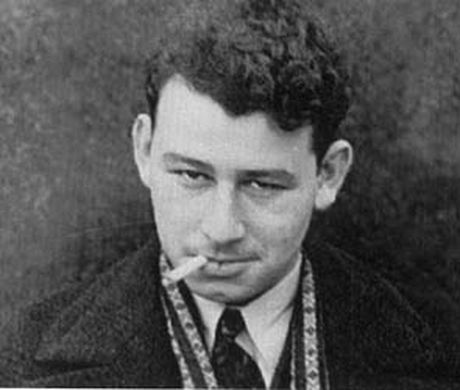 There was something absolutely wonderful about the kind of science fiction that was published in the American SF magazines in the 1950’s. While the “mainstream” fiction writers struggled to obey increasingly rigid notions of “realism” and the short story virtually disappeared as an art form in the literary world, Science Fiction writers flourished in their small ghetto, free to let their imaginations roam, and free to satirize society with infinite jest. That wonderful creative cauldron gave us Theodore Sturgeon, Philip K. Dick, Avram Davidson, Edgar Pangborn, William Tenn, Alfred Bester, and many, many more. These were among the finest writers America ever produced. There was one writer that almost all these men looked up to and admired, and that was Cyril M. Kornbluth. Sadly, his career ended with premature death in 1958, after only seven years of writing. But in those seven years he produced several masterpieces in collaboration with Fredrik Pohl —such as the brilliant satire of advertising, The Space Merchants, and the remarkably prescient Gladiator-at-Law. He also produced several fine novels on his own, much more biting (perhaps because Pohl’s mellower personality influenced the collaborations), as well as a plethora of brilliant short stories. ‘The Little Black Bag’ and ‘The Marching Morons’ are perfect examples of his superb artistry.
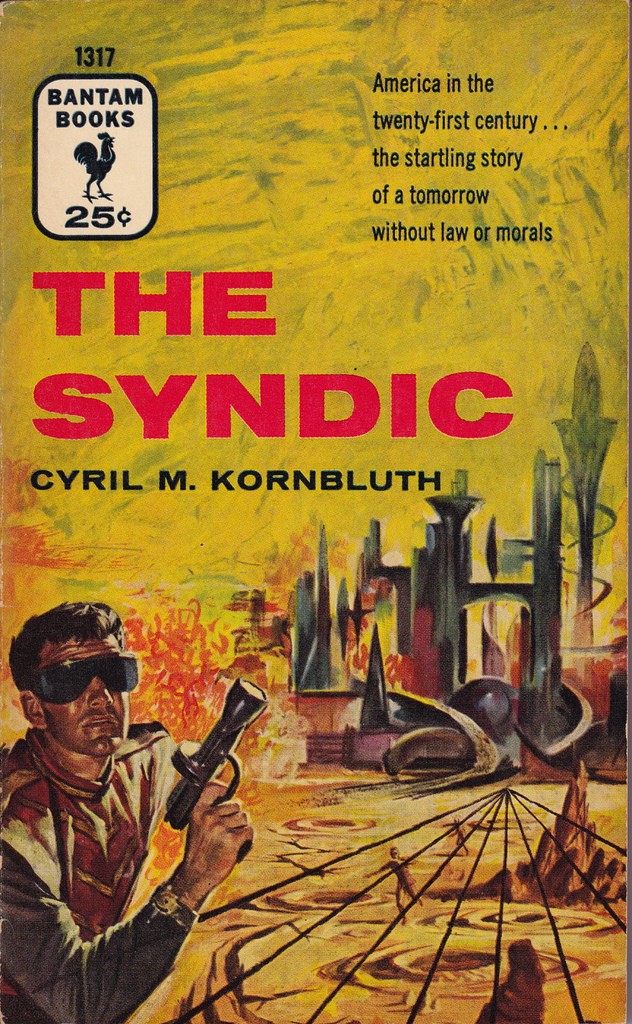 A fine introduction to Kornbluth’s work would be this novel, The Syndic, published in 1953. It posits a future in which governments have collapsed under their own weight of bureaucracy and been replaced by the Mafia. In 1953, it was far-out whimsy. How would an Eastern European read it today? The real pleasure in reading Kornbluth is that his sharp satire is delivered in a crisp, purely colloquial style, as if Damon Runyan where writing sociological Science Fiction. A serious writer, today, would make heavy going of this stuff, stretching it out and filling it with stylistic tricks and learned references. Kornbluth wrote like an experienced barber.… a few deft strokes with a very sharp blade, done like magic, and over before you can catch your breath. Fifty-three years have passed since this novel hit the stands, and it is not quaint. It’s still a good, clean shave.
14751. (David G. Hubbard) The Skyjacker, His Flights of Fancy
Posted by Phil Paine
on September 12, 2006
No comments
In the late 1960’s, there was a wave of “skyjackings” — where lone gunmen would force airplanes to fly to Cuba. This book was a contemporary psychiatrist’s attempt to analyze the motivations of the Skyjackers, based on interviews with them in jail. In most cases, Cuba simply extradited them to Canada, which then extradited them to the United States. Even at the time, it was understood by everyone that the skyjackings were not initiated by, or encouraged by the Castro regime, which was actually rather embarrassed by the phenomenon. The author rejects the idea that there was any serious political motivation behind the skyjackings. In most cases, the political proclamations of the perpetrators were far too shallow and silly to be taken seriously as motives. He goes through the personal history of each skyjacker and finds that they are remarkably uniform. The typical skyjacker was the child of a violent, bullying father and a deeply religious mother, who subsequently failed miserably in carving out any kind of success. They were usually obsessively religious, and socially and psychologically extremely conservative. Their sexual lives, most of the time, were pathetic. After some particularly devasting failure or betrayal, they quite spontaneously concocted a scheme to create a dramatic event that would somehow, they felt, resolve their difficulties, at least in a symbolic sense. The idea of the skyjackings seems to have occured to them simply because others had done it, and it was a big thing in the news. The similarity to the psychological profiles of serial killers, discussed in Elliott Leyton’s work, is striking. Leyton would have had a more common-sense approach to the case histories. Hubbard used his data to concoct a rather lame theory from the pseudo-science of psychotherapy which was then still very influential. But the case histories speak for themselves, and it’s interesting for a reader in 2006 to be reminded that air travel was not particularly safe forty years ago.
14749. (Cory Doctorow) Someone Comes to Town, Someone Leaves Town
Posted by Phil Paine
on September 3, 2006
No comments
This is an extremely imaginative and well-written novel, pulling together several themes that would not normally work well together. Doctorow combines a realistic representation of life in Toronto’s pleasantly chaotic Kensington Market neighbourhood with nightmarish fantasy elements that have the feeling of the grimmer parts or Norse, German or Native Canadian folklore, and throws in a little cyberpunk, as well. These disparate components are not set apart in blocks, but flow and blend into each other on a paragraph-by-paragraph, sometimes a sentence-by-sentence basis. I won’t summarize the plot: it will just sound arbitrarily grotesque, and will not give you any hint of the humanity and the effective language of the book. The book gives me some hope, because I was feeling that Science Fiction writing in North America was moribund, and this is an example of a returning vigour.
READING – AUGUST 2006
Posted by Phil Paine
on August 31, 2006
No comments
14719. (Brian Doyle) Easy Avenue
14720. (Mary Mapes) Truth and Duty ― The Press, the President, and the Priviledge of Power
(Walter Mosley) Futureland: Nine Stories of an Imminent World:
. . . . 14721. (Walter Mosley) Whispers in the Dark [story]
. . . . 14722. (Walter Mosley) The Greatest [story]
. . . . 14723. (Walter Mosley) Doctor Kismet [story]
Read more »
14746. (Elliott Leyton) Hunting Humans
Posted by Phil Paine
on August 28, 2006
No comments
This is the seminal work on the anthropology and sociology of serial killing. I read it in conjunction with an NFB documentary film “The Man Who Studies Murder”, which puts a face to the voice of the book. Leyton is a country boy from small-town Saskatchewan (who looks and sounds distinctly Metis, though I can’t say for sure that he is) and now lives in Newfoundland. Newfoundland is rural, poor by North American standards, and virtually every house has a gun. Economically, it’s the Canadian equivalent of Arkansas. But it has one of the lowest murder rates in the world. In the film, Leyton discusses the reasons why he considers cultural choices and mores the principal determinant of murder rates and styles of murder, often using his home as a laboratory.
The book on serial and mass killers, dealing with the “classic” cases, attempts to get beyond the kind of unverifiable psychiatric speculations that dominated the issue before Leyton came on the scene. As he demonstrates, psychiatry has been of little use in understanding the phenomenon. He shows the fundamental similarities in most serial killings, and does his best to deflate the nonsense generated by Thomas Harris’s “Hannibal Lecter” fantasies. Serial killers are invariably pathetic, ineffective losers, usually pretty dumb.…. never the suave supergeniuses of fiction. Leyton rejects biological and psychiatric explanations in favour of a cultural one, and argues it persuasively. He may not have the last word on this issue, but his opinions are more worth reading than most. He is also a witty and entertaining writer ― and from the evidence of the film, has the same qualities in person.