I just finished reading Sayyid Qutb’s Ma’alim fi-l-Tariq [“Milestones”]. This book is not available in my public library system. Since it bears the same relationship to the rise of Islamist totalitarianism as Mein Kampf and The Communist Manifesto do to European totalitarianism, you would think it would be smart for our libraries to have it. You cannot resist a movement of oppression and aggression by knowing nothing about it. Milestones is the ideological entry-point by which bored, spoilt-brat teenagers in Muslim families are drawn into the movement and converted into zealots for death and destruction. It should be read, grasped, and understood by sane people, so that its insanity can be countered. Read more »
Category Archives: B - READING - Page 41
14737. (Joseph Boyden) Three Day Road
This book caught my eye because it’s heroes are from the coast of Hudson’s Bay, a nostalgic place for me. Two Cree lads from Moose Factory fight in the trenches of World War I. Boyden writes beautifully, is familiar with Cree culture, and researched WWI trench warfare with a historian’s skill. The book compares well with the classic Canadian novel of WWI, Timothy Findlay’s The Wars. The Great War of 1914–1918 had a tremendous impact on Canada — far more than on the United States. Canada was involved during the entire length of the war, had twice as many soldiers on the front per-capita as the U.S., and one Canadian family in five suffered a casualty. The war ended the desire of most Canadians to keep any serious political ties with Britain, and scarred an entire generation. So it isn’t surprising that WWI novels continue to be written, and loom large in Canadian literature. This is a worthy example. Read more »
14735. (Peter D. Edward) Gorgon ― Paleontology, Obsession, and the Greatest Catastrophe in Earth’s History
Edward is a paleontologist who did important work on the Permian Extinction, a period in Earth’s history that seems to have undergone a catastrophe even more spectacular than the better known Cretaceous meteor impact that turned the dinosaurs to toast. In the mass extinctions that took place 248 million years ago, ninety to ninety-five percent of marine species were eliminated, and on land a complex proto-mammalian fauna was wiped out. Edward’s book contains only a simplified summary of the science. It’s primarily autobiographical. He did most of his research in the Great Karoo region of South Africa, and his visits there coincided with dramatic periods in South Africa. He describes the totalitarian atmosphere during the late Apartheid era, and then the chaotic one of the post-Apartheid era. This, and description of the physical and emotional challenges of doing hard science in the field are the reason to read the book.
[If you want to learn more about the Permian Extinction Event, a good place to start is the Hooper Virtual Natural History Museum, run by Carlton University, Ottawa. It’s a user-friendly site, geared to the general public. A section devoted to “Creationism” makes no attempt to pussyfoot with the tide of ignorance: it begins with a primer on the fourteen most common logical fallacies of argument, straight out of Aristotle]
14734. (Robert Swindells) Brother in the Land
Written in 1984, when the Cold War was heating up again, this is a narrative of an English teenager’s survival after a nuclear war. Swindell attempts to convey the utter hopelessness of the situation. Steeped in the British class system, he assumes that the rich and powerful would do everything to protect themselves. and simply exterminate anyone inconvenient to them. Perhaps this would have been true — I don’t know British society well enough to judge. The book gives a reasonably accurate portrayal of the effects of a nuclear war on an ordinary region (at least in terms of the scientific knowledge then available). As personal drama, it is very effective. People who now imagine that the world is a newly terrifying place, merely because a handful of terrorists can plant bombs in planes, have either forgotten, or are incapable of imagining, the kind of anxiety people lived under during the periods when the imminent incineration of the planet was something to worry about.
14730. (Karl E. Meyer) The Dust of Empire: The Race for Mastery in the Asian Heartland
Meyer provides a basic primer on the history of Central Asia and the Caucasus. It’s a short volume, so it can only sumarize the complexities. Still, even a well-educated reader is likely to know nothing about this large portion of the Earth. Newshounds usually refer to the post-Soviet Central Asian republics as “the Stans”. Well, at least a flippant nickname is more attention than these places got before.
Despite its low profile in public discourse, Central Asia has gotten plenty of attention from geopolitical schemers and imperial powers, invariably creating disasters. Something about the place generates fantasies and delusions. And no country is more prone to living in fantasy than the United States, the latest imperial power to decide it is going to bring enlightenment to the land of the mountain warrior clan and the poppy. As Meyer demonstrates, the delusional chatter coming from Washington is identical to that which emanated from Britain and Romanov Russia, and the Soviet Union when they began the same disastrous projects, ending in defeat for themselves and endless misery for the people of the region. Read more »
READING – JULY 2006
14695. (N. A. M. Rodger) The Safeguard of the Sea ― A Naval History of Britain, Vol.1, 660‑1649
14696. (John Dille –ed.) Time Capsule 1925, A History of the Year Condensed From the Pages
. . . . . of Time
14697. (Jon George) Faces of Mist and Time
14698. (Raymond W. Baker) Capitalism’s Achilles Heel: Dirty Money and How to Renew the
. . . . . Free-Market System
14699. (Jared Diamond) The Third Chimpanzee
14700. (Mervyn Peake) Gormenghast
Read more »
14717. (Robert Swindells) No Angels
Swindells runs two stories in parallel. One is set in 19th century London, and tells of an orphan boy who encounters Dr. John Snow, the founder of modern epidemiology, and discoverer of the cause of cholera. The second story is set in modern times, and follows a young girl who flees sexual abuse from her mother’s boyfriend, and lives in a London “squat”. Interspersed through these episodes are newspaper letters from a conservative crank, and the diaries of a nasty Victorian magistrate. The boy’s narrative is written in phonetic transcription of his dialect, which may cause trouble for a Canadian or American reader. Juggling these disparate elements is a difficult task, and the author pulls it off beautifully. The novel has an obvious message: the struggle against ignorance never ceases. I was delighted that a youth novel like this draws attention to Snow, who is one of my personal heroes. The more attention is paid to really important historical personages like Snow, the more people will understand the difference between them and the assortment of gangsters, thugs, and con-men who are conventionally represented as “great”.
14716. (Bernard DeVoto) Mark Twain’s America
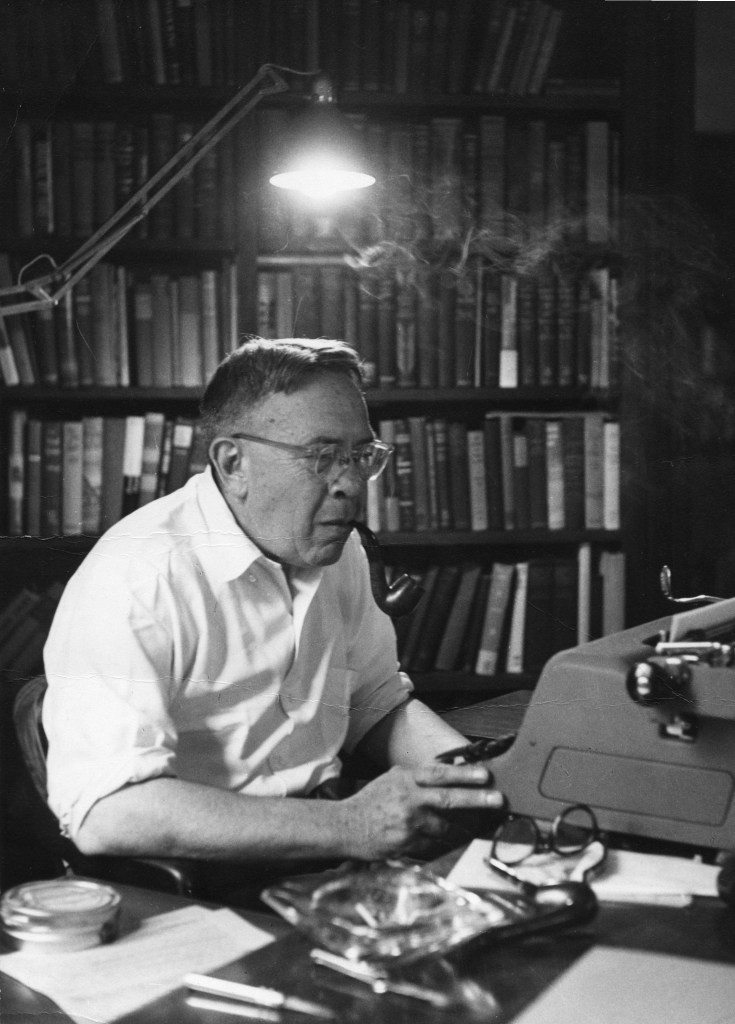 Bernard DeVoto was was one of the leading Mark Twain scholars, as well as being a historian of the American far west, a passionate advocate of nature conservation, and a leading advocate of civil liberties. In this curious book, written in 1932, he devotes most of his energy to criticizing other Mark Twain Scholars. The book is clever, acerbic, and sometimes downright nasty, but entertains precisely for those reasons. DeVoto detested the scholastic habits of reifying abstractions (The Frontier, Puritanism, The Artist, Materialism) and basing grand explanatory theories on trivial or dubious evidence, or no evidence at all. Sometimes his sarcasm grates on the reader, but often it is just so good (that is to say, cruel, like Scottish humour) that it brings up a smile from that little reservoir of malice that hides somewhere in even the kindest reader. Here is his treatment of one well-known pundit: “He exhibits the amateur’s reverence for the principle of ambivalence. This, in his lay psycho-analysis, is a device for the reconciliation of contradictory evidence. It explains that a fact can be both its literal self and a symbol of its opposite, that one fact can prove a given assertion on one page and a contradictory assertion on another, that the two facts which seem to indicate irreconcilable conclusions really mean one thing — the preferred thing.” Boy, I wish I could write sarcasm of that distillation. DeVoto could probably take on six coral snakes and a grizzlie before breakfast, then move on to serious sarcasm after coffee. Psychoanalytic criticism was the babble of that time, but I’m sure he would make mincemeat of today’s equivalents (“post-modernism”, for example).
14715. (Jung Chang) Mao, the Unknown Story
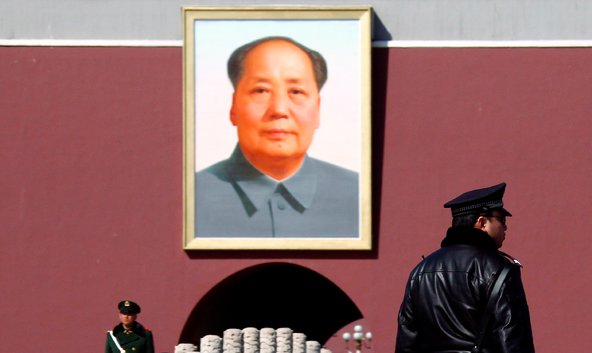 There’s a common belief, fostered in gentle societies, where people expect their children to grow up, and famine never stalks the land, that there is no such thing as absolute evil, and that dictators are confused idealists who took a wrong turn. This, the first seriously researched and accurate biography of Mao Zedong, should disabuse anyone of such naivité. I have spent most of my lifetime studying the motives, ideologies, mechanisms, and agents of slavery, but I was still not prepared for the contents of this book, which is one of the most important biographies of modern times. It is absolutely essential that this book be in every library and school in the world, for Holocaust Denial is the endemic sickness of our age, and the worship of mass murderers the endemic sickness of all ages.
I remember when college campuses were adorned with posters of Mao, when Jean-Paul Sartre was proclaiming that Mao’s “revolutionary violence” was “profoundly moral”, when university professors prattled the moronic, megalomaniac slogans of Mao’s Little Red Book [“Power comes from the muzzle of a gun”] as if they were profound philosophy, and a lawyer and feminist activist tried to slap me in the face when I told her that Mao was a genocidal criminal. I remember when another student activist gleefully showed me a photograph of one of Mao’s “projects” — thousands of ragged, starved, brutalized slaves digging up earth with their bare hands while machine-gun-toting Communist Party cadrés watched over them, smoking cigarettes, barbed wire and wooden watchtowers clearly visible in the background. This, he explained, was the ideal society, Utopia being constructed for the common good. This was not even the death camps or the laogai, mind you, of which no pictures where permitted to exist, but of one of the projects the Party liked to publicize. And their calculations were correct. To the campus intellectuals in Paris, Berkeley, or Toronto, such pictures were appealing. To any actual human being, they could not be anything but horrifying and disgusting. Read more »
14706. (N. A. M. Rodger) The Command of the Ocean ― A Naval History of Britain, Volume Two, 1649–1815
The two hefty volumes of Rodger’s history of the British Navy bring the story only up to 1815. But this lifetime scholarly work is well-balanced with readability. Rodger thinks strategically more than tactically. He knows that the economics of getting ships on the sea, administering and supplying them, and making sure they do something useful is the heart of the matter. Britain had exercised considerable sea power in the northern world in Anglo-Saxon times, but the land-lubbing, horse riding Norman aristocracy used ships very crudely. Even in the Renaissance, there was no real “navy”, but merely inconsistent attempts to put together fleets for various temporary purposes, and naval tactics remained primitive. Henry VIII was particularly irresponsible and destructive, as he was with everything else. Elizabeth’s reign was dominated by “privateering”. It was only during Cromwellian times, when the ruling dictatorship feared disloyalty among seamen, that the first attempts were made to organize and administer what would fit our modern notions of a national navy. Much of the story, of course, involves the more economically advanced Dutch, with whom British political, military and economic relations were interwoven for centuries. Rodgers is very adept at sorting out these complexities.