 This French turntablist quartet is eroding the distinctions between DJs, bands, and electronic artists. They play live in clubs, mixing their own material, or that of live musicians pressed onto vinyl, rather than the usual samples, and restructure much of what they create in the studio. The result is interesting music, likely to appeal to an older crowd than most club-goers.
Category Archives: C - LISTENING - Page 30
Birdy Nam Nam: Manual For Successful Rioting
Posted by Phil Paine
on March 29, 2009
No comments
Antonín Dvořák: Symphony #1 in C m “The Bells of Zlonice”, Op.3, B.9
Posted by Phil Paine
on March 21, 2009
No comments
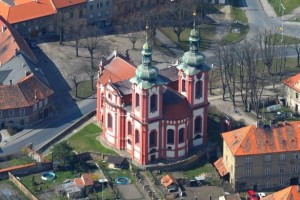
Antonín Dvořák lived in Zlonice, a small town in Bohemia, from 1853 to 1856. He must have been fond of this church’s bells.
I have an odd advantage over Dvořák. I’ve heard this symphony, while he never did. It was composed in 1865, when Dvořák was only 24. He submitted the manuscript to a competition in Germany, and the only copy disappeared, so he never had a chance to hear it performed, or even to revise it. He dismissed it as lost, and did not number it among his compositions. However, in 1882, it was found by a German student in a second-hand shop in Leipzig, and kicked around until it finally resurfaced in 1923. It did not have a complete and unaltered performance until 1973.
How does it sound? It’s pretty much Mendelssohn, or rather Mendelssohn when he sounds most like Beethoven. But it’s damn good for a callow youth’s first symphony, and could stand on its own at any concert. Every now and then you hear a premonition of distinctively Dvořákian features. Many passages are beautiful, or at least entertaining. It just doesn’t come together in a completely satisfying way. The recording I have is conducted by Stephen Gunzenhauser, with the Czecho-Slovak Radio Symphony Orchestra, and was made in 1993 (only 27 days after the separation of the Czech and Slovak Republics, hence the oddly hyphenated name). It isn’t clear why it was called “The Bells of Zlonice” ― there are no bells in it, or bell-like passages, and the phrase is nowhere on the score ― but Dvořák is reputed to have called it by that name in later years. He lived in the small town of Zlonice for three years, and it has rather nice looking church. Perhaps its bells were particularly fine. How much of this youthful work did he remember? Could he play parts of it in his head, in old age, or did it simply disolve into a vague impression? Sadly, we get to indulge in the guilty pleasure of listening to some perfectly good Dvořák that Dvořák himself never heard. So let us at least hoist a pilsner to his honour, whenever we do so.
Zombie Zombie: Mad Dog
Posted by Phil Paine
on March 13, 2009
No comments
Scored for theremin, space echo RE201, toy piano, ARPprodGX, Roland SH101, Prophet 600, 808 Roland, percussions, tape recorder, analog delay Ibanez UE305, toy piano and “screaming”, this album is an exercise in creating a sense of uneasiness in the listener. French electronic musicians Etienne Jaumet and CosmicNeman (from Herman Dune) acknowledge the influence of George Romero and John Carpenter’s horror films as much as the traditional electronic gurus. I can’t say that Mad Dog held my rapt attention all the time, but it succeeds well enough in its aims to be worth a serious listen. This is a 2006 debut full-length release (after one 12“er). I don’t know if there has been any follow up since then.
Apparat Organ Quartet
Posted by Phil Paine
on March 5, 2009
No comments
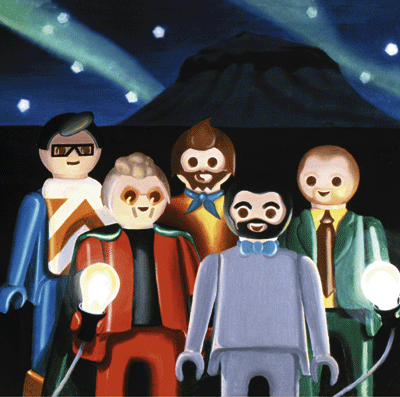 This Icelandic band constructs soundscapes with old-fashioned electronic effects reminiscent of the 1970’s. The cheesy beeps and whirs gradually build into intelligent structures, with elements of hard rock and house. I especially liked track seven, “Seremonia”, which builds to a satisfying resolution. Jóhann Jóhannsson, Iceland’s wonderfully sinister-looking composer and multimedia impresario, is behind it all. If you like listening to old Kraftwerk albums, and the instrumental piece “Telstar” drifts out of your subconscious when you come out of a coma, you’ll enjoy this.
First-time listening for February, 2009
Posted by Phil Paine
on February 28, 2009
No comments
19513. (Anton Bruckner) Symphony # “0”
19514. (Jean Sibelius) “Souda, Souda, Sinisorsa [Swim, Duck, Swim]”, JS 180 [s. Anne Sofie
. . . . . von Otter]
19515. (Jean Sibelius) “Norden [The North]”, Op.90 no.1 [s. Anne Sofie von Otter]
19516. (Jean Sibelius) “Narciss [Narcissus]”, JS 140 [s. Anne Sofie von Otter] Read more »
A Pleasure Awaits Me
Posted by Phil Paine
on February 27, 2009
No comments
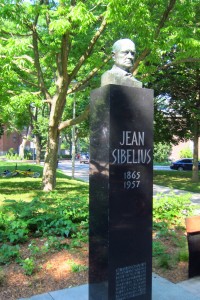
The composer scowls menacingly over little children playing in Toronto’s Sibelius Park
Hurray! As my readers will know from constant references, I’m an ardent Sibelian… given to making pilgrimages to his statue in Toronto’s Sibelius Park, for example. The Toronto Symphony Orchestra will be performing all seven Sibelius symphonies, in sequence, in their coming season, under guest conductor Thomas Dausgaard. Dausgaard is a Danish conductor with a good reputation, but I’ve heard none of his recordings. The tests will be how he handles the finale of the Fifth Symphony… the last bars must be timed perfectly to get the effect I think Sibelius was after, and many of the recordings I have screw it up completely. But most of all, it’s the subtleties of the grim and ambiguous Fourth Symphony that matter to me. Only one modern conductor, Colin Davis, satisfies me for this symphony. If Dausgaard comes even close I’ll be in ecstasy.
Prokofiev’s “Classical” Symphony
Posted by Phil Paine
on February 21, 2009
No comments
Symphony No. 1 in D major, Op 25 was designated “Classical Symphony” by Prokofiev when it premiered in 1918, in Petrograd. “Neo-classical” would be more appropriate. Prokofiev said it was a symphony “that Haydn would compose if he lived today”. There are no quotations from Haydn in the work, however, and the melodies are unmistakably Prokofiev, with his usual sardonic humour. The work must be hard for a conductor to interpret, because the three recordings I have all feel rather different. I have two vinyls: one by Jean Martinon, which is performed at breakneck speed, and an old Soviet recording by Gennady Rozhdestvensky which is done a little more respectfully. On CD, I have Neeme Järvi’s set of the complete symphonies, with the Royal Scottish National Orchestra. I find this one the most satisfying. Read more »
Eclectic El Guincho
Posted by Phil Paine
on February 11, 2009
No comments
 It would be hard to name a musical influence that isn’t to be found in the first two albums by Catalunyan musician Pablo Díaz-Reixa, aka El Guincho. His myspace page describes his music as “pop/tropical/club”, but that hardly begins to list the eclectic sources that he puts together on his Roland SP-404 sampling workstation. There’s a resemblance to Animal Collective’s work, but it wouldn’t be mistaken for it. Nothing comes across as ponderously serious — every piece is clearly designed to be fun to listen to. It’s more “party music” than “arty music”, even though it is technically elaborate. The first album, Folías (2007) has some nice bits, but Alegranza! (2008) has the outstanding work. I particularly like the catchy, almost high-life “Fata Morgana”, “Kalise”, with its manic steel-band continuo, and most of all, the grand, many-layered “Buenos Matrimonios Ahí Fuera”.
Ali Farka Touré: The Source
Posted by Phil Paine
on February 6, 2009
No comments
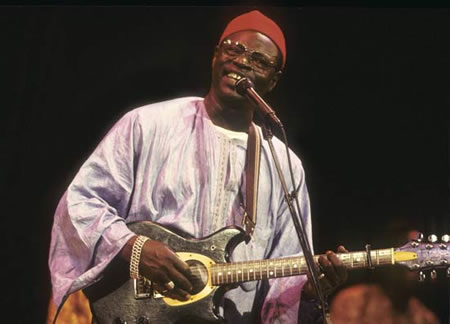
I’m playing, for the umpteenth time, my favourite among Touré’s albums. I’ve written elsewhere about this astonishing musician [Thinking of Timbuktu; Ali Farka Touré, Toumani Diabaté In Perfect Sync; Ali Farka Touré and Ry Cooder Talking Timbuktu]. This album is a tribute to his beloved Niger River roots, with song lyrics jumping casually between Bambara, Temazhek and French. Tracks like “Cinquante Six” and “Yenna” demonstrate his absolute mastery of the guitar, with the perfect timing that made him a legend. My favourite track is the song “Dofana”, in which he wistfully evokes a small village, “a paradise on Earth, only twenty kilometres from here”, threatened only by the “idiocy of politicians”. Touré, on becoming a successful recording artist, eschewed the migration to Paris or London, and instead became the mayor of just such a village. Most of the money he made went into supplying it with clean water and electricity.

First-time listening for January, 2009
Posted by Phil Paine
on January 31, 2009
No comments
19430. (Charles Ives) Symphony #5 “Universe Symphony” [reconstructed by Larry Austin]
19431. (Scratch Perverts) FabricLive 22
19432. (Oasis) Definitely Maybe [Japanese release with two extra songs; original at 2447]
19433. (Charlie Haden & the Liberation Music Orchestra) Dream Keeper
19434. (Deerhunter) Cryptograms
19435. (Jean Sibelius) “Svarta Rosor [Black Roses]”, Op.36 #1 [s. Anne Sofie von Otter]
Read more »