17982. (William Byrd) Dileges Dominum
17983. (William Byrd) Ad Dominum cum tribulater
17984. (William Byrd) Mass for 5 Voices [version with Prospers (4) for the Feast of All Saints]
. . . . . [see regular version [2060]
(Armen Grigoryan, douduk, with ensemble) Douduk, the Sound of Armenia:
. . . . 17985. (Anon.) Gyoumrva Parer
. . . . 17986. (Sayat Nova) Es Me Gharib Blbuli Pes
Read more »
Category Archives: C - LISTENING - Page 36
First-time listening for December, 2007
Posted by Phil Paine
on December 31, 2007
No comments
Rinaldo di Capua
Posted by Phil Paine
on December 20, 2007
No comments
We don’t know much about the life of the Neapolitan composer Rinaldo di Capua, who was born somewhere around 1710 and died, in poverty and obscurity, in 1780. But, briefly, he achieved some fame as a composer of opera, and made one of the key innovations in the transformation of the symphony from a mere suite of vignettes, which could be shuffled or substituted like a deck of cards, to its later form as a coherent whole, the “symphony-sonata” form that makes, say, a Beethoven symphony appear as narrative as a play, and saw it’s ultimate degree of logical development in Sibelius’ Seventh. According to the diary of Charles Burney, a musician traveling in Italy in 1770, di Capua had the same tendency to solidify the opera buffa into something more resembling our idea of a dramatic opera. Burney relates that, after a period of celebrity for many operas (all but one of which are lost), he found him “living, or rather starving in 1770 at Rome, the chief scene of his former glory! This composer, whose productions were, during many years, the delight of all Europe, was reduced at Rome to the utmost indigence. Diogenes the Cynic was never more meanly clad through choice, than Rinaldo through necessity: a patched coat, and stockings that wanted to be patched or darned.” Burney reports that the old man was particularly bitter because he had hoped to provide for his old age by publishing his collected works, only to discover that his son had burned all his manuscipts! Hence, we know little about a fairly important composer of the Rococo period. Toronto Public Library’s huge collection contains nothing by him, though the University of Toronto’s Thomas Fisher Rare Book Library [one of the little-known treasures of the city, by the way], has a libretto of one of his operas, and elsewhere the University has some scraps of sheet music. But one, random example of his operas survives, apparently a minor early work. It is La Zingara, an Intermezo in Two Parts. This was later reworked into something more unified opera, but what survives is in the original opera buffa form. It was performed by the Mainz Chamber Orchestra, with Annelies Mokewitz (soprano), Rodolfo Malacarne (tenor) and Laerte Malaguti (bass). The performance exists on a Turnabout recording which I obtained in a yard sale in my neighborhood, where yard sales can turn up anything. If this one, minor work is any hint, di Capua was a talented man. The melodies are fine, the ritornellos are dramatically effective. I don’t urge anyone to run out and listen, because their chances of finding the piece are remote.
Chansons de la Vieille France.…et du Canada
Posted by Phil Paine
on December 13, 2007
No comments
After listening to Nana Mouskouri’s Nouvelles chansons de la Vieille France (1978), I dug up the album that preceded it, Vieilles chansons de France (1973). Both albums, covering a wide variety of traditional French melodies, some dating from the middle ages, acted as a useful reminder that Canadian folk music owes something to France. The Canadian folk tradition is so saturated with Celtic elements — one musicologist classified the whole country as a “Celtic out-island” — that one forgets that many of the oldest songs do come from France. Listening to these two albums, I found it easy to guess what part of France a song came from. If the song sounded vaguely familiar and had a “Canadian feeling” to it, it turned out to have come from Britanny, Normandy, or the Lower Loire. These are, of course, the places where the bulk of the first settlers in Canada originated, the maritime villages of the west coast of France. Many of these settlers did not even speak French, but were Bretons, whose Celtic language is closest to Welsh, so the earliest Canadian music already started out on a quasi-Celtic footing. Subsequently, wave after wave of Scottish and Irish music deeply Celticized the folk music of all of Canada, whether it was sung in French, English, Gaelic, or aboriginal languages. But in many cases, the original melody does come from France, and occasionally has survived in both countries. It’s interesting to hear them sung by a European singer, though I suppose my own heritage will ensure that the Celticized Canadian versions will always feel “the right way” to me.
Mouskouri has been called “the the best selling female singer of all time” (though I suspect Lata Mangeshkar has a better claim to that title). A Greek, born at Chania, on Crete, she is still going strong, performing many concerts yearly at the age of 74. She sings in many languages, but she is best known for her work in French, and also American Jazz. Both these albums are delightful.
Ali Farka Touré, Toumani Diabaté In Perfect Sync
Posted by Phil Paine
on December 7, 2007
No comments
I’ve written before about Ali Farka Touré, the sublime guitarist and song writer Timbuktu [in blog entry Thinking of Timbuktu]. In the Heart of the Moon was the second last album he released before his death in March of 2006. Here, he is teamed up with master kora player Toumani Diabaté, in a spontaneous jam session, without rehearsal. A few overdubs (some by Ry Cooder) were later added, but these are discreet, and not intrusive to the effortless flow of the session. All twelve tracks are superb. It is also more traditional, harking back to the pre-electric days of the griot performers of classical Malian music, and mixing both Songhai and Bambara strains. The cumulative mood is hypnotically pleasurable. There is no hint of rivalry in the duets. The kora is built from a calabash gourd cut in half and covered with cow skin, with a notched bridge, putting it roughly in the mandolin family. But it’s played somewhat like a flamenco guitar, and the strings give a distinctly harp-like sound. Diabaté is perhaps the finest interpreter of this instrument. Touré, as the more famous musician, doesn’t hog the show. He lets the Diabaté’s kora shine in the limelight for most of the songs. The subtlety of their collaboration hits the listener only as one gets well into the album. If you are going to buy three albums to introduce yourself to the glories of the Malian Renaissance (for that is what is going on in that country), then I recommend this album, Touré’s The Source, and Amadou et Mariam’s Dimanche à Bamako.
First-time listening for November, 2007
Posted by Phil Paine
on November 30, 2007
No comments
17809. (Christos Hatzis) Constantinople
17810. (DJ Assassin) The Stalker EP
17811. (OutKast) Big Boi and Dre Present….OutKast
17812. (Souad Massi) Mesk elil
17813. (Asia) Asia
Read more »
The Soul of Mbira
Posted by Phil Paine
on November 26, 2007
No comments
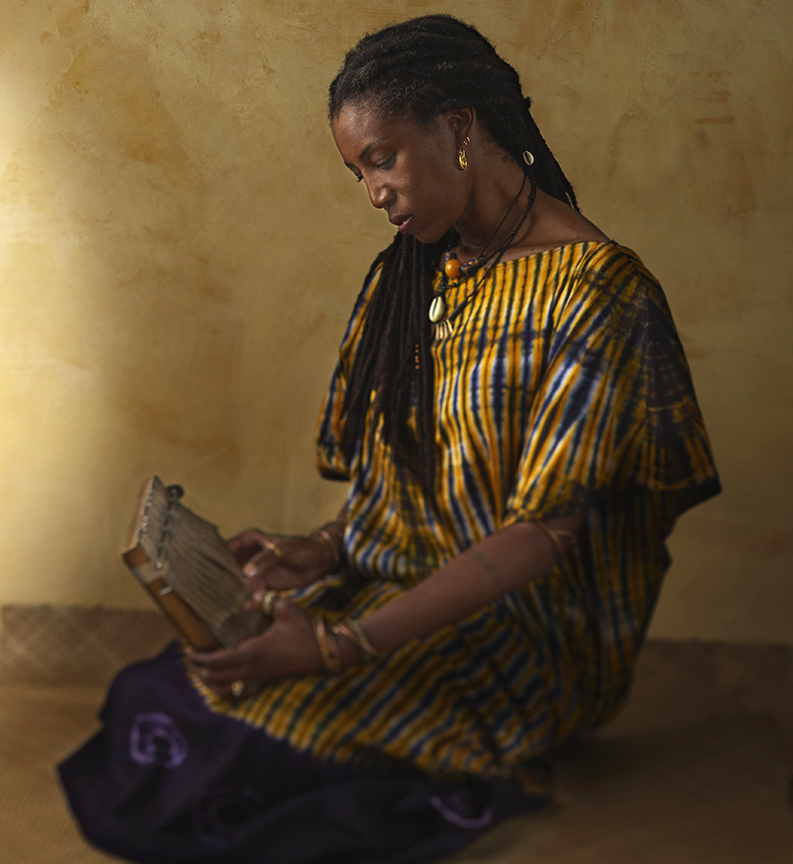 I’ve just acquired Zimbabwe: Traditions of the Shona People ― The Soul of Mbira. Most ethnological recordings are of limited interest to non-specialists, but the sound of the African instrument known as the mbira or kalimba is so delightful that a broad audience can enjoy this album. The album consists of recordings made in Zimbabwe by ethnomusicologist Paul F. Berliner. Berliner is the acknowledged authority on mbira music, and author of The Soul of Mbira, published in 1993 by University of Chicago Press. The mbira consists of a wooden sounding board, on which tuned iron keys are mounted. The keys are played by the thumbs. The music of the mbira, as it is played by the Shona people of Zimbabwe, is complex and polyrhythmic, often giving the impression of several instruments played at once. The form of mbira pieces, usually accompanied by a drum called the hosho, vaguely resembles the works of Philip Glass, in that complex repeating patterns slowly mutate over a long time. The mbira is documented in African culture as early as 1589, and is probably much older. It may be closely associated with the technology of iron smelting, which in turn is associated with the expansion of the Bantu-speaking peoples of Africa. There was very good quality iron smelting in the Mutapa Empire of the 13th to 17th centuries.
While the mbira has not spread out of Africa in the same way that the banjul (banjo) did, it has some afficianados in the rest of the world. Earth, Wind and Fire, the eclectic Chicago-based band of the 1970s, featured the kalimba. This is a variant of the mbira, tuned diatonically in the key of G, with the keys placed in a non-traditional manner (adjacent notes on the scale sitting on opposite sides). It was invented in the 1950’s and was an “export” version of the instrument, originally marketed by a New Jersey firm as a toy! Earth, Wind and Fire’s bandleader, Maurice White, became quite proficient on the instrument, and his performances helped rescue the instrument from its “toy” status.
Christos Hatzis “Constantinople”
Posted by Phil Paine
on November 2, 2007
No comments
For my eighteen-thousandth first listening, I wanted to pick something at least a little special, so I chose Christos Hatzis’ 90-minute work for soprano, middle-eastern vocalist, piano trio, and digital audio. When I listened to it, my reaction was “wow” ― not a word that comes up very often, considering my jaded listening experience.
About five (maybe six) years ago, I heard a fragment of music over the radio that struck me as very beautiful. It was clearly a modern piece, but unlike most of the mildly interesting, but bloodless items ground out by the conservatory crowd, it was suffused with intense emotion. Technically, it could have been by any of the eclectic composers of today, but emotionally, it could have been by Rachmaninov! Whatever it was, it was profoundly moving. But I was interrupted, and didn’t learn what it was or who composed it. Two years ago, I heard another piece, very similar, performed by the Gryphon Trio. It was labeled “Old Photographs”, by the Toronto composer Christos Hatzis. I liked this almost as much as the first, and it was clearly connected to the mystery piece I had heard before, part of a suite or something. I subsequently found a number of his choral pieces, all of them enjoyable. Read more »
First-time listening for October, 2007
Posted by Phil Paine
on October 31, 2007
No comments
17668. (Albert Roussel) Symphony #2, Op.23
17669. (Albert Roussel) Symphony #4, Op.53
Rough Guide to the Music of Thailand:
. . . . 17670. (Man Motorgai) “Hae Nang Maew”
. . . . 17671. (Namoiy Thammalangka) “Lam Yai Lam Poon”
. . . . 17672. (Surasak Donchai) “Phin Solo ‘Transcendental Technique’ ”
. . . . 17673. (Mike Piromporn) “Lerk Dai Lerm Bor Dai”
. . . . 17674. (Siriporn Aumpiapong) “Rang Jai Rai Wan”
Read more »
Oscar Peterson Plays Duke Ellington
Posted by Phil Paine
on October 29, 2007
No comments
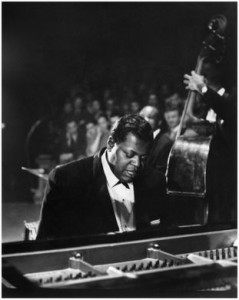 It took me a long time to get into Oscar Peterson. His compositions seem, at first, to be casual little puffs, dashed off effortlessly. This is an illusion. As you let them sink in, you realize what incredible precision, control, and subtlety they have. Peterson is as cool as a plate of sliced cucumbers served on a bed of freshly fallen snow, but there is an emotional power behind it. The precision itself becomes an emotional statement: this is exactly how things should be, this is where this note belongs, this is the precise one hundredth of a second it should be struck.… see! Not for everyone, but for those who feel it, it’s ambrosia.
Peterson is without contest Canada’s jazz giant, the man who speaks for us. Duke Ellington is just as deeply American. Their jazz pantheon is so huge that he can’t claim unchallenged primacy, but surely he’s among the greatest American jazzmen. Like Peterson, Ellington was a perfectionist, a man who planned every note, a classicist at heart. He didn’t much resemble the troubled, erratic geniuses that people associate with jazz. His brilliance was so obvious that nothing could keep his compositions out of the symphonic repertoire, even in the 1920s. Ellington had a stronger, louder voice than you hear in Peterson’s delicate, contemplative compositions. So is there a conflict? Hardly. Playing Ellington seems to have allowed Peterson to cut loose. You hear another Peterson, sassier than when he played his own stuff. I love this record.
Tagaq: Sinaa
Posted by Phil Paine
on October 23, 2007
No comments
 Tanya Gillis Tagak is a young singer from Ikaluktuutiak (Cambridge Bay), in Nunavut. She learned traditional Innuit throat singing at the age of fifteen, but quickly moved to develop an “avant-guarde” style of solo throat singing. Comments that she is the Björk of the Arctic are well deserved. She collaborated with Björk on the 2004 album Medúlla, and toured with her. The duet from that album, “Ancestors”, appears on Sinaa (2005), her first complete studio album. It had a tremendous impact in Canada’s aboriginal cirlces. She has performed with the Kronos Quartet and the eclectic Scottish band Shooglenifty. Like Björk, Tagaq is relentlessly experimental. The casual listener, however, who hasn’t been raised with Innuit throat singing may not be able to distinguish what is traditional from what is innovation.