(Parrish 1969) Journey to the Far Side of the Sun
(Boorman 1974) Zardoz
(Lieberman 2004) Earthsea
(Harding 2006) Agatha Christie’s Poirot: Ep.55 ― Cards on the Table
(del Toro 2004) Hellboy
(Zeisler 1936) The Amazing Quest of Ernest Bliss [as Amazing Adventure]
(Stevens 1941) Penny Serenade
Read more »
Monthly Archives: March 2008
FILMS JANUARY-MARCH 2008
Posted by Phil Paine
on March 31, 2008
No comments
First-time listening for March, 2008
Posted by Phil Paine
on March 31, 2008
No comments
Carnival in Brazil: 40 Latin Classics:
. . . . 18306. (Brazilia Party Squad) “Brazil La La La La”
. . . . 18307. (Samba De Janeiro) “Samba De Janeiro”
. . . . 18308. (Maria Lopez) “Garota de Ipanema [The Girl from Ipanema]”
. . . . 18309. (João Fernandes) “Mais Que Nada”
. . . . 18310. (Del Paz) “Soul Bossa Nova [from Austin Powers]”
. . . . 18311. (Astrud De Mata) “Sway”
. . . . 18312. (Luis Alves) “Copacabana”
. . . . 18313. (Samba) “Lambada”
. . . . 18314. (Enrique Paz) “La Vida Es Un Carnival”
Read more »
READING – MARCH 2008
Posted by Phil Paine
on March 31, 2008
No comments
15738. (Unto Salo) Ukko, The God of Thunder of the Ancient Finns and His Indo-European
. . . . . Family
15739. (Émile Benveniste) Les valeurs économiques dans le vocabulaire indo-européen
. . . . . [article]
15740. (Bernard Wailes) The Origins of Settled Farming in Temperate Europe [article]
15741. (Bernice Morgan) Cloud of Bone
15742. (Edgar Polomé) Germanic and Regional Indo-European [article]
15743. (William F. Wyatt, Jr.) The Indo-Europeanization of Greece [article]
Read more »
Saturday, March 29, 2008 — The Poisoning of a People
Posted by Phil Paine
on March 29, 2008
No comments
I just saw an old movie from the early 1980’s called Testament. It was an attempt to show the lives of the people of a small American town after a nuclear war. It’s a very simple film. In it, the nuclear war happens off-stage. It portrays a California town, far from targets. As it gradually loses contact with the rest of the world, its citizens do the best they can to maintain their families and community, while radiation sucks away their lives. The film was made with respect for its audience. The people in it seem to come from another America, one where you would expect that people would do their best, even in the most hopeless conceivable situation. A few exploiters, a few look-out-for-number-one assholes turn up, to be sure, but most people are ready and willing to behave like free and civilized men and women, even when faced with this ultimate test.
I recognized the film’s basic truth, because I knew those people. Decent, hard-working Americans, who generally treated each other with mutual respect. There were millions of them, across the country. The film was set in Northern California, a place I had lived, and knew well. A few years later, there was a devastating earthquake, there. Those same kind of people were everywhere, behaving with both competence and decency. Read more »
15956. (Timothy Burke) [blog Easily Distracted] Competency as a Cultural Value [article]
Posted by Phil Paine
on March 29, 2008
No comments
This is an interesting discussion of the psychological reality of American politics, and why Democrats from a professional background don’t connect with it. However, it makes unwarranted assumptions about the rationality and “procedural savvy” of the social group the author sees himself as belonging to. In my experience, they have demonstrated exactly the same degree of susceptibility to superstition, magical thinking, and irrational mumbo-jumbo as any of the proles that he contrasts them to. You rarely see this kind of discussion in Canada. We really do live in different worlds, now. It is a good article, making some good observations, despite the patronizing tone, and the annoying use of the silly neologism “competency” in place of the English word “competence”. Available at Burke’s blog Easily Distracted, or through Brad DeLong’s site..
Testament (Littman 1983)
Posted by Phil Paine
on March 28, 2008
No comments
See discussion of this film in blog entry The Poisoning of a People.
15821. (Anon. attr. to Damiq-ilišu of Isin, ruled 1816–1794 BC) Weidner Chronicle, ABC 19 [aka Esagila Chronicle] 15822. (Anon. late third millennium BCE, Ur III period) Sumerian King List based on version G, an octagonal prism from Larsa
Posted by Phil Paine
on March 26, 2008
No comments
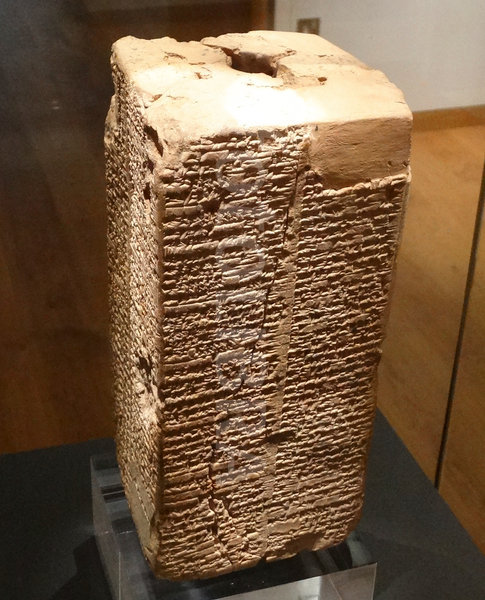 The earliest known historical document is a Sumerian king list, of which there are 16 extant copies. It is somewhat mythical in tone (the second king, Alalgar, is said to have ruled for 64,800 years. But many of the kings seem to have been real, and some seem to have had humble origins, which the chronicle is careful to point out. We are told that “The divine Dumuzi, the shepherd, ruled for 36,000 years”, that “Etana, the shepherd, who ascended to heaven and put all countries in order, became king; he ruled for 1,500 years”, and “The divine Lugal-banda, the shepherd, ruled for 1200 years”. Not only shepherds aspired to kingship: “The divine Dumuzi, the fisherman, whose city was Ku’ara, ruled for 100.” He was the king just before Gilgamesh, of epic fame, who is generally thought to have been a real person. Other tradesmen in the king list include Kiš, Su-suda, the fuller, Mamagal, the boatman, Bazi, the leather worker, and Nanniya, the stonecutter. Altogether, even in a long king list, this seems a remarkable number. Perhaps there is, embedded in this list, a hint at some misinterpretation in our ideas of the nature of Sumerian kingship.
But most remarkable of all was a woman king (apparently not a queen who came to power through widowhood), Kubaba. The text reads: “In Kiš, Ku-Baba, the woman tavern-keeper, who made firm the foundations of Kiš, became king; she ruled for 100 years.” Surely there’s a interesting tale behind this terse entry. If she is a real historical figure (and one shouldn’t assume so), her reign may have been in c.2400 BC. It’s thought that she overthrew the rule of En-Shakansha-Ana of the 2nd Uruk Dynasty to become monarth. The people of the ancient Near East certainly thought her remarkable. Kubaba (or Ku-Baba or Kug-Bau) also appears in the text known as the Weidner Chronicle, in this most remarkable passage: Read more »
Monday, March 24, 2008 — What Alika Lafontaine Tells Us About Ourselves
Posted by Phil Paine
on March 24, 2008
No comments
There is an interesting television contest here in Canada. It’s called Canada’s Next Great Prime Minister. People between the ages of 18 and 25 are asked to submit a five-minute Youtube presentation in which they address one current political issue. Ten finalists are chosen, and brought to a “political boot camp”. From these, four are selected to be voted on by the audience. They not only present their views, but are subjected to an intense grilling from a panel of three former Canadian Prime Ministers and one Provincial Premier (yes, in Canada, Prime Ministers appear on game shows, and even on comedy skit shows). There is a $50,000 prize. Read more »
Navajo Two-Step Songs Live
Posted by Phil Paine
on March 24, 2008
No comments
There’s nothing ponderously “spiritual” in Navaho Two-Step songs. This is party music, light-hearted and ironic songs of love and courting that you can hear at weekend social gatherings all over Dinetah. The genre has made stars of singers like Ed Lee Natay and Davis Mitchell. Navaho music is a bit far from my current stomping grounds, but years ago, I used to hang out in that part of the world, and I picked up some good tapes. This is one of my favourites, recorded at the Chinle Valley Festival in April of 1986. Fine performances by the Toh-Den-Nas Shai Singers, Twin Lakes Swingers, Smoke Signal Travelers, Four Corners Singers, Nataani Nez Travelers, Beclabito Valley Singers, and the Chinle Valley Boys. Most noteworthy are the bouncy first number, “Six Pack To Go” by Toh-Den-Nas Shai and the amusing “My Mother Dislikes Our Relationship” by Four Corners Singers.
15802. (James Turner) Rex Libris: I, Librarian [comix]
Posted by Phil Paine
on March 21, 2008
No comments
I can’t describe this amusing graphic novel any better than the back cover blurb: “The astonishing story of the incomperable Rex Libris, Head Librarian at Middleton Public Library. From ancient Egypt, where his beloved Hypatia was murdered, to the farthest reaches of the galaxy in search of overdue books, Rex upholds his vow to fight the forces of ignorance and darkness. Wearing his super thick bottle glasses and armed with an arsenal of high technology weapons, he strikes fear into the recalcitrant borrowers, and can take on virtually any foe from zombies to renegade literary characters.