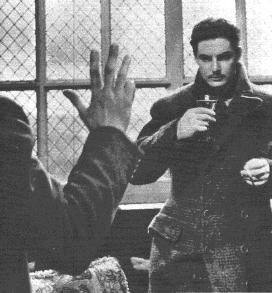
 This is a film classic that holds up rather well. John Buchan’s spy thriller, published in 1915, formed the template for hundreds of future stories. It certainly provided the formula that Hitchcock repeated in many of his films: an innocent man, ordinary enough, but cheerful, resourceful, and modestly brave, accidentally gets entangled in a complicated espionage scheme, gets framed for murder, goes on the run, and has to foil the spies to clear his name. The chase takes him across country, a pilgrim’s progress through a sequence of encounters with comical and sinister characters, and finds love along the way. Hitchcock made exactly the film again in Saboteurand North By Northwest. Robert Donat played this kind of hero to perfection, so charmingly that you forget the familiarity of the plot. Hitchcock moved the story up from 1915 to the time of filming, and made the hero, for some reason, a Canadian, but the formula works in any time or place.
(Hitchcock 1935) The 39 Steps
16106. (David Matas & Hon. David Kilgour) Bloody Harvest: Revised Report into Allegations of Organ Harvesting of Falun Gong Practitioners in China [report]
David Kilgour has been one of Canada’s longest serving Members of Parliament (27 years), as a Cabinet Minister, and as Secretary of State for Asia-Pacific Affairs. Few Members of Parliament are as widely respected. One journalist has written: “in the past 25 years, no Canadian could take this kind of moral time-test and pass with such flying colours as David Kilgour.” — and no Canadian politician comes even close to him as a consistent and principled advocate of human rights. He has published four books on varied subjects, ranging from Espionage to Canadian-American relations. David Matas is a lawyer and lecturer on constitutional law, international law, and civil liberties. He was in the Canadian Delegation to the Stockholm International Forum on the Holocaust, and since 1997 has been the Director of the International Centre for Human Rights & Democratic Development. Read more »
Jake and the Fundamentals
Jake Thomas (“Jake the Snake”) and the Fundamentals have been the dean of the local R & B scene in North Bay, Ontario. I have a tape, The Fundamentals Live at the Dive, from a performance I attended and enjoyed. But the band line-up does not correspond to the current version of the band. It has a fine rendition of “Summer in the City” and also of one my favourite John Hyatt songs “Where is the Next One Coming From?”
Wednesday, April 9, 2008 — Tibetan Freedom Movement: Beware of Slimy Fellow-travelers
It has been wonderful to see the public protests against the 1936 Berlin Olympics soon to be held in Beijing. For once, an instinctive revulsion against totalitarianism is driving a global movement of protest. But every legitimate protest movement attracts slimy elements, who seek to cash in on a human rights issue to cover up their anti-human-rights agenda. Both the Civil Rights movement and the Anti-War movements in the 1950s and 1960s were infiltrated by totalitarians, seeking to exploit a just cause for their own nefarious purposes. Read more »
Jimmy Cliff: Many Rivers To Cross
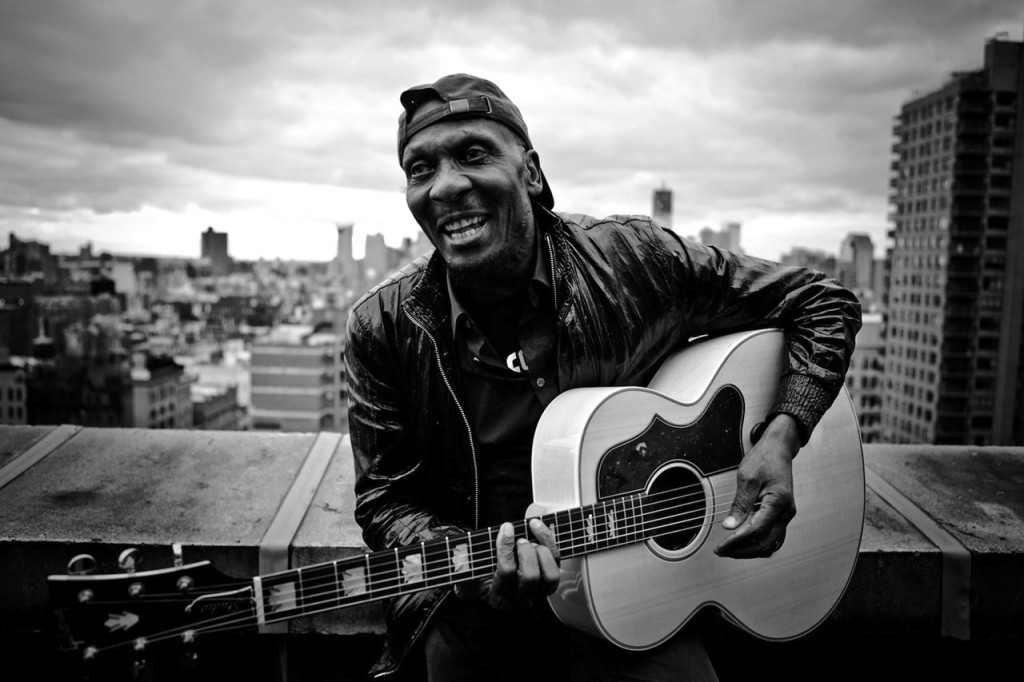 My old friend Peter Svilans gave me a cd collection of Jimmy Cliff. Cliff was my first taste of Reggae. His appearance in the 1972 Jamaican film The Harder They Come, still sticks in my mind. I saw it at a rep-house showing in Petaluma, California, with my friend Simon Agree. Cliff played the lead character, and some of his best songs were played on the soundtrack: “You Can Get It If You Really Want”, “Many Rivers To Cross”, “The Harder They Come”, “Sitting Here In Limbo”. The first two of those are in the Trojan CD collection, and twenty-three other songs of uniformly high quality. Jimmy Cliff was eventually eclipsed in the public mind by Bob Marley, and that man’s genius is undeniable. But Jimmy’s music had a jaunty, innocent charm to it, and he should not be neglected in anyone’s collection. In his day, Reggae was still Island music, a down-home kind of thing. Marley made it cosmopolitan, universal. But Cliff, too, sometimes touched universal chords. Who is there, who has ever had to trudge through the weary ups and downs of life, who won’t respond to “Many Rivers to Cross”, the kind of song best heard late at night, stranded in a donut shop on a highway you never planned to drive.
Wednesday, April 2, 2008 — Distinguishing Between Fake and Real Human Rights Issues
A friend of mine has been complaining about a much-publicized legal case, where a Sikh employee at a lumber yard is demanding that he be exempted from new safety laws, which require a hard helmet when working with lumber. There is no question of the employer using the law to further prejudice or racism. Sikhs are highly respected in the community. The employee has been there for years, and the company wanted to solve the problem by shifting him to an indoor position, where there would be no conflict. In the distant past, there have been several legal squabbles where it was obvious that regulations were being used to further intolerant agendas. However, there have been none of those kind of things, to my knowledge, for decades, and this certainly is not one. Is this a “human rights” issue, as many claim? No, it is not. Read more »
Zhao Li
I haven’t been able to find out anything biographical about Zhao Li, composer of at least five film soundtracks — not even a birth date. I’ve been listening to the soundtrack of Xiǎochéng zhī chūn[Springtime in a Small Town], an acclaimed 2002 film by Tian Zhuangzhuang. The songs are a bit sugary, rather like Burt Bacharach, and not to my taste, but I like the orchestral interludes.
15976. (Timothy Findley) Famous Last Words
This was Timothy Findley’s fourth novel, and it attempts to get into the morbid world of the celebrities and intellectuals who cosied up to the Nazis and the Italian Fascists. This was identical, psychologically, to the coterie of celebrities who cosied up to the Communists. It was a loathsome time, in which there were very few voices who spoke for anything good. Everyone was some kind of sleazy creep. Ezra Pound, the Duke and Duchess of Windsor, Harry Oakes, Rudolf Hess, and von Ribbentrop appear as characters, among others, all seen through the eyes of a fictional Hugh Selwyn Mauberley (the persona of some of Pound’s poems), whose frozen corpse is found in an Alpine hotel, with a testament scrawled in pencil on the walls of three rooms.It’s a good and intriguing read, but the absence of any character that one can feel any sympathy for left me feeling worn out by the end. But that has always been my response to the intellectual world between the two World Wars. Frankly, I don’t care about the fact that people like Ezra Pound of Bertolt Brecht were talented writers — they were disgusting little pieces of shit, and no amount of cleverness or artistry makes them admirable. The Nazi-Communist-Fascist mentality was the lowest ebb of the human mind, when geniuses degraded themselves into moronic savages. There is probably no way to write about it, or read about it, without feeling ill. We are still suffering the aftereffects of that intellectual holocaust.
(Benedek 1953) The Wild One
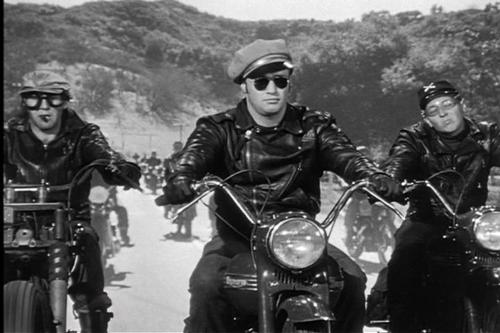 Marlon Brando’s performances were stunning in several fine films of the 1950’s (On The Waterfront, A Streetcar Named Desire, Julius Caesar). But some films just don’t travel well through time. Whatever it was that people saw in this film, widely regarded as a classic, has evaporated. Brando’s performance mesmerized audiences at the time, who seemed to see some kind of pulsating animal magnetism in it. But Brando was already getting pudgy, and the character now just seems to be a complete nitwit. You start laughing in the opening credits, as you see a motorcyle gang “riding” fake motorcycles in front of a projected backdrop. They’re about as menacing as the Brady Bunch. They terrorize a small California town with a reign of impoliteness. Brando has animal magnetism, alright — he looks like a chipmunk in a leather jacket. Whatever this film had then, it just doesn’t work anymore.
Image of the month: art of Hans Memling

Hans Memling: Advent and Triumph of Christ(1480) oil on wood 81 × 189 cm