
First-time listening for April, 2008
Posted by Phil Paine
on April 30, 2008
No comments
18441. (Jim Carroll) Praying Mantis
18442. (Perth County Conspiracy) Does Not Exist
18443. (Paul Joseph Lorieau & Edmonton Fans) “Oh Canada”
18444. (Paul Segarini) Edison Twins Theme
18445. (Michael Mitchell) “Canada Is…”
18446. (Blood, Sweat & Tears) “Spinning Wheel”
Read more »
READING – APRIL 2008
Posted by Phil Paine
on April 30, 2008
No comments
15976. (Timothy Findley) Famous Last Words
15977. (Richard E. Michod) Evolution of the Individual [article]
(W. H. Wills & Robert D. Leonard) The Ancient Southwestern Community ― Models and
. Methods for the Stury of Prehistoric Social Organization:
. . . . 15978. (W. H. Wills & Robert D. Leonard) Preface [preface]
. . . . 15979. (Ben A. Nelson) Approaches to Analyzing Prehistoric Community Dynamics
. . . . . . . . [article]
. . . . 15980. (Elizabeth A. Brandt) Egalitarianism, Hierarchy and Centralization in the
. . . . . . . . Pueblos [article]
. . . . 15981. (Dean J. Saitta) Class and Community in the Prehistoric Southwest [article]
. . . . 15982. (Katherine A. Spielman) Clustered Confederacies: Sociopolitical Organization
. . . . . . . . in the Protohistoric Rio Grande [article]
. . . . 15983. (Barbara J. Mills) Community Dynamics and Archaeological Dynamics: Some
. . . . . . . . Considerations of Middle-Range Theory [article] Read more »
Sunday, April 27, 2008 — Canadian Delusions of Global Glory: It’s Time to Wake Up and Grow Up
Posted by Phil Paine
on April 27, 2008
No comments
Those Canadians who imagine that Canada’s role in global politics is both important and successful need to have some of their balloons punctured.
Our politicians are constantly repeating to us how much the world admires us for our “peace keeping tradition”, and how important our international commitments are. The truth is that almost nobody outside of Canada has heard about them, and even fewer care. I once checked out a published history of U.N. peacekeeping. It contained no reference to the activities of any Canadian forces at all. Outside of Canada, I have never encountered any press or personal discussion by anyone about Canada’s supposedly famous peace-keeping activities, or of any Canadian military actions or commitments. Even in countries where we are, in fact, doing peacekeeping work, only the blue U.N. uniforms are recognized by the local belligerents, and they don’t care whether we are Canadians or Martians. Far from caring about what Canada does on the global military scene, few people outside of Canada know that we have an army at all. If we are fighting anywhere near Americans, it is taken for granted that we are Americans, or that, if we are not, the distinction is of no importance. I hate to break it to misty-eyed fans of our glorious military, but this is especially true in Afghanistan, where we are engaged in our largest military project since the Korean War. Read more »
(Linklater 2001) Waking Life
Posted by Phil Paine
on April 27, 2008
No comments
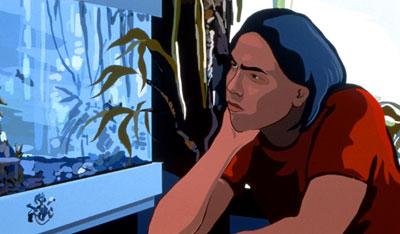
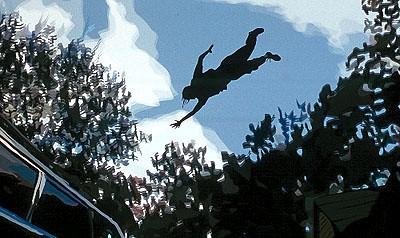 Richard Linklater’s Dazed and Confused(1993) has an enduring popularity. It was an ensemble piece, focusing on a dozen characters, all young, unknown actors at the time. Ben Affleck, among them, went on to a major film career. But whenever I discuss the film with anyone, they always fix on one performance, that of Wiley Wiggins, who played an amazingly likable character that saved the film from being too patly cynical. Linklater wisely employed Wiggins again to play the central character in Waking Life. This offbeat 2001 film employs a combination of rotoscope and computer animation. Rotoscoping is a technique that is usually annoying, but here it works perfectly to put across the idea of lucid dreaming. The story line involves a character who is trapped in a dream about being trapped in a dream, and suspicious that he is actually dead. He constantly encounters characters who lecture him on various conventional philosophical notions ― the standard repertoire of Existentialism, Postmodernism, etc, the kind of stuff that usually makes me cringe. But the warmth of Wiggins’ personality (his character is never named) makes it all work, and the animation’s shifting styles and visual jokes are perfect for portraying dream states. Some of the segments are quite beautiful.
16140. (Marc Bekoff) The Emotional Lives of Animals
Posted by Phil Paine
on April 23, 2008
No comments
Both compact and comprehensive, this is the first book you should read to enter into the interesting science of cognitive ethology. Bekoff summarizes the reductionist strictures that ethologists had to confront when the field began to form, and intelligently discusses the moral and social implications of the science. The book, in effect, provides a case study of the cult of “scientism”, which often infected science in the twentieth century. This occurred when fake poses of objectivity, spurious quantification, and epistemological confusion led to nonsensical, but irritatingly tenacious orthodoxies.
(Nathaniel Hawthorne) The Celestial Railroad and Other Stories
Posted by Phil Paine
on April 22, 2008
No comments
Hawthorne’s allegorical short stories were, in some ways, the ancestors of some of the grimmer Twilight Zone episodes. This collection includes stories written between 1832 and 1851, and includes the most famous ones, “Young Goodman Brown” , “Ethan Brand”, “Rappaccini’s Daughter”, and “Dr. Heidegger’s Experiment”. All fine stories, but the one that tickled my fancy was the less well known “The Maypole of Merry Mount”. It’s a sort of 1836 version of The Wicker Man, except that the Puritans, not the Pagans, triumph. It is all the more interesting because Hawthorne seems to have been well aware of things that would not be part of common knowledge until James Frazer published The Golden Bough. Read more »
Wednesday, April 16, 2008 — Who Wrote Don Giovanni?
Posted by Phil Paine
on April 16, 2008
No comments
There is a consistent pattern, among those who describe societies and economies, past and present, to reverse cause and effect in significant events. I would like to dub this the Emperor Josef Wrote Don Giovanni Syndrome. This is the tendency to shift attention from those who create to those who rule, sometimes bluntly, sometimes subtly, until one has the vague impression that those who rule are the ones who create.
This, of course, begins at the crudest level when historians casually assert that something that happened to come into existence during the reign of a king, or an emperor, or a pharaoh was “made” by them or “built” by them. The historian may retreat to the excuse that this is a conventional form, understood by all to mean its opposite, but this leaves unexplained why there should be any need to have a formulaic phrasing so misleading and perverse. In fact, it is usually easy enough to tell from the context that the author does not really contradict or qualify, in his mind, the conventional phrase, and really does believe that a ruler is the creative force, in every sense, behind whatever admirable achievements happen to be known from his reign. The more distant the events are in time, the more this prevails. No historian can get away with claiming that the Emperor Joseph II was the composer of Don Giovanni, but that is because the events are recent, and approaching the time when composers were beginning to be be perceived as important people. However, those who know Mozart know that it was a close call. He was a celebrity as a child, because of his precocity, but anyone who understands the era knows that the aristocracy of the Austro-Hungarian empire thought of him as nothing more important than a servant, and when he left their brief attention span, he died in poverty. His body vanished into an anonymous pauper’s grave. If his reputation had not been relentlessly championed by musicians who knew him, his named would have been forgotten. Read more »
Sibelius’ Kullervo, Op.7
Posted by Phil Paine
on April 15, 2008
No comments
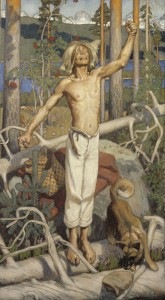
Kullervo is the darkest character in the Kalevala, the epic of Finnish mythology that had a profound effect on me in childhood. His story is told in runos31 through 36 of the epic. Enslaved and abused as a child, Kullervo’s life is dominated by the quest for revenge, which leads him to commit horrifying crimes, including the rape of his own sister. The most striking part of the story is his death, where he asks his sword if he should kill himself, and the sword bursts into song:
 “Mieks’en söisi mielelläni,
söisi syylistä lihoa,
viallista verta joisi?
Syön lihoa syyttömänki,
juon verta viattomanki.”
“Why, if I desire it,
should I not kill you,
swallow up your wicked blood?
I have consumed innocent flesh,
and swallowed up guiltless blood.”
This little sequence was borrowed by Poul Anderson in The Broken Sword, and by Michael Moorcock in one of his Elrictales. Väinämöinen, the wise central character of the Kalevala, remarks that Kullervo’s fate proves that children should never be mistreated, since an abused child will grow up without wisdom or honour. Read more »
Monday, April 14, 2008 — Jeune Afrique 8 avril 2008 AFP: Les députés modifient la Constitution pour juger Hissène Habré — A Personal Ghost Comes Back in a Brief News Report
Posted by Phil Paine
on April 14, 2008
No comments
It seems that a relentless treadmill of events forces me to write, in this blog, about nothing but dictators, famines, and wars. For those of you who are tired of it, let me confess that I am, too. I wanted to devote a new entry to one of my real passions ― landscape, music, reading, nature, erotic pleasure, the exquisite freedom of the road. But an article forwarded to me unleashed a flood of memory and opened up private boxes that I’ve generally kept shut. And it was about a dictator. Now, I write a lot about dictators, and the observant among you will notice that I don’t much like them. But, in most cases, this is the result of studying history. Dictators are people I’ve mostly encountered in books. But there is one exception. There is a dictator with whom my relationship is more concrete, and has nothing to do with books. He is one of the “small-fry”. His crimes are monstrous, but his numerous victims were people the world cared nothing about. The slaugther and horror took place right next door to the current slaughter in Darfur, and was on the same scale, but in those pre-internet days it might as well have taken place in another solar system. The man I’m talking about is Hissène Habré.
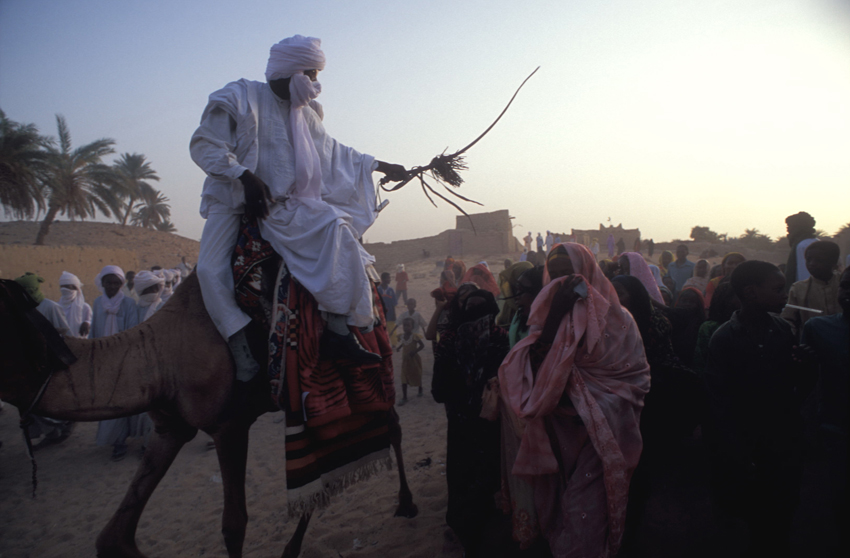
A mounted Dazaga (Gourane).… not quite a match for the more remote (and seldom photographed) Teda.