
 The 1994–1996 television movies based on Ellis Peters’ medieval murder mysteries are very well done. The production values are modest, but do their job. What makes it all work is the acting skill of Derek Jacobi, who becomes the character so thoroughly that that when I read one of the novels I couldn’t help but hear his voice and see his face. He has created one of the most likable characters on television. Monk’s Hoodhas all the elements that Ellis Peters likes to play with: the interplay of local and kingdom politics, the ambiguity of the Church being both inside and outside the society, the no-man’s-land between the Welsh and English, and, of course, flowers and herbs. The monk’s hood, by the way is a particularly pretty flower.
Cadfael: Monk’s Hood
14611. (Michael Friscolnati) Friendly Fire ― The Untold Story of the U. S. Bombing That Killed Four Canadian Soldiers in Afghanistan
This incident, probably little known to the public in the U.S., was a big issue in Canada. Canadians, on the whole, approve of having a military presence in Afghanistan, and of fighting against the Taliban. The Canadian armed forces were eager to get into a clear-cut combat situation, after decades of nerve-wracking peacekeeping missions where they faced constant danger, but couldn’t go on the offensive. The issue of fighting under U. S. or British direction, however, has always been a touchy one for Canadians. Nevertheless, there was a huge popular backing at home for a Canadian presence in Afghanistan, which is still felt, despite this incident. The bulk of the Canadian public sees this as an absolutely distinct issue from Iraq: the war against Osama and the Taliban is war against terrorism, while the war in Iraq is a disgusting swindle by a lying, traitorous George Bush regime and international oil cartels, which Canadians never wanted any part of. Read more »
14606. (Edmonstoune Duncan –ed.) Lyrics from the Old Song Books
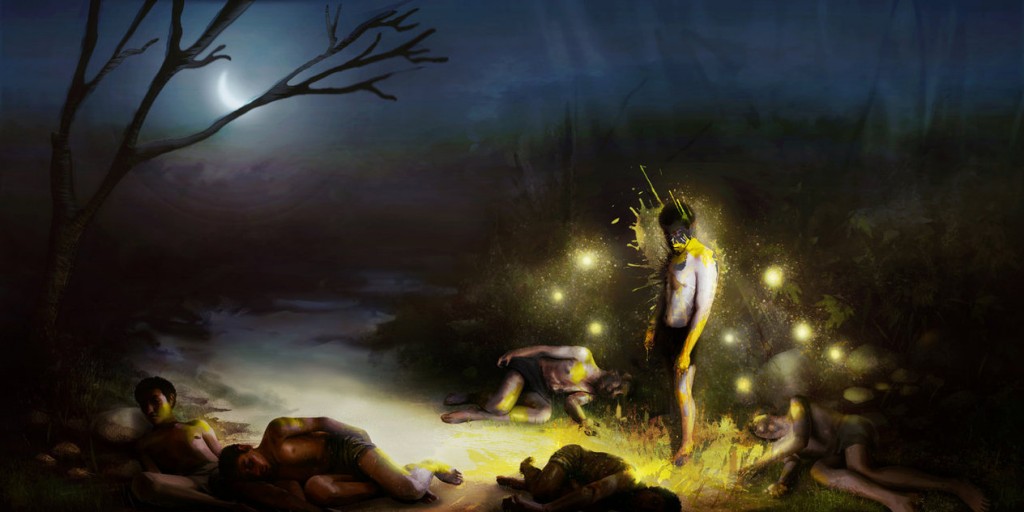
Golden Slumbersby Narasura of Kashi
This is an anthology of song lyrics ranging from medieval times to the middle of the nineteenth century. It was published by Routledge in a sturdy little blue binding in 1927. Sometimes you come upon a book which is a pleasure to read because of its contents, and almost as much because the physical feeling of the book itself gives pleasure. This one was a delightful find in at a Goodwill store. Even the editor’s name is charming… I don’t think I’ve ever come across the name “Edmonstoune”.
The first song is, of course, “Sumer is icumen in”, the oldest English song for which we have a certain melody. This version dates from about 1250, but the song must have been old even then, and it’s earthy, pagan images make it feel like it echoed off the lintels of Stonehenge.
Groweth sed, and bloweth med
And springeth the wude nu
Sing cuccu!
The bulk of the songs in the book are from the Tudor era. Lots of nightingales and fa-la-las. Many are credited to Elizabethan dramatists, including Shakespeare, who certainly liked a good pop song and stuffed many of them into his plays. Poets were still of this earth, and living among us, rather than pursuing the abstruse goals they have for the last century. They properly expected their verses to be bellowed by drunks staggering out of taverns, stuttered by nervous teenagers trying to get laid, and sweetly sung by women hanging out the wash. But it’s the anonymous, straight-from-the-pubs-and-the-fields songs that have the strongest impact:
One time I gave thee a paper of pins
Another time a tawdry lace
And if thou wilt not grant me love
In truth I die before thy face.
Wherefore, cease, make no delay
And if you’ll love me, love me now
Or else I seek some other way
For I cannot come every day to woo.
In Elizabethan England, love obsessed even the humblest, and it struck like lightning:
I did but see her passing by
And yet I love her till I die.
The songs before the English Civil War are almost all about love, in a background of nature. Religion creeps in with the Puritans, and War comes with it. Love songs never vanish, but by the 18 th century they compete with political satire, patriotism, war songs, and cynical observations on social climbing and greed. The Elizabethans were certainly no less violent than their successors, but they apparently did not feel a need to sing about it.
Domestic love figures as strongly as the pursuit of poontang. Some of the sweetest of the songs are lullabies. Here is one credited to Thomas Dekker, one of Shakespeare’s competitors ― which you will almost certainly have heard without knowing it:
Golden slumbers, kiss your eye
Smiles awake you when you rise
Sleep, pretty wantons, do not cry
― And I will sing a lullaby.
It is, of course, sung near the end of the Beatles’ Abbey Road. . The Liverpool Boys not only knew a good thing when they saw it, but they themselves were far more the legitimate heirs of Shakespeare’s tongue than most prize-winning poets.
I will no doubt be dipping into this book for years.
Image of the month: Afternoon Sun, Lake Superior

Lawren Harris’ 1924 paintingAfternoon Sun, Lake Superior