The word “socialism” is used to mean virtually anything imaginable, but if it means anything at all intelligible, it is “control of productive enterprise by the state”. More exactly, it means that the people who control production and the people who control the state are the same people. Most states in human history have been predominantly socialist. In most pre-modern societies, the state had direct control of production. Peasants worked land owned by an aristocracy, and that aristocracy constituted state power. Industries were owned by the king or relatives of the king, by barons, by the Church, or by corporate bodies, all of which exercised the authority of the state. Read more »
Category Archives: A - BLOG - Page 39
Monday, October 27, 2008 — Sense and Nonsense About “Socialism”
Posted by Phil Paine
on October 27, 2008
No comments
Tuesday, October 14, 2008 — The Notorious Overhead Projector
Posted by Phil Paine
on October 14, 2008
No comments
Ever wonder about that “three million dollar earmark for an overhead projector” that is such an important talking point in John McCain’s election campaign? According to an article in this week’s Science News, it turns out that the “overhead projector” is the Zeis star projector in the venerable Adler Planetarium in Chicago. Like the other two major American planetariums in New York and Los Angeles, the Adler must replace its fifty-year old instrument, which the original German manufacturer will no longer service. As with the other two, the request for federal funding is routine, and no politician would dream of voting against it. The three planetariums teach the fundamentals of astronomy to millions of urban school children who have never seen a clear night star-filled sky, and are basic amenities of major cities. The cost of a few million dollars amortized over half a century is trivial. No politician in any of the three states involved would have voted otherwise. Could anything better demonstrate the dishonesty and the mind-boggling ignorance of the McCain campaign?
SEVENTH MEDITATION ON DEMOCRACY (written October 1, 2008)
Posted by Phil Paine
on October 1, 2008
No comments
A few days ago, I was in the subway, and I overheard a conversation about our current national election. Two boys who, from their appearance, could have been no further along in school than grade nine or ten, were discussing the televised debates between the leaders of the five major political parties. What struck me, as I listened in, was that the discussion was cogent and intelligent. One of the boys, who seemed the youngest, was particularly articulate, and his opinions were not the simple parroting of some adult he had heard, or the pursuit of a party line. In fact, his analysis of the debate showed keener observation and judgment than that of the professional commentators who dissected the debate after the broadcast.
Read more »

Tuesday, Sept 16, 2008 — More On Terms Misused
Posted by Phil Paine
on September 16, 2008
No comments
“Laissez-faire” is one of many terms that are consistently misunderstood, misused, and distorted.
The term originated in 17th century France. Under the rule of Louis XIV, France had a centralized, state-managed economy. Virtually all key economic decisions were in the hands of Louis’ intendant (“manager” is a better translation than “minister”), Jean-Baptiste Colbert. Colbert directed the country’s industries with absolute authority, punishing the disobedient with brutal sanctions. He suppressed what little labour organization there was. He encouraged the creation of giant corporations, and he gave out military contracts, monopolies, subsidies and privileges to those he liked. The corporations grew fat on the proceeds of Louis’ incessant wars. France was a sort of Haliburton’s Heaven. As a consequence, after a brief boom created by the initial concentration of capital, France’s technology and economy stagnated, the gap between rich and poor widened, and those at the bottom starved, just as it has transpired in all such dirigiste regimes. Read more »
Monday, September 15, 2008 — Of Oil and Elections
Posted by Phil Paine
on September 15, 2008
No comments
If one examines closely the speech that Stephen Harper gave to an American conservative think-tank, before he became our Prime Minister [1], one is struck immediately by this: our Prime Minister hates Canada and despises Canadians. We are, in his own words “a second-rate country”[2]. In statement after statement, Mr. Harper made it clear that his only loyalty is to the rich and powerful in other countries, and not to Canada or Canadians. For most of his life, the Rich and Powerful lived in the United States, and that is where his spirit has hovered. The United States that he worships, with the most abject and slavish servility, is not, of course, the real United States, the one embodied in the Declaration of Independence, or in its two centuries of struggle for freedom and justice. No, what Mr. Harper worships is the current, King George’s version of the United States, the one that has been betrayed, degraded, debauched and bankrupted by a generation of Conservative treason. Read more »
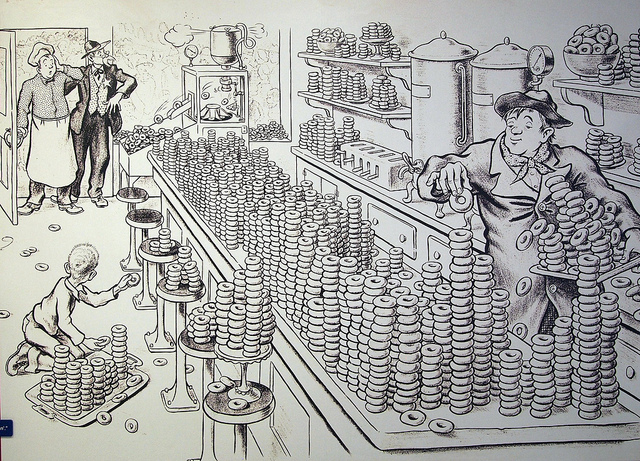
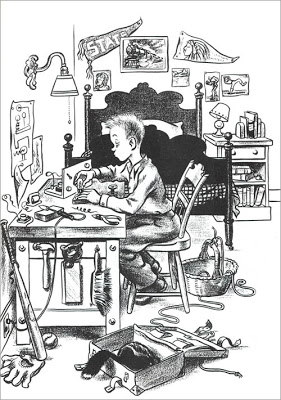
16397. (Robert McCloskey) Homer Price
Posted by Phil Paine
on August 11, 2008
No comments
 This was one of the “children’s classics”, written in 1943, that I had glanced at as a child, but never actually read. A pity. McCloskey was a gentle humorist with a charming style and great human empathy, who chose to write for children rather than, say, subscribers to the New Yorker. He was also a talented artist, in a style reminiscent of Ernie Pyle. The world he writes about now seems so far away that a contemporary child might have some problems interpreting it. It would seem exotic, rather than comfortingly familiar. But if you are an adult with any feeling for North American social history, the child-viewpoint stories about pet skunks, donut machines, and giant balls of string will be fascinating.
Monday, August 4, 2008 — Still Time To Do What’s Right
Posted by Phil Paine
on August 4, 2008
No comments
I admire athletic talent and consider many Olympic events to be important expressions of human achievement. For that reason, I oppose the Olympic organization and the people who run it, especially when they conspire to hold their spectacles in lands without freedom or democracy, an act which underlines their contempt for the human race. The Olympics debase and corrupt athletics. The Olympics are in their essence about money, power, and exploitation. The current Olympics in Beijing are the worst to date. Their only purpose is to put the world’s stamp of approval on the Communist Party’s imperial conquests and assaults on human rights. They are being held to glorify and legitimize slavery, imperialism, and genocide.
Read more »