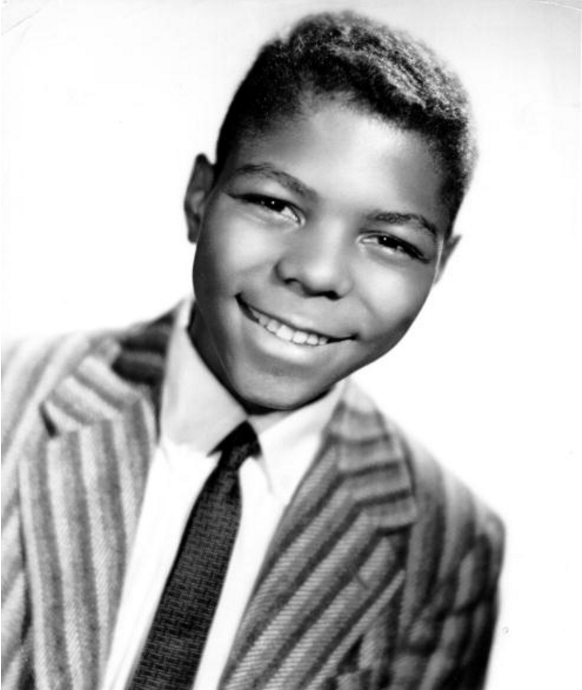
The amazingly talented Frankie Lymon. Frankie Lymon & The Teenagers scored a huge hit in 1956 with “Why Do Fools Fall In Love?”, but Lymon had perfected the song and its fantastic dance number two years before, when he was twelve years old.
The amazingly talented Frankie Lymon. Frankie Lymon & The Teenagers scored a huge hit in 1956 with “Why Do Fools Fall In Love?”, but Lymon had perfected the song and its fantastic dance number two years before, when he was twelve years old.
Pakistani dictator Pervez Musharraf revealed, in an interview with the CBC (Canadian Broadcasting Corp.) exactly how the leadership of the Grand Alliance Against Terrorism sees Canada’s role. With some insultingly snide put-downs, he dismissed any concern in Canada about casualties in Afghanistan as cry-baby weakness. Read more »
Soraj Honglaradom, at the Philosophy department of the University of Chulalongkorn University, Bangkok, has graciously allowed me to quote his e‑mail concerning the coup in Thailand:
The coup d’etat was perpetrated by a group of officers who are disatisfied with the Prime Minister Thaksin Shinawatra, who has generated such an intense amount of controversies in Thailand as has never been experienced before. The transition process is going on smoothly and there is no violence. At the time of writing this mail, everything appears calm. The “Reform Group for Democracy under Monarchy”, as the group calls itself, has declared today (Sept.20) to be a holiday and so I am writing this from home. Many people that I know actually welcome the event, as they are fed up with the regime of the Prime Minister. From my past experiences with previous Thai coups, what will happen next is probably that the Reform Group will name an interim Prime Minister. A new charter will be drafted (the much vaunted Constitution of 1997 lasted only nine years), and finally a general election will be called. No one knows exactly when this will happen, but my guess is that we will expect a general election within a year. This is only my guess: things have a way of unravelling themselves in unexpected ways.
Mr. Saroj’s comment rings true to me. It seems to fit the other reports I’ve gotten. Read more »
A delightful Danish saying, told me by my friend Joan Jacobsen: “Du kan vænne dig til alt, undtagen sult…når først du har vænnet dig til det, dør du af det.” [You can get used to anything except hunger …Once you’re used to it, it kills you.]
Jason Hunter, who visited for almost a week, left this morning. He headed back up north, where he will undertake a vision quest. He will fast for four days in preparation. It will be interesting to see how it affects him. He was good company while he was here. Fortunately, it was possible for him to take the train part of the way. Even the ten-hour journey on Ontario Northland Railway’s Northlander will take him only half of the way home, but it will be much more pleasant than taking buses or hitching rides. The final half, of course, must be done by airplane.
The media, at least here in Canada, have been taken completely by surprise by recent events in Thailand. A faction of the Thai military says it has overthrown Prime Minister Thaksin Shinawatra. Presumably, a long sequence of important events led up to this, but none of them attracted the attention of journalists in North America. It might be wise for people here to pay a bit more attention. At place of concentrating on dubious and implausible attempts to bring democracy to places like Afghanistan, we should be more concerned about its precarious position in relatively important places like Thailand. For Thailand is an important country, with tremendous economic potential. It is unique in the region in that it never suffered the experience of colonialism, though it has had to dance nimbly between the pressures brought to bear on it by Britain and France (which had colonies on either side of it), by Japan, America, and China.
Under Thaksin, Thailand seems to have had a thin veneer of democratic process, under which steamed a cauldron of corruption, manoeuvering by the military, and factional disputes. It is not clear to me exactly who wants this sudden military coup, and who opposes it. I simply don’t know enough to have an opinion about Thaksin and his policies. To tell the truth, I’m embarrassed that I know next to nothing about this important country’s politics. Thailand is the kind of country that should be able to find its inner strengths, and establish a working democracy. There is no scarring legacy of colonialism, it is full of enterprising and well-educated people, it has a vigorous cultural life, it has not been torn up by war. But it doesn’t seem to be able to make things work. I’m hoping that some Thai correspondents will give me some insights into this perplexing situation.
I’m enjoying a visitor from my old stomping ground, Peawanuck. You will have to look hard for it on a map — it’s an isolated Weenusk First Nation community of only a little more than a hundred inhabitants, and cannot be reached by any road. It’s about thirty km up the Winisk River from the shores of Hudson’s Bay, and is surrounded on all sides by the 23,552 square km of Polar Bear Provincial Park (the name of which is somewhat misleading… it has no visitor facilities, is reachable only by air, and special permission is required before visiting it). But this little town has a special place in my heart, and I am delighted to give hospitality to anyone who hails from there.
My guest is Jason Hunter, a musician and film-maker. I’ve had to work much of the time he was here, and he had his own affairs to attend to, but we did find time to explore nearby Don Valley together. The trip held a surprise. I took Jason through several wooded ravines, then to an abandoned brick pit, now flooded and filled with ponds, marshes, ducks and turtles, and a “sacred spot” with a wonderful view of the city. Near that, there is a large abandoned factory, in ruinous condition. It is boarded up and protected by chain-link fences, but that is nothing to enterprising trespassers. We were soon inside, walking among the immense brick ovens, illuminated by shafts of light from the decaying and damaged roof. But we were not alone. We heard the noises of some other intruders. So climbed up to the rusting catwalks that criss-crossed the ovens. The other people were a camera crew, preparing an elaborate photo shoot. The model was a tall woman, posing entirely naked, except for a fantastic bird head-dress and a trailing cape. It was in imitation of a symbolist painting that I recognized, but could not name. Sensing that our ogling was impolite, we retreated to other parts of the ruined factory, finding a way up onto the roof. I had told Jason there were all sorts of odd things to find in the Don Valley.
Puzzled by the blog title? Peawanuck means “flintstone” in Cree.
The Pope has just denounced Canada for its popular and political support for gay marriage. Canada has, throughout its history, been a country with a Catholic majority, at least in theory. But, in fact, the practice of “private religion” — the search for some personal philosophy independent of any organized sect or authority — is what actually predominates in Canada, as well as an ingrained belief that churches should stay out of politics. This has long been a significant cultural difference between Canada and the United States. Most Canadians would not likely know the religious affiliation of any of their politicians, and would not think it of any interest. Canada’s former Prime Minister, Paul Martin, who is a practicing Catholic, remarked today that the Pope’s opinion did not in the least affect him. “It’s the job of the courts to apply the Charter of Rights, and it was my job as Prime Minister to see that those rights were respected.” Read more »
Another “friendly fire” incident occurred in Afghanistan, where two US A‑10 Thunderbolts straffed a Canadian Forces base camp. Five Canadian soldiers were severely wounded, and one killed. The dead soldier, Mark Graham, was a widely liked Olympic track star. This followed closely on four Canadian combat deaths over the weekend. Combat deaths are to be expected, but yet another “friendly fire” debacle involving poorly-commanded American forces killing Canadian troops is re-enforcing doubts the Canadian public has about our “mission” in Afghanistan. All the more because Stephen Harper’s Conservative government has made it obvious that Canadian forces are increasingly deployed as mere mercenary forces for George W. Bush. As far as Harper is concerned, there is no Canadian foreign policy. There is only George W. Bush’s policy. However, the Canadian people seem to have another notion, that the Canadian military is intended to defend Canada and the interests of the Canadian people, and to engage in combat on foreign soil only when the moral issues are clear and unequivocal. Read more »
 If you want to know the difference between a free country and a collectivist, sovietized society, where the State directs, manipulates and socially engineers the life of the individual, then one has only to walk into a drugstore in Canada and then into one in the United States. In any Canadian drugstore, any woman can purchase Plan B, the “morning after pill”, without prescription or harassment, as is her right. In the United States, this is not the case. There, the State rules over the most private domain of the individual. As in Communist China, Americans suffer a government which considers their bodies the property of the State. Their most intimate personal choices do not belong to them, but to an all-powerful collectivism, to the Leviathan. It makes me profoundly grateful that I live in a significantly freer, more individualist society, where, as one Canadian Prime Minister once proclaimed, “The State has no place in the bedrooms of the nation.”
There are many things of which I disapprove in my own country, and Lord knows there are plenty of stupid things that happen here. But, at least we are not reduced to such pathetic serfdom that we surrender our sexual organs to the tyranny of squalid bureaucrats and a Supreme Soviet on Pennsylvania Avenue.