William Tenn was one of Science Fiction’s sharpest satirists in the fifties and sixties. His short stories bit like blackflies. Of Men and Monsters was one of his only two novels, and it was expanded from a short story. It shows it, as the core story is still visible, and the end shows a distinct falling off in quality, with the satire disappearing so that there can be a conventional, plot-driven resolution. But never mind that. SF writers in that period had no social prestige, and very modest incomes; it was standard practice to inflate any successful short story into a “novel” that might pay the rent. But Tenn’s talent lay in beautiful, self-contained miniatures that did not lend themselves to expansion. Read more »
Category Archives: B - READING - Page 24
Sunday, March 14, 2010 — A Lay of Ancient Toronto, Part 1
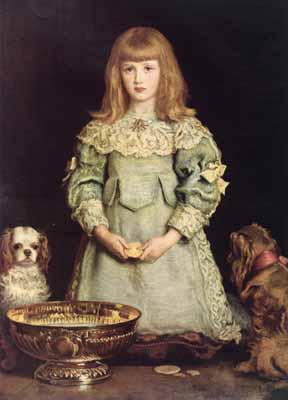
Steve Muhlberger has been more prolific in his blog, lately, and it has featured some fine pieces on the psychology of historians. Entries such as “Is the past another country?” among many, are well worth reading. I’m reminded of them when I re-shelve a nice little book that I recently found in a second-hand shop ― an 1882 edition of Macaulay’s Lays of Ancient Rome. It’s just the sort of thing that delights anyone who is fascinated by the past. It’s inscribed twice by early owners. The first inscription reads: “Dorothea Thorpe, from Hughey Jnr., March 20, 1884″ The second reads: “Lavinia Mary Ford, from Dorothea’s Husband and in memory of her. Charnwood 18th October 1934, St. Luke’s Day”. These excite the historical imagination in me. Read more »
The Beggar’s Opera
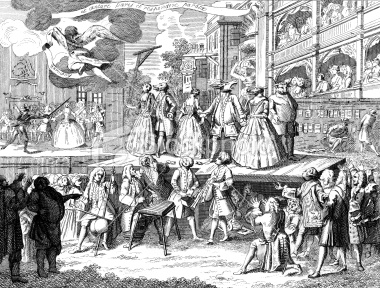
The Beggar’s Opera is a pointed example of unpretentious popular art long outliving the “serious” works of its day. In 1728, a rather unsuccessful English poet, John Gay, penned a satire of the upper class’s taste for Italian Opera, as well as the establishment politics of the day (then personified in First Lord of the Treasury, Robert Walpole). Using a kleptomaniac collection of Scottish and French folk-tunes, Gay conceived a fast-moving, tight-knit plot involving, instead of the usual operatic cast of Classical heroes and deities, the whores and thieves of the London slums. Read more »
READING – FEBRUARY 2010
18576. (Steve Muhlberger) [in blog Muhlberger’s Early History] Population Crash in Europe?
.… . [article]
18577. (Steve Muhlberger) [in blog Muhlberger’s Early History] The Chronicle of the Good
.… . Duke and “Modern Times” [article]
Read more »
William Bolcom’s Songs of Innocence and Songs of Experience
Musicians have long been attracted to William Blake’s interconnected poems known as the Songs of Innocence and of Experience. Allen Ginsberg has asserted that a study of the rhyme and meter of the poems reveals that Blake intended them to be sung. They certainly have the feeling of English tavern ballads strangely mutated into moral and metaphysical meditations. This mixture of serious purpose and popular form is exactly the stuff that best suits American composer William Bolcom. Read more »
READING — JANUARY 2010
18426. [3] (Elias Lönnrot) The Kalevala: Epic of the Finnish People [translated by Eino Friberg ;
. . . . . editing and introduction by George C. Schoolfield; illustrated by Björn Landström]
. . . . . [read previously in Kirby (1) and Bosley (2) translations]
18427. [2] (F. R. Kreutzwald) Kalevipoeg: An Ancient Estonian Tale compiled by Fr.R. Kreutzwald ;
. . . . . translation with notes and afterword by Jüri Kurman Read more »
18586. [3] (Edgar Pangborn) Davy
A most pleasurable third reading of an old favourite of mine. Edgar Pangborn’s gentle and humane novels had a tremendous influence on me. The book that really hit the mark was A Mirror For Observers, but the Davy stories were almost as good. This novel introduces the character at the age of fourteen, but hops back and forth in time. The background is post-apocalyptic, with the human population of upstate New York and New England reduced to an early Medieval level of technology and the Huly Murcan Church providing what little social cohesion exists. But this is not a remake of Miller’s A Canticle For Leibowitz. Pangborn saw organized religion as more of a repressive and regressive force than Miller did. Nothing rings false in Pangborn’s imagined world. The young Davy is a randy little ragamuffin, and his picaresque progress is more along the line of Fielding than Bunyan. But unlike most picaresque writers, Pangborn never placed sex in opposition to love, or to morality. Rather, he understood that sex stands at the heart of morality. Spider Robinson has remarked that “Edgar Pangborn said again and again in his books that love is not a condition or an event or even a state of mind — that love is a country, which we are sometimes privileged to visit.”
18426. [3] (Elias Lönnrot) The Kalevala: Epic of the Finnish People; 18427. [2] (F. R. Kreutzwald) Kalevipoeg: An Ancient Estonian Tale
As my December reading has concentrated on the related subjects of shamanism, Finno-Ugric linguistics and folklore, it’s appropriate for me to start off the year by re-reading the Kalevala and the Kalevipoeg. The Finnish Kalevala has been a constant, haunting presence with me for most of my life, but the less well known Estonian Kalevipoeg is something I’ve gotten into more recently. Read more »
Sibelius’ Kullervo
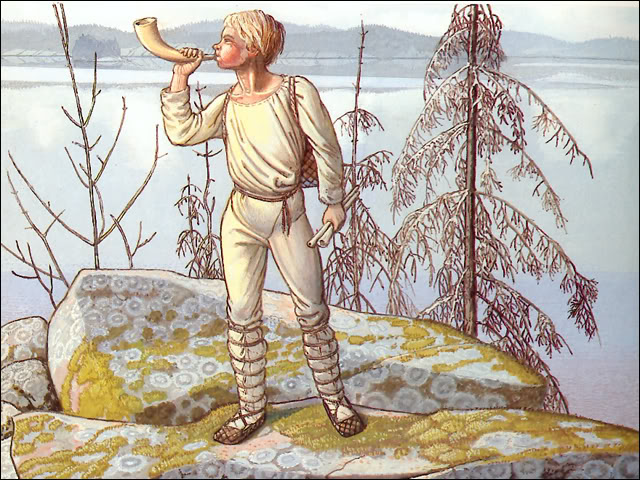 As I’m beginning the year with a re-reading of the Kalevala, the Finnish mythological epic that has haunted me since childhood, it’s logical for me to begin the year’s musical listening with Sibelius’ largest scale work based on it, the spectacular unified sequence of tone poems about the Kalevala hero Kullervo. I have two recordings of Kullervo, Symphonic Poem for Soprano, Baritone, Chorus and Orchestra, Op.7: Jorma Panula conducting the Turku Philharmonic Orchestra, and Paavo Berglund directing the Helsinki Symphony Orchestra. They’re both fine, but I prefer the Berglund. Eeva-Liisa Saarinen’s soprano in it is superb.
Read more »
READING — DECEMBER 2009
18261. (Émile Souvestre) The World As It Shall Be [Le Monde tel qu’il sera; 1846;
. . . . . tr. Margaret Clarke]
18262. (Neal Ascherson) Stone Voices: The Search for Scotland
18263. (Nicolas-Edme Restif de la Bretonne) La découverte australe, Vol.2 [1781] Read more »