This is a well-written mystery novel, with a very lean prose style and direct, sequential plotting. Murder and mayhem in a Viennese military academy, 1903. Detectives improbably using psychoanalytic techniques to solve the mystery, but, hey, that’s the conceit of the tale. Music everywhere, pastries, waltzes, and absynthe bubbling on the spoon. Tallis’ insertion of piquant historical details is carefully calculated to please the reader — never too much at a time, never too didactic. The decaying polyglot Austro-Hungarian Empire is the perfect background for the thriller and murder mystery writer, especially with our retrospective fascination with its sexual and psychopathelogical obsessions. Even old Kraft-Ebbing turns up in a toast.
Category Archives: B - READING - Page 27
READING — APRIL 2009
17371. (Alexander Mackenzie) Voyages from Montreal on the River St. Laurence through the
. . . . . Continent of North America to the Frozen and Pacific Oceans In the Years 1789
. . . . . and 1793 with a Preliminary Account of the Rise, Progress, and Present State
. . . . . of The Fur Trade of That Country
17372. (Arthur Conan Doyle) The Final Problem [story]
(Christopher S. Beekman & William W. Baden –ed.) Nonlinear Models for Archaeology and
. Anthropology ― Continuing the Revolution:
Read more »
17394. (Jack W. Brink) Imagining Head-Smashed-In ― Aboriginal Buffalo Hunting on the Northern Plains
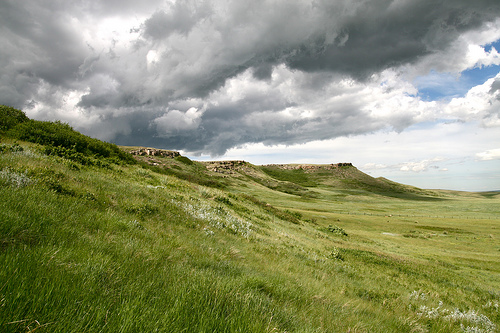
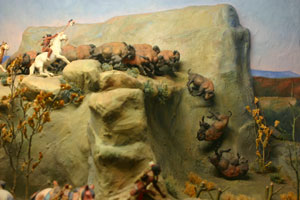 The Province of Alberta has two superb museums associated with outdoor sites. One, of course, is the famed Tyrell Museum of Paleontology. The other is Head-Smashed-In Buffalo Jump, declared a World Heritage Site by UNESCO in 1981, with its Interpretive Centre. For a period of five thousand years, native peoples of the region drove herds of buffalo over this cliff. The beasts were driven and herded to their deaths with aid of a complex system of cairns, fences, and corrals, and organized team-work. The bodies were butchered and processed into pemmican (a spoilage-resistant concentrated food) and hundreds of other products, which were traded across the region. It was virtually an industrial-scale enterprise. Head-Smashed-In was only one of many such sites in the region, but it is the one most thoroughly investigated. Read more »
Monday, April 2, 2009 — Maps, Snake Mounds, Buffalo, Mackenzie ― A Personal Reflection
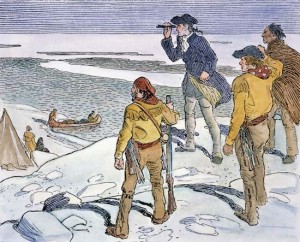 Before I could even read and write, I drew maps. The desire to create a visual model of my physical environment seems to have been built into me. Throughout childhood, I drew maps of the nearby forests, carefully pacing out trails in order to reproduce their proportions correctly, and marking down swamps, cliffs, and glacial boulders. When I became aware of the existence of published maps and atlases, I pored over them with the enthusiasm that other kids had for hockey cards and comics.
I was not, however, destined to be an “armchair traveler”. Maps, for me, were ― and remain ― an expression of an impatient restlessness that is the signature of my temperament. Wanderlust. Itchy feet. A chronic chafing against any confinement or restraint. It’s not surprising that my intellectual interests combined geography and history with the philosophical issues of freedom and slavery. Read more »
READING MARCH 2009
17244. (Arthur Conan Doyle) The Adventure of the Speckled Band [story]
17245. (Henry C. Clark) Compass of Society: Commerce and Absolutism in Old-Regime France
17246. (Graham Watson) The Reification of Ethnicity and Its Political Consequences in the North
. . . . . [article]
17247. [2] (Verne Dusenberry) Waiting for a Day that Never Comes: The Dispossessed Métis of
. . . . . Montana [article]
17248. (Peter Armitage & John C. Kennedy) Redbaiting and Racism on Our Frontier: Military
. . . . . Expansion in Labrador and Quebec [article] Read more »
17258. (Sattareh Farman Farmaian & Dona Munker) Daughter of Persia: A Woman’s Journey From Her Father’s Harem Through the Islamic Revolution
This autobiography written (with some assistance) by an upper-class Iranian woman is both a profoundly moving personal document and a perfect introduction to the history of Iran in the 20th century. Born in the harem of a member of the Qajar nobility, Sattareh Farman Farmian lived through the dissolution of the old Kingdom, the reigns of the two Pahlevi Shahs (the first, a soldier randomly chosen and installed by the British, the second, installed by the CIA), and finally through the first stages of the Revolution of the Ayatollahs. Read more »
17245. (Henry C. Clark) Compass of Society: Commerce and Absolutism in Old-Regime France
If you are under the impression, as many are, that economic thought begins with Adam Smith, then this book will act as a corrective. Henry C. Clark outlines the changing themes in the discussion of trade that took place in France during the 17th and 18th centuries, as well as the English and Dutch works that they reacted to. What strikes me is that most of the issues being discussed are much the same as the ones being debated today, and most of the same ideas are similar. Adam Smith, in 1776, was not beginning a new discipline, but producing a selective synthesis of a long-existing and complex one. Along the way to The Wealth of Nations, there was a long list of important and interesting people commenting on the nature of trade, money, and the proper roles of the state and the individual in commerce. Among them was the recognizable, but consistently under-estimated Montesquieu. But there were many other, forgotten thinkers worth paying attention to.
READING FEBRUARY 2009
17156. (David Leavitt) The Lost Language of Cranes
17157. (Government of Canada: Dept. of Finance) Notice of Ways and Means Motion to Implement
. . . . . Certain Provisions of the Budget Tabled in Parliament on January 27, 2009 and
. . . . . Related Fiscal Measures / Avis de motion de voies et moyens portant exécution
. . . . . de certaines dispositions du budget déposé au Parlement le 27 janvier 2009
. . . . . et mettant en oeuvre des mesures fiscales connexes [report]
17158. (Jackie Grom) Turtles Island-Hopped Their Way Across a Warm Arctic [article]
17159. (Sara Coelho) A Rich History of Chocolate in North America [article]
Read more »
17199. (Jean Gaudemet) Les élections dans l’Église latine des origines au XVIè siècle
This a very good study of the use of elective procedures in the Church from Late Antiquity to the end of the Middle Ages. The book minimizes interpretation and analysis in favour of providing hundreds of texts with references to election, and letting them speak for themselves. The author chimes in when it is necessary to explain how a particular word or concept might have a different meaning in a medieval context, or a religious context. Overall interpretation, and that very cautious, is saved for the end of the book. Two basic groups of documents are covered: those relating to election within the Clergy, and those relating to election within the monastic system. The monastic documents are of greater interest to a historian of democracy. Read more »
17175. (Ram Sharan Sharma) India’s Ancient Past
For a long time, the most reader-friendly introduction to the history of ancient India (i.e. anything before the Gupta period) has been the first volume of Romila Thapar’s History of India. But that book was published back in 1966, and advances in archaeology and scholarship have outdated it. I would now recommend this book as a contemporary substitute. It’s a good place for someone to start their reading on the subject, though I suggest that they read it in conjunction with Wikipedia entries on most of its main topics.
I have some problems with Sharma’s work. He embraces some dubious notions of “social evolution”, he sees nothing of interest in the “tribal” and non-Vedic or non-Dravidian peoples of India except their inevitable conversion to “civilization”, and he writes absolutely nothing about India’s interaction with Southeast Asia. This last stands in contrast to his lengthy discussions of Indian trade, political, and cultural interactions with Central Asia, and even the Roman Empire. But important as these were, India never exported much of its culture to these areas, whereas in Southeast Asia, Indian culture was exported on a gigantic scale. Hindu and Indo-Buddhist kingdoms were set up in places as far as Vietnam. India’s eastward trade links were every bit, and perhaps more, important than its westward ones. Sharma hardly mentions them. But despite these weaknesses, the book remains a good introduction to a subject with which every educated person in the world should have some basic familiarity.