In the jargon of science fiction fandom, Rich Coad is publishing a “sercon fanzine” — an amateur publication that emphasizes serious discussion of science fiction literature and issues, rather than social chatter, autobiographical writings, or in-group humour. Long before the existence of blogging or the web, fanzines were the vehicle that carried much of the same functions and sensibility. A few science fiction fanzines of the old-fashioned print-on-paper variety still survive, but fewer still are “sercon”. There’s a special pleasure in holding the stuff in your hands, and my hat goes off to Rich for facing the daunting barriers of high postal rates and computer-generation apathy. Read more »
Category Archives: B - READING - Page 31
(Rich Coad –ed.) Sense of Wonder Stories #0–2, Feb-July 2008 [zines]
16400. (Jana Švábová & Tomáš Rygl) Prague

When I returned from up north, I found this book in the mail — a wonderful gift from my friend Filip Marek in Prague. It’s a beautiful, highly detailed guide to the medieval, renaissance and baroque architectural treasures of Prague. Filip knows how much I love those buildings, and how much this is a treat for me. The above photo is from elsewhere, but it gives you some idea of Prague’s charms, if you haven’t been there.
16397. (Robert McCloskey) Homer Price
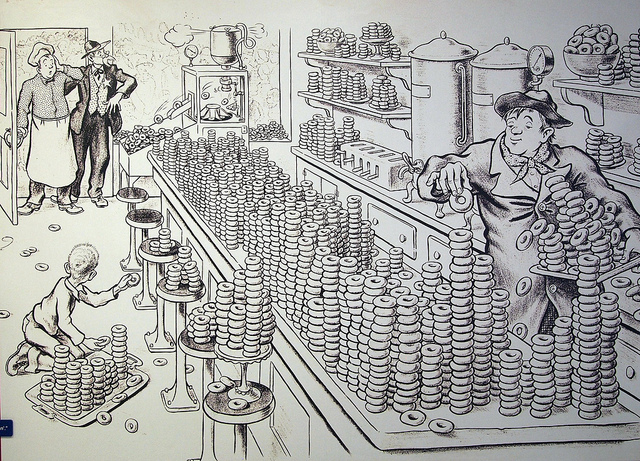
 This was one of the “children’s classics”, written in 1943, that I had glanced at as a child, but never actually read. A pity. McCloskey was a gentle humorist with a charming style and great human empathy, who chose to write for children rather than, say, subscribers to the New Yorker. He was also a talented artist, in a style reminiscent of Ernie Pyle. The world he writes about now seems so far away that a contemporary child might have some problems interpreting it. It would seem exotic, rather than comfortingly familiar. But if you are an adult with any feeling for North American social history, the child-viewpoint stories about pet skunks, donut machines, and giant balls of string will be fascinating.

16396. (Michael H. Shuman) The Small-Mart Revolution ― How Local Businesses are Beating the Global Competition
I would like to see everyone involved with urban reform and with democratic activism to read this book. There is a powerful undercurrent of change going on in both the United States and Canada, definitely something moving up from the grass roots and ignored by both the media and the elite political drones. It’s something far more creative and significant than a mere flaky fashion for “anti-globalism” demonstrations, with which the reader might at first confuse it. It’s the fact that people — ordinary people — are starting to question the orthodoxies they have been taught about how things “have to be”, and realizing that their self-interest, as well as their future, depends on re-invigorating local economic and political power. You would never guess it from following the media, but Americans and Canadians are starting to shake off the passivity and morbid fatalism that their rulers have energetically cultivated. They’ve begun to notice that Wal-Mart moving into your neighbourhood produces poverty, not prosperity, that North American society has been rapidly hemoraging cash into a “global” empire of multinationals-kings-dictators, and that if they don’t do something about it they are going to become helpless paupers. Shuman describes some of the things that people have been doing, mostly in small scale entrepreneurial and social action, to turn the tide. His analysis of the issues and processes is not entirely accurate — he still suffers from the confusion of categorical terminology, such as the idiotic “left-right” concept, that cripples reform thinking — but he is definitely on the right track. Read more »
16390. (Thomas T. Allsen) The Royal Hunt in Eurasian History
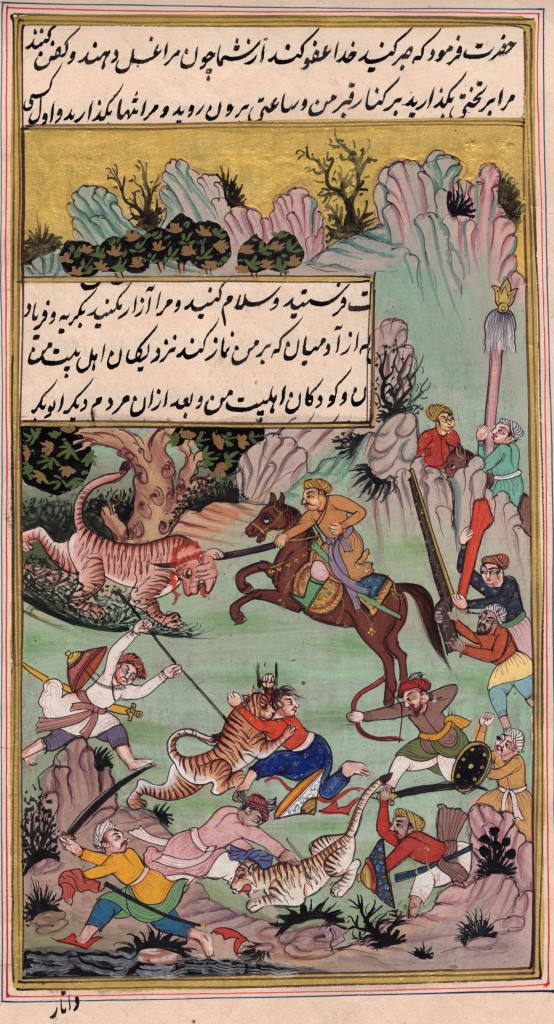 This is an excellent book, which demonstrates that historians do not have to be sequestered in continental ghettos. Allsen is able to cite the Armenian and Georgian Chronicles, the classics of Indian and Persian literature, and the vast bureaucratic documentation of China with the same ease and familiarity as when he cites standard European sources. “Eurasia” actually means something to him. In other words, the man is modern. With this kind of attitude, he is capable of addressing a phenomenon that other historians have ignored: the Royal Hunt. This institution — which often called up an impressive chunk of a society’s resources — persisted as a continuously interconnected phenomenon from the earliest antiquity to near-modern times. It demonstrates that the whole supercontinent of Afro-Eurasia has been a cultural continuum throughout recorded history, with ideas and customs traveling back and forth from end to end to end. Allsen tries to get some sort of handle on how and why the rulers of states engaged in spectacular collective hunting expeditions and maintained vast “game parks”, a custom which transcended all the barriers of empire, language, ecosystem, and religion. His work has no “theory” behind it, only a relentless curiosity and a respect for the sources. The only deficiency that I found was that he seemed to never ask the question “what happened to the meat?”. It’s my hunch that he could have reached a more complete understanding of the phenomenon if he had explored the issues of who got to eat the vast quantities of meat that these hunts produced, how it was distributed, and how this distribution served social and political ends. I’ve noticed that there is a similar absense of the question in studies of Rome’s “games”.
(Robert A. Heinlein) Four Frontiers
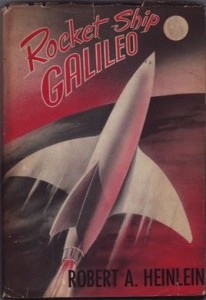
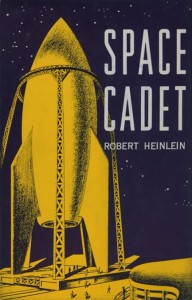 This is an omnibus volume presenting Robert Heinlein’s first four “juvenile” novels, originally published by Scribner’s in 1947, 1948, 1949, and 1950. Heinlein wrote twelve science fiction novels for teenagers, and put more care and artistry into them than most writers put into serious adult fiction. Their impact has been astonishing, and they remain widely read long after their science and “futurity” has become outdated. They were tremendously liberating for young readers, especially when you judge them in the context of North American society when they were written. Unlike any author writing for young people, up to that time, Heinlein treated his readers with honesty and respect, as well as providing them with a rich intellectual feast. Heinlein struggled with his editors, who constantly panicked over the possible “unsuitability” of his treatment and subject matter. But they were devoured by libraries, and thus were available to people (like me) who were in no position to buy books. Scribner’s published them in a handsome format, with illustrations of great artistic merit by Clifford Geary. I came to them when they were starting to show their age, but their “sense of wonder” and their moral impact remained vivid. Citizen of the Galaxy, for example, was one of the three books that most stimulated my life-long fascination with the issue of freedom and slavery.
Read more »
READING – JULY 2008
16317. [2] (Arthur Conan Doyle) A Scandal In Bohemia [story]
16318. (Charles Lamb) On the Tragedies of Shakespeare [article]
16319. (Andrew Curry) Raiders or Traders? [article]
16320. (Stephen Jay Schneider –ed.) 501 Movie Stars [article]
16321. (Will McLean) [blog A Commonplace Book] The 14th Century Social Pyramid [article] Read more »
16384. (Barbara Kingsolver, Steven L. Hopp & Camille Kingsolver) Animal, Vegetable, Miracle ― A Year of Food Life
Novelist Barbara Kingsolver and her family meditate on their efforts to feed themselves outside of what I call “corporate communism” — the globalized and collectivized system of agriculture that is rapidly destroying health, environment and freedom on this planet. Kingsolver doesn’t use my terminology, and confines herself to immediate issues of personal health, aesthetics, animal ethics, and local economic vitality. But the book is useful background for the kind of issues that interest me, as well as being entertainingly written. The book doesn’t have the sanctimonious tone that hampers much that is written on the subject. Kingsolver knows that real families have to make economic choices under the constraint of shrinking financial resources, and practical reality. She is a strong advocate of the “eat local / eat seasonal” movement, which lies at the crux of her strategy, and takes every occasion to point out that both economy and pleasure tend to be maximized by it.
Thursday, June 19, 2008 — Omlowen dha bos!
While I’ve been silenced by the demands of work, my friend Steve Muhlberger has become more voluble, with longer and more detailed blog entries, inspired by his European travels. These can be read at Muhlberger’s Early History. Among them are items on Latvia, Medieval robots, the enchanting Cornish landscape, the truth about the Cornish pastie, and a particularly fine one on the legacy of Cornish tin mines. The discussion of the distinctive pride of the miners reminded me of a medieval mining town of Kutná Hora I visited in Czech Republic. There, the gothic Church of St. Barbara (Chrám svaté Barbory) is decorated with wonderful frescoes that depict the daily life and work of miners and minters. The miners had considerable political and social power and independence, and expressed it in this extraordinary art. Read more »
READING – JUNE 2008
16271. (George Woodcock) Gabriel Dumont
16272. (Shashi Tharoor) The Elephant, the Tiger, and the Cell Phone ― Reflections on India,
. . . . . the Emerging 21st-Century Power
16273. (Richard van Emden) Boy Soldiers of the Great War Read more »