22687. (Count Basie) Count Basie [Verve Jazz Masters #2]
22688. (Steely Dan) The Nightfly
22689. (Snailhouse) Lies On The Prize
22690. (Smiths) Louder Than Bombs Read more »
Category Archives: C - LISTENING - Page 24
First-time listening for March, 2011
Posted by Phil Paine
on March 31, 2011
No comments
First-time listening for February, 2011
Posted by Phil Paine
on February 28, 2011
No comments
(Capilla Flamenca) The A‑La-Mi-Re Manuscripts:
. . . 22662. (Matthias Gascogne) Missa Myn hert: Kyrie
. . . 22663. (Jean Mouton) Celeste beneficium Read more »
Dvořak’s “American” Quartet No. 12 in F, Op. 96, B. 179
Posted by Phil Paine
on February 4, 2011
No comments
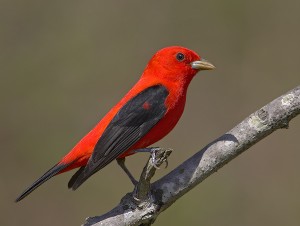
A Scarlet Tanager
I love string quartets. Composers seem to put their hearts and minds into them in a way that they don’t reliably do for other forms. Since they have little commercial value, they are usually composed with nobody looking over the composer’s shoulder, and no box-office considerations. The stark simplicity of the combination of two violins, viola, and cello, which nevertheless allows for a full tonal range and the interplay of individual and combined voices, attracts the composer who wants to put across serious thoughts.
Antonín Dvořak wrote fourteen string quartets, but the twelfth, nicknamed “American”, is by far the most popular and moving. It has a sweetness of melody and an inventiveness, from moment to moment, that links it with his wonderful “New World” symphony. It was, in fact, written at the same time, while Dvořak was visiting a small town in Iowa (settled by Bohemian and Moravian immigrants). It’s easy to find the influence of African-American spirituals in it, while its Czech elements are just as solid. The first violin motif in the third movement echoes the song of the scarlet tanager, a bird he heard often in Iowa. Like the popular ninth symphony, it’s a profoundly humanistic and optimistic work. This was the happiest time in Dvořak’s life, and he was by nature a gentle and compassionate man. Those elements infuse the work, which was written, as I understand, mostly outdoors, on the banks of a stream near an Iowa farm. This spot must have been, for him, simultaneously the pioneer-broken prairies of a “new world”, and the left bank of the Vltava at Nelahozeves. Comforting tradition and wild freedom, age and youth, wisdom and innocence all combined, without conflict, without contradiction. When I feel that things are basically all right in the universe, that the forces of darkness must in the long run be overtaken by the light, then this is the music for me.
First-time listening for January, 2011
Posted by Phil Paine
on January 31, 2011
No comments
22648. (Audioslave) Revelations
22649. (Rolling Stones) 12 X 5
22650. (Piirpauke) Piirpauke 2 Read more »
Image of the month: Jean Sibelius
Posted by Phil Paine
on January 1, 2011
No comments
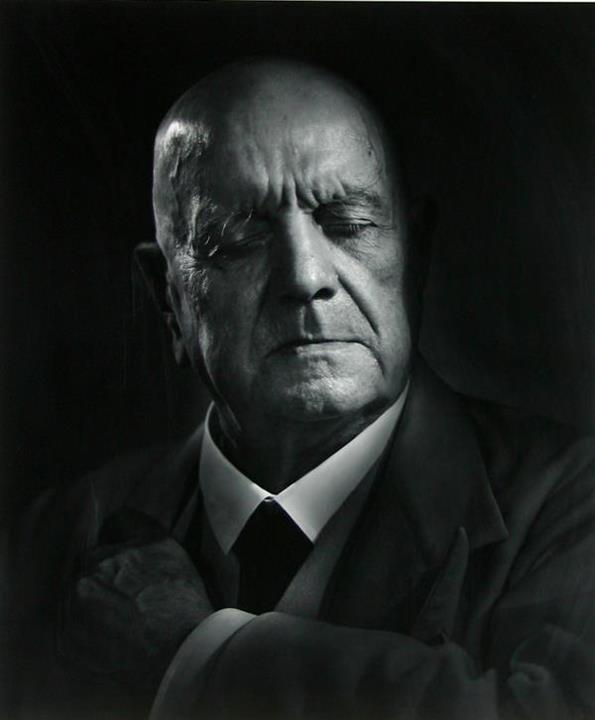
Jean Sibelius has remained my favourite composer throughout my life. Something in his work touches me directly. One of my greatest pleasures was to attend the unique concert series in which all his symphonies were performed (for the first time) in sequence, under the direction of the young and brilliant conductor Thomas Dausgaard. When I told him, during the post-performance reception, that it was the best performance of the 4th symphony (my favourite) I had ever heard, he replied that it was his favourite as well.. giving much the same reasons I would have. It is the most difficult, and perhaps the least played of the seven symphonies.… dark, ambiguous, complex, and intriguing.
This photograph is by Jousuf Karsh, the Canadian portrait photographer who made iconic images of Winston Churchill, Ernest Hemmingway, and many others. Karsh remembered details of the sitting:
“I arrived at Sibelius’s home ‘Ainola,’ named for his wife Aino, laden with gifts from his admirers — an inscribed manuscript from composer Ralph Vaughan Williams, a warm letter from Olin Downes, the celebrated music critic of the New York Times, a box of his favorite cigars and a bottle of old cognac from the Canadian High Commissioner in London. This last we shared with little Finnish cookies and coffee. His daughter interpreted for the straight-backed patriarch of eighty-four, although there was such a meeting of minds that words became scarcely necessary. The structure of his face reminded me of carved granite, yet with infinite warmth and humanity. This photograph was one of the last taken. He was visibly moved as I told him how the Finnish workers, in their northern Canadian logging camps, doubled their wartime output when his Finlandia was played for them.”
The links go to related articles on this blog. Some others:
The Kalevala, is the Finnish epic that inspired much of Sibelius’ music. A youthful work of his, Kullervo Op.7, is a choral-orchestral telling of part of the epic. I also discuss it here. En Saga, Op.9 is another. I have also written blog items about his string quartets, and his first symphony.
First-time listening for December, 2010
Posted by Phil Paine
on December 31, 2010
No comments
22625. (George Formby) George Formby — Private Compilation, vol.2 [33 items]
22626. (Alice in Chains) Come and Save Me [Paris, 1993 bootleg]
22627. (Lightnin’ Hopkins) Texas Blues [Blues Collection #31] Read more »
First-time listening for November, 2010
Posted by Phil Paine
on November 30, 2010
No comments
22586. (As The Poets Affirm) I Want to Tell My Heart to You, But I Cannot Say English
22587. (Piirpauke) Piirpauke Live
22588. (Deadmau5) Random Album Title Read more »
Deadmaus5
Posted by Phil Paine
on November 28, 2010
No comments
 The techno-rave scene has been moribund for the last few years, but there’s an occasional good album that comes out. Canadian DJ Deadmaus5 (Joel Zimmerman) publicizes himself with a silly gimmick: he appears in public in a mouse costume. But Random Album Title, which came out in 2008, is an entertaining set, though more for listening, as long segments don’t sound very danceable to me. The “I Remember,” “Faxing Berlin,” and “Not Exactly” segments, which follow each other, stand out. It’s a slow warm-up to get to them, however.
North, an Arizona metal band
Posted by Phil Paine
on November 24, 2010
No comments
I don’t know if this Tucson-based metal band is still active, but I rather like their 2008 album What You Were, which trots along loudly, with growly vocals by Kyle Hardy, at a steady, unrushed pace. I’m not sure if they would be called “melodic metal” or “post-rock” in the current jargon, but there is both melodic and rythmic sophistication in most of the songs. “Eidolon” and “Falling In Perpetuum” stand out among the tracks. The album has a fine balance, sequencing the songs to good effect in a genre which tends to turn albums into undifferentiated blurs. I also have an EP from the same year, Ruins.
Bach’s 1046
Posted by Phil Paine
on November 17, 2010
No comments
The first of the Brandenburg Concertos, catalog # bwv1046, is actually entitled Concerto 1mo à 2 Corni di Caccia, 3 Hautb: è Bassono, Violino Piccolo concertato, 2 Violini, una Viola è Violoncello, col Basso Continuo. It has four movements, unlike the other five concertos, which have three. You would think that the pattern allegro — adagio — allegro — minuet would make it clumsy, but for some reason, it works in this case. The final minuet doesn’t seem out of place or anti-climactic. Nothing could be a better introduction to the pleasures of baroque music. Read more »