17026. (Yothu Yindi) Freedom
17027. (John Adams) Violin Concerto
17028. (John Adams) Shaker Loops
17029. (Hot Hot Heat) Elevator
17030. (Johannes Brahms) Hungarian Dance #1 in G Minor for Piano Four-hands
17031. (Johannes Brahms) Hungarian Dance #2 in D Minor for Piano Four-hands Read more »
Category Archives: C - LISTENING - Page 39
First-time listening for February, 2007
Posted by Phil Paine
on February 28, 2007
No comments
el hadj N’diaye — XEL
Posted by Phil Paine
on February 23, 2007
No comments
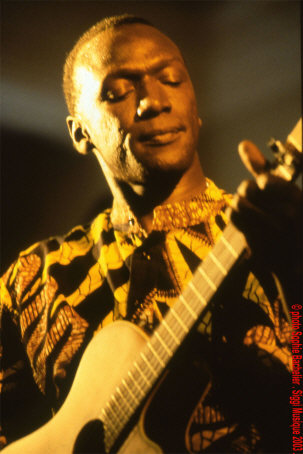 Even within the fabulous cornucopia of West African music, el hadj N’diaye’s Xel (2001) is a exceptional treasure. N’diaye takes a journey beyond the familiar mbalax beat of Senegal’s popular music to explore more varied territory. Some of the rhythms and guitar work could have come out of a Clapton album. But they are blended perfectly with African drums and balofon. The balofon solo on the song “Casa di mansa” is particularly beautiful. This is a tragic song about the ill-fated secessionist movement in southern Senegal, sung in French and English. Most of the songs on the album are sung in Wolof, Senegal’s primary language. But the emotions in them are so powerful that you have the odd feeling that you understand every word. “Yoon wil”, “Xale bi” and “Yu sew yii” moved me in particular. This entire album combines a refinement and precision of performance with intense emotions: bitterness, sadness, yearning, remorse. I will play this album over and over again, and I’ll do my best to find more of N’diaye’s work.
Wax [K‑Pop]
Posted by Phil Paine
on February 11, 2007
No comments
![07-02-11 LISTN Wax [K-pop]](http://www.philpaine.com/wp-content/uploads/2007/02/07-02-11-LISTN-Wax-K-pop.jpg) For quite some time, Cool and Wax dominated Korean pop music. Wax is the stage name for a talented female vocalist with a very expressive, and sometimes beautiful voice. Her arrangements range from cheesy synthesizer pop to fairly raunchy rhythm and blues. In some cases, genres are bizarrely mixed, such as when a chorus of grunting male metal voices inexplicably fill in the spaces between verses of a Britney Spears-ish love song. This may all sound pretty trashy to a North American listener, but there’s no law against musical synchretism, and in any case, East Asian pop plays by its own rules. I’m told that a lot of her success comes from the perspicacity of her songwriters, Choi Joon Young and Kim Gee Hoonong. It can’t all be in the lyrics: Wax’s popularity extends far beyond the K‑pop scene, to the much broader East Asian pop scene covering China, HK, Taiwan, Vietnam, Singapore and Japan. My exposure is through the double compilation album Best Day & Best Night and the third album from 2002, Wax 3.
For quite some time, Cool and Wax dominated Korean pop music. Wax is the stage name for a talented female vocalist with a very expressive, and sometimes beautiful voice. Her arrangements range from cheesy synthesizer pop to fairly raunchy rhythm and blues. In some cases, genres are bizarrely mixed, such as when a chorus of grunting male metal voices inexplicably fill in the spaces between verses of a Britney Spears-ish love song. This may all sound pretty trashy to a North American listener, but there’s no law against musical synchretism, and in any case, East Asian pop plays by its own rules. I’m told that a lot of her success comes from the perspicacity of her songwriters, Choi Joon Young and Kim Gee Hoonong. It can’t all be in the lyrics: Wax’s popularity extends far beyond the K‑pop scene, to the much broader East Asian pop scene covering China, HK, Taiwan, Vietnam, Singapore and Japan. My exposure is through the double compilation album Best Day & Best Night and the third album from 2002, Wax 3.
First-time listening for January, 2007
Posted by Phil Paine
on January 31, 2007
No comments
16911. (Wolfgang Amadeus Mozart) Thamos, König in Ägypten, K.345 [336a] [d. Harnoncourt;
. . . . . w. Thomaschke, Perry, Mühle, Altena, van der Kamp]
16912. (Martha Wainwright) Martha Wainwright
Mojo Chess Northern Soul:
. . . . 16913. (Marlena Shaw) “Let’s Wade in the Water”
. . . . 16914. (Mamie Galore) “It Ain’t Necessarily So”
. . . . 16915. (Radiants) “Hold On”
. . . . 16916. (Dells) “Wear It On Our Face”
Read more »
Songs of Mukanda : music of the secret society of the Luvale people of Central Africa
Posted by Phil Paine
on January 23, 2007
No comments
This is an anthropological collection songs and music which take place during the initiation/seclusion period (mukanda) of Luvale boys of Zambia. Most Luvale art is in the form of masks, many of which are danced with, during ceremonies to educate the initiates and to mark the territory where the ceremonies take place. The Luvale (who also live in Angola, where they are called Lwena) peoples are closely related to the Chokwe, and their history is interconnected with both Chokwe and Lunda political movements, which have historically dominated the region. They number about 20,000. The agrarian Luvale grow manioc, cassava, yams, peanuts, tobacco, hemp and maize (grown to make beer). They keep some sheep, goats, pigs, and chickens, but prestige meats are wild game provided by a restricted secret society of hunters. The Luvale are divided into two categories, those who are descended from the founding matrilineal lines and those who are descended from former enslaved populations. The society is governed by family headmen who owe tenuous allegiance to local chiefs who inherit their positions matrilineally from the maternal uncle. The chiefs (mwana nganga) consult with a committee of elders and ritual specialists before making decisions. The Luvale preserve traditional religion, based on Kalunga, a god of creation, and a series of nature and ancestral spirits. The music in the collection is chiefly of interest to anthropologists and African musicologists, but some of the songs might entertain a casual listener.
Sidney Bechet
Posted by Phil Paine
on January 13, 2007
No comments
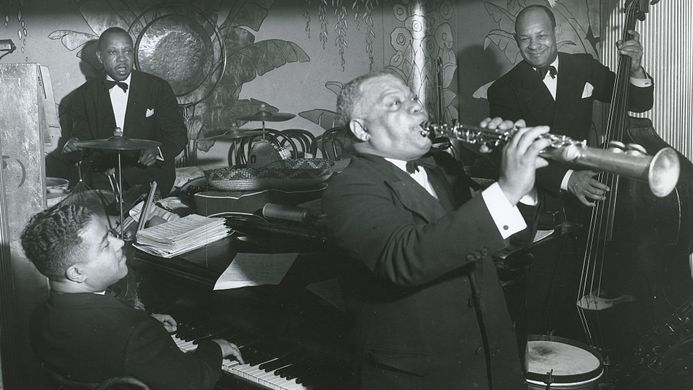 Everest Records’ Archive series gives me a selection of fine New Orleans tunes by one of the most versatile of early jazzmen. Bechet (1897–1959) played many instruments, but was best known on soprano sax, clarinet, and cornet. He was a prodigy, discovered at the age of eight by Freddy Keppard, and employed in Keppard’s band at eleven. Greatly admired as a highly creative and individual performer by other jazzmen (notably Duke Ellington), Bechet was a cultured and poetic man, who divided his time between Europe and America, and after WW2, married and ended his days in France. It’s said that he was the model for the character “Pablo” in Hermann Hesse’s Steppenwolf. This is quite possible. In 1929, he appeared with his own band at the Haus Vaterland café in Berlin, where Hesse could easily have seen him. Some of the cuts on this disk feature Lionel Hampton, and Bechet’s powerful vibrato is deliciously echoed by his vibes. The Everest vinyl is probably hard to find, but there’s a good cd collection called The Legendary Sidney Bechet, which includes his performances with the New Orleans Feetwarmers, Tommy Ladnier, Jelly Roll Morton, and Dr. Henry Levine.
Joe Zawinul
Posted by Phil Paine
on January 5, 2007
No comments
Jazz pianist and composer Josef Erich Zawinul first came into prominence as the founder of the band Weather Report, which I will consider separately. He’s been a major figure in jazz since then. Though he emigrated to the United States from his native Austria as a young man, he always retained strong European roots, emotionally as well as musically, and eventually returned to Austria. My focus here is on two of his solo albums, Zawinul (1970) and Stories of the Danube (1995).
Despite the eponymous title, the first one is essentially a collaboration of Zawinul and Herbie Hancock. It’s an early example of the fusion movement that swept Jazz in the seventies, with Miles Davis, Zawinul and Hancock at the forefront. The Rhodes piano-echoplex-ring modulator combo of this album was soon to be superseded by synthesizers. The jazz conventions are still there, but Zawinul is mostly interested in creating ambient soundscapes, and the feeling is not spontaneous. In fact, it’s hard to get emotionally involved with this music. Only the first cut, the long piece called “Doctor Honoris Causa”, is satisfying. Woody Shaw participates on this piece, to good effect. The second cut, “In a Silent Way”, is particularly disappointing, because Miles Davis did a much better job covering it, later on. The rest is rather dry. Twenty-five years later, there is not much jazz left in Stories of the Danube, which is a symphonic suite enlivened by fragmentary whiffs of jazz and middle eastern dance music. The melody of “Doctor Honoris” makes an appearance. It’s pretty much an updated version of Smetana’s Mauldau, using a bigger river and a less intimate palette. Most of it will give pleasure to the listener, especially since the movements grow more engaging towards the end. I wish I had more of his work in my collection, so I could trace out the evolution between these two albums.
First-time listening for December, 2006
Posted by Phil Paine
on December 31, 2006
No comments
16832. (John Taverner) Kyrie “Leroy”, for 4 voices
16833. (John Taverner) Missa Gloria Tibi Trinitatis for 6 voices
16834. (John Taverner) Dum transisset sabbatum (i), motet for 5 voices
16835. (Weather Report) I Sing the Body Electric
16836. (Ferrante & Teicher) Moonlight Melodies
16837. (Heitor Villa-Lobos) Bachianas Brazileira #1 for Eight Cellos
16838. (Heitor Villa-Lobos) Suite for Voice and Violin
16839. (Heitor Villa-Lobos) Preludes and Fugues from Bach’s “48” for Orchestra of Cellos
16840. (Franz Josef Haydn) String Quartet in B‑flat, Op.71 #1
Read more »
Haider Ali
Posted by Phil Paine
on December 22, 2006
No comments
 Haider Ali (or Ali Haider, علی حیدر ) is probably the most popular light pop singer to come out of Pakistan. His seven albums will be hard for a Canadian to accumulate, but it is easy to find the two Best of Haider Ali discs, which I have. He is not as much of a light-weight as you might guess. Yes, the arrangements are pure pop, but he chooses melodies that have some folkloric roots, and his performances are flawless. There is also noticeable development. He finds his feet with the fourth album, Qarar. This contained the hit “Purani Jeans”, which I’m told found a cross-generational audience. After this, the songs became subtler, and better crafted, with touches of classical Urdu style embedded in the euro-pop orchestration. Some of the later songs have live flute, tabla, dholak, sitar and banjo. “Papa Mumi”, a hit from his best-regarded fifth album Dastaan, is more than just a pop song, and it comes across emotionally to someone like me, who doesn’t understand Urdu.
First-time listening for November, 2006
Posted by Phil Paine
on November 30, 2006
No comments
16729. (Edward Elgar) Chantant for Piano
16730. (Edward Elgar) Pastourrelle, air de ballet
16731. (Edward Elgar) Rosemary [piano version]
16732. (Edward Elgar) Griffinesque for Piano
16733. (Edward Elgar) Sonatina [original version]
Read more »