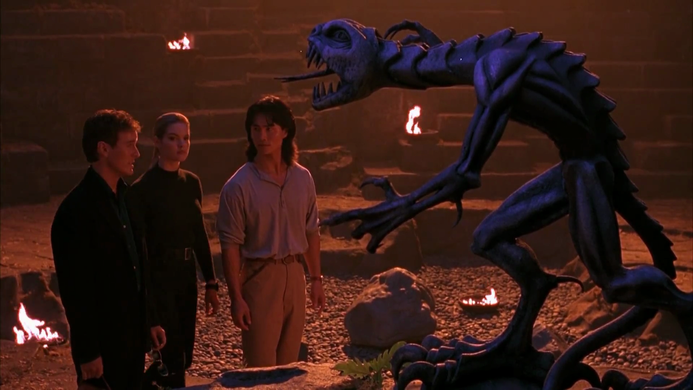
My rationale: Somebody went to the trouble to get sufficiently stoned to make this movie. I felt that I owed it to them to get sufficiently stoned to watch it.
My rationale: Somebody went to the trouble to get sufficiently stoned to make this movie. I felt that I owed it to them to get sufficiently stoned to watch it.
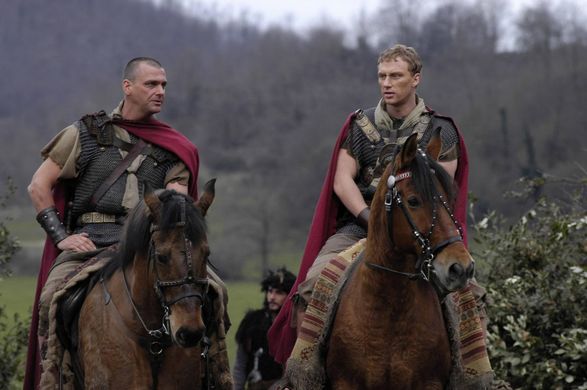
Ray Stevenson as Titus Pullo and Kevin McKidd as Lucius Vorenus
HBO’s Rome is a superb series. There are some historical inaccuracies: Octavian was shipwrecked in his youth, but never kidnapped, and he was not in Rome when Caesar was assassinated. Neither was Cicero. Caesar is shown offering to give land in Pannonia to the 13th Legion, though Pannonia wasn’t in the empire at that time. But as far as presenting Roman society, and the mores and behaviour of Romans, the series is quite accurate. It quite properly shows the casual violence and brutality of a society that was not informed by any real ethical principlrs, but merely by custom, caste consciousness, vengeance, and barbaric concepts of “honour”. Much of our world remains like that, today, and it is a profound distortion of history to ignore it, as most historical film and fiction usually does. The reality of slavery and Roman sexual practices are shown with reasonable accuracy. The death of Caesar is shown as it is in Plutarch’s account, rather than Suetonius. Read more »
(Benedek 1953) The Wild One
(Nicholls 1995) Alien Empires: Hardware
(Nicholls 1995) Alien Empires: Replicators Read more »
Oh My Gawd what a horrible film! Oil riggers equipped with no skill or knowledge save the earth from asteroid impact by flying to the asteroid in the Space Shuttle and drilling a hole a mere 800 feet into it (as if this would make a difference?), to plant a nuclear bomb . They and NASA and various military types save the Earth by competing in how loudly they can shout at each other and who can say the toughest things. A soppy romance is thrown in — one that makes you cringe whenever those characters show their faces. Annoying acting, annoying music, annoying everything, and scientific illiteracy so profound that NASA uses the film to train astronauts. They are required to identify as many of the 167 major violations of physical laws and probabilities as they can. Yes, 167.
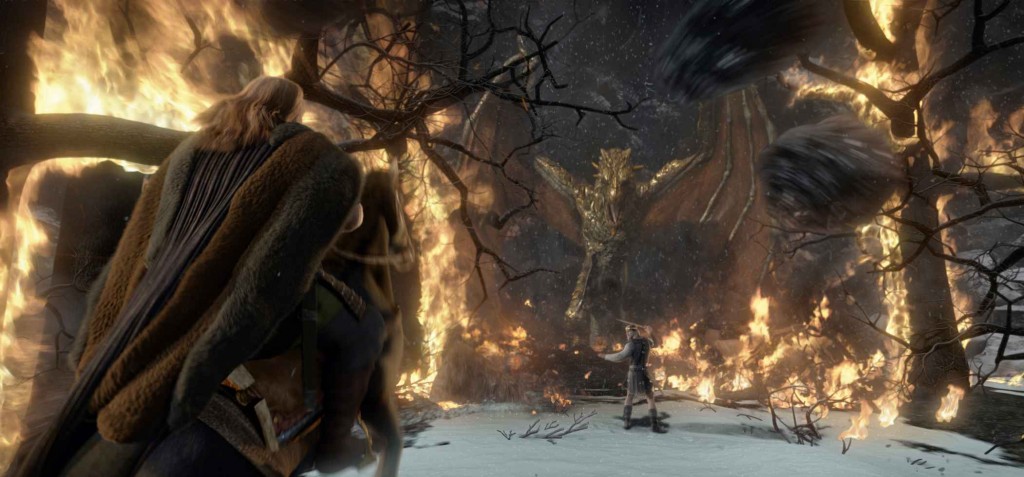
I was satisfied with this performance-capture animated version of the Beowulf epic. It doesn’t have much to do with the original Anglo-Saxon epic, but mythology is, by its very nature, open to any mutation the re-teller cares to make. Who the hell knows what transformations the story experienced before our “literary” version appeared? No one objected when Allan Gardner turned the story on its head in his novel “Grendel”. This animated version is an even greater departure, but it held my attention and was visually pleasing.
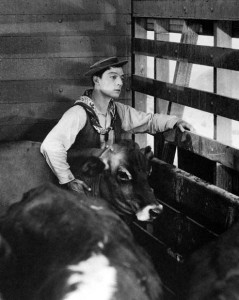
Buster Keaton in Out West (1918)…
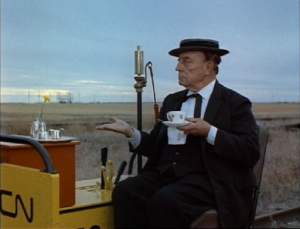
… and nearly a half century later in The Railrodder (1965)
I acknowledge Charlie Chaplin’s genius, but I have to say that his screen personality never appealed to me, and I appreciate his films with a detached, technical eye. Buster Keaton is another thing entirely, for me. His comic genius touches me directly. I laugh when I see Keaton’s silent classics. I was first exposed to his work as a child. The last film he made, before his death, was a short promotional film for the CNR”s coast-to-coast passenger service across Canada. His stone-faced character crosses the country on a railway hand-car. Keaton was as brilliant in it as in any film he had made a half-century before. Read more »
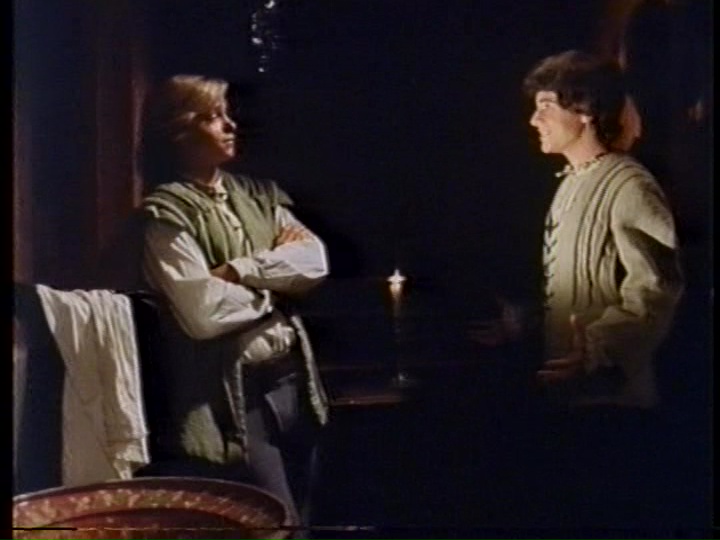
Lance Kerwin and Chris Makepeace in The Mysterious Stranger.
Back in the 1980’s, Nebraska Public Television undertook an ambitious project of filming Mark Twain’s less famous books and stories. These were low-budget affairs, but they had the merit of remaining faithful to Twain’s texts.
Puddin’head Wilson is difficult for an audience of today to assimilate. Few modern viewers understand the social complexities of slavery in pre-Civil War America. Twain’s novel was written in 1893, and set in the period 1630–1850. It turns on a “switched babies” plot device, with a slave and a free baby living out the consequences. The laws of slavery permitted someone who was 1/32 black to be enslaved, so this is perfectly credible. Few now realize that many slaves were in this category. Twain’s bitter satire examines, in turn, all the pretensions, contradictions, and hypocrisies of a slave-holding society. Only one character, Puddin’head Wilson, comes off favourably. He is the only one who seems to care about truth, and not to be driven by greed, revenge, or pretension. Naturally, he is dismissed by all as a “pudd’nhead”, a fool. The low-budget TV film was reasonably well-crafted, and boasted a fine performance by Lise Hilbodt.
But most intriguing is The Mysterious Stranger. This bizarre story did not exist in any definitive edition until 1982. Twain worked on it for twenty years, producing three extremely different versions, all of which remained unpublished. His literary executor, Albert Bigelow Paine, issued a composite version in 1916. The film sticks closest to this version, with some elements of the others. It’s set in Renaissance Austria, where a strange youth, calling himself “No. 44, New Series 864962” appears amidst the apprentices of a printing firm. His ability to perform sundry miracles, and to travel anywhere in time and space, are revealed to one of the apprentices. The film version hints at Twain’s pessimistic world-view, which some have described as “existentialist”, though this unduly trivializes it. Twain struggled all his life to reconcile conflicting attitudes about himself and humanity, and no story of his shows it more than this one. This film version retains enough of the metaphysical spookiness and religious skepticism to ensure that it would come as something of a shock to any American public school or “family” audience that saw it. The public is used to denatured, candified film versions of Twain. Actually, it had more success in Europe, where it was filmed, than in America. The young television actor, Lance Kerwin, gave a surprisingly subtle performance as No.44, though for some reason, he was not given the star billing — probably because the character played by Canadian child star Chris Makepeace is technically the protagonist. Also, Kerwin had been was mainly a television actor, while Makepeace had scored success in film with Meatballs (1979) and My Bodyguard (1980).
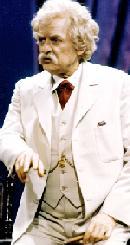 Hal Holbrook’s one-man stage show, in which he reproduces Mark Twain’s nineteenth century stage appearances, is perhaps the most exact and subtle representation of any pre-cinema era historic figure undertaken by any actor. It’s not just Holbrook’s technical virtuosity, but the taste and intelligence with which he selected from Twain’s writings that makes the performance unforgettable. Much of this material is highly relevant today. Twain was not a simple man. His ambiguities have fascinated both historians and lovers of literature since he left the world’s stage (just as he entered it) with Haley’s comet. Holbrook captures this. The 1967 CBS broadcast of the Broadway show must have been one of the most amazing television events of its time. It’s available from Kultur, a company that specializes in preserving notable stage performances on DVD.
 This is a slow-paced psychological drama, stylistically influenced by Tarkovsky. It holds attention because the acting is superb, the psychological nuances realistic. One scene, for example, involving a lost watch, stands out for the fine-tuned performances of the two lead actors, Muzaffer Ozdemir and Emin Toprak. Sadly, Toprak died in a car crash shortly after learning he had received his award at Cannes. The cinematography is first rate, with Istanbul buried in snow forming a grey backdrop to the claustrophobic interior shots and tightly repressed relationships of the characters. It’s a grim film, but the sympathy of the script makes this tolerable to the viewer, and the camera conveys both the beauty and the bleakness of a Turkish winter.
A well-crafted suspense film employing some of the formulas of Hitchcock. Despite the title, it’s a Spanish film. The main character is a Portuguese video distributor, on a car trip from Spain, going home. He picks up a mysterious woman, and gets tangled in a web of murder. Well-trodden material, but director Hernandez handles it well, and the oddly low-key ending is original.