17244. (Arthur Conan Doyle) The Adventure of the Speckled Band [story]
17245. (Henry C. Clark) Compass of Society: Commerce and Absolutism in Old-Regime France
17246. (Graham Watson) The Reification of Ethnicity and Its Political Consequences in the North
. . . . . [article]
17247. [2] (Verne Dusenberry) Waiting for a Day that Never Comes: The Dispossessed Métis of
. . . . . Montana [article]
17248. (Peter Armitage & John C. Kennedy) Redbaiting and Racism on Our Frontier: Military
. . . . . Expansion in Labrador and Quebec [article] Read more »
READING MARCH 2009
Posted by Phil Paine
on March 31, 2009
No comments
Birdy Nam Nam: Manual For Successful Rioting
Posted by Phil Paine
on March 29, 2009
No comments
 This French turntablist quartet is eroding the distinctions between DJs, bands, and electronic artists. They play live in clubs, mixing their own material, or that of live musicians pressed onto vinyl, rather than the usual samples, and restructure much of what they create in the studio. The result is interesting music, likely to appeal to an older crowd than most club-goers.
(Tarsem 2006) The Fall
Posted by Phil Paine
on March 22, 2009
No comments
This interesting fantasy was filmed in India, Romania, Namibia, South Africa, Czech Republic, Indonesia, and other places. The cinematography is superb, reminding me of the crisp images of James Wong Howe. The director, Tarsem Singh, was trying for an adult approach to a psychological parable about suicide and death, illuminated by some of the most beautiful landscape and architecture in the world. It’s thick with cultural, scientific, and historical references best enjoyed by a well-read audience, though it can be enjoyed well enough without noticing them.
The story: in 1920’s Hollywood, a stuntman recovers from a serious injury, and rejection in love, in a hospital. Another patient is a young Romanian immigrant girl (perhaps ten years old). In order to bribe the child to get him morphine pills with which to commit suicide, the stuntman tells her a fantastic tale, with the flavour of the Masnavior the Arabian Nights. The films intercuts to representations of this tale, which employ real landscapes and settings with fantastic costume and magical effects.
This film appeared and passed unnoticed in 2006.
Antonín Dvořák: Symphony #1 in C m “The Bells of Zlonice”, Op.3, B.9
Posted by Phil Paine
on March 21, 2009
No comments

Antonín Dvořák lived in Zlonice, a small town in Bohemia, from 1853 to 1856. He must have been fond of this church’s bells.
I have an odd advantage over Dvořák. I’ve heard this symphony, while he never did. It was composed in 1865, when Dvořák was only 24. He submitted the manuscript to a competition in Germany, and the only copy disappeared, so he never had a chance to hear it performed, or even to revise it. He dismissed it as lost, and did not number it among his compositions. However, in 1882, it was found by a German student in a second-hand shop in Leipzig, and kicked around until it finally resurfaced in 1923. It did not have a complete and unaltered performance until 1973.
How does it sound? It’s pretty much Mendelssohn, or rather Mendelssohn when he sounds most like Beethoven. But it’s damn good for a callow youth’s first symphony, and could stand on its own at any concert. Every now and then you hear a premonition of distinctively Dvořákian features. Many passages are beautiful, or at least entertaining. It just doesn’t come together in a completely satisfying way. The recording I have is conducted by Stephen Gunzenhauser, with the Czecho-Slovak Radio Symphony Orchestra, and was made in 1993 (only 27 days after the separation of the Czech and Slovak Republics, hence the oddly hyphenated name). It isn’t clear why it was called “The Bells of Zlonice” ― there are no bells in it, or bell-like passages, and the phrase is nowhere on the score ― but Dvořák is reputed to have called it by that name in later years. He lived in the small town of Zlonice for three years, and it has rather nice looking church. Perhaps its bells were particularly fine. How much of this youthful work did he remember? Could he play parts of it in his head, in old age, or did it simply disolve into a vague impression? Sadly, we get to indulge in the guilty pleasure of listening to some perfectly good Dvořák that Dvořák himself never heard. So let us at least hoist a pilsner to his honour, whenever we do so.
Zombie Zombie: Mad Dog
Posted by Phil Paine
on March 13, 2009
No comments
Scored for theremin, space echo RE201, toy piano, ARPprodGX, Roland SH101, Prophet 600, 808 Roland, percussions, tape recorder, analog delay Ibanez UE305, toy piano and “screaming”, this album is an exercise in creating a sense of uneasiness in the listener. French electronic musicians Etienne Jaumet and CosmicNeman (from Herman Dune) acknowledge the influence of George Romero and John Carpenter’s horror films as much as the traditional electronic gurus. I can’t say that Mad Dog held my rapt attention all the time, but it succeeds well enough in its aims to be worth a serious listen. This is a 2006 debut full-length release (after one 12“er). I don’t know if there has been any follow up since then.
17258. (Sattareh Farman Farmaian & Dona Munker) Daughter of Persia: A Woman’s Journey From Her Father’s Harem Through the Islamic Revolution
Posted by Phil Paine
on March 7, 2009
No comments
This autobiography written (with some assistance) by an upper-class Iranian woman is both a profoundly moving personal document and a perfect introduction to the history of Iran in the 20th century. Born in the harem of a member of the Qajar nobility, Sattareh Farman Farmian lived through the dissolution of the old Kingdom, the reigns of the two Pahlevi Shahs (the first, a soldier randomly chosen and installed by the British, the second, installed by the CIA), and finally through the first stages of the Revolution of the Ayatollahs. Read more »
Apparat Organ Quartet
Posted by Phil Paine
on March 5, 2009
No comments
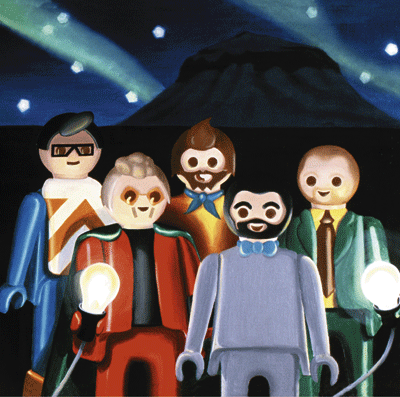 This Icelandic band constructs soundscapes with old-fashioned electronic effects reminiscent of the 1970’s. The cheesy beeps and whirs gradually build into intelligent structures, with elements of hard rock and house. I especially liked track seven, “Seremonia”, which builds to a satisfying resolution. Jóhann Jóhannsson, Iceland’s wonderfully sinister-looking composer and multimedia impresario, is behind it all. If you like listening to old Kraftwerk albums, and the instrumental piece “Telstar” drifts out of your subconscious when you come out of a coma, you’ll enjoy this.
17245. (Henry C. Clark) Compass of Society: Commerce and Absolutism in Old-Regime France
Posted by Phil Paine
on March 3, 2009
No comments
If you are under the impression, as many are, that economic thought begins with Adam Smith, then this book will act as a corrective. Henry C. Clark outlines the changing themes in the discussion of trade that took place in France during the 17th and 18th centuries, as well as the English and Dutch works that they reacted to. What strikes me is that most of the issues being discussed are much the same as the ones being debated today, and most of the same ideas are similar. Adam Smith, in 1776, was not beginning a new discipline, but producing a selective synthesis of a long-existing and complex one. Along the way to The Wealth of Nations, there was a long list of important and interesting people commenting on the nature of trade, money, and the proper roles of the state and the individual in commerce. Among them was the recognizable, but consistently under-estimated Montesquieu. But there were many other, forgotten thinkers worth paying attention to.
Image of the month: Temple of the Inscriptions, Palenque
Posted by Phil Paine
on March 1, 2009
No comments

First-time listening for February, 2009
Posted by Phil Paine
on February 28, 2009
No comments
19513. (Anton Bruckner) Symphony # “0”
19514. (Jean Sibelius) “Souda, Souda, Sinisorsa [Swim, Duck, Swim]”, JS 180 [s. Anne Sofie
. . . . . von Otter]
19515. (Jean Sibelius) “Norden [The North]”, Op.90 no.1 [s. Anne Sofie von Otter]
19516. (Jean Sibelius) “Narciss [Narcissus]”, JS 140 [s. Anne Sofie von Otter] Read more »