17156. (David Leavitt) The Lost Language of Cranes
17157. (Government of Canada: Dept. of Finance) Notice of Ways and Means Motion to Implement
. . . . . Certain Provisions of the Budget Tabled in Parliament on January 27, 2009 and
. . . . . Related Fiscal Measures / Avis de motion de voies et moyens portant exécution
. . . . . de certaines dispositions du budget déposé au Parlement le 27 janvier 2009
. . . . . et mettant en oeuvre des mesures fiscales connexes [report]
17158. (Jackie Grom) Turtles Island-Hopped Their Way Across a Warm Arctic [article]
17159. (Sara Coelho) A Rich History of Chocolate in North America [article]
Read more »
READING FEBRUARY 2009
Posted by Phil Paine
on February 28, 2009
No comments
A Pleasure Awaits Me
Posted by Phil Paine
on February 27, 2009
No comments
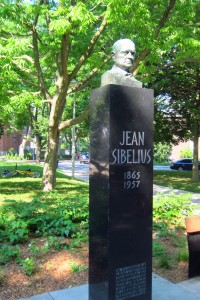
The composer scowls menacingly over little children playing in Toronto’s Sibelius Park
Hurray! As my readers will know from constant references, I’m an ardent Sibelian… given to making pilgrimages to his statue in Toronto’s Sibelius Park, for example. The Toronto Symphony Orchestra will be performing all seven Sibelius symphonies, in sequence, in their coming season, under guest conductor Thomas Dausgaard. Dausgaard is a Danish conductor with a good reputation, but I’ve heard none of his recordings. The tests will be how he handles the finale of the Fifth Symphony… the last bars must be timed perfectly to get the effect I think Sibelius was after, and many of the recordings I have screw it up completely. But most of all, it’s the subtleties of the grim and ambiguous Fourth Symphony that matter to me. Only one modern conductor, Colin Davis, satisfies me for this symphony. If Dausgaard comes even close I’ll be in ecstasy.
Prokofiev’s “Classical” Symphony
Posted by Phil Paine
on February 21, 2009
No comments
Symphony No. 1 in D major, Op 25 was designated “Classical Symphony” by Prokofiev when it premiered in 1918, in Petrograd. “Neo-classical” would be more appropriate. Prokofiev said it was a symphony “that Haydn would compose if he lived today”. There are no quotations from Haydn in the work, however, and the melodies are unmistakably Prokofiev, with his usual sardonic humour. The work must be hard for a conductor to interpret, because the three recordings I have all feel rather different. I have two vinyls: one by Jean Martinon, which is performed at breakneck speed, and an old Soviet recording by Gennady Rozhdestvensky which is done a little more respectfully. On CD, I have Neeme Järvi’s set of the complete symphonies, with the Royal Scottish National Orchestra. I find this one the most satisfying. Read more »
17199. (Jean Gaudemet) Les élections dans l’Église latine des origines au XVIè siècle
Posted by Phil Paine
on February 15, 2009
No comments
This a very good study of the use of elective procedures in the Church from Late Antiquity to the end of the Middle Ages. The book minimizes interpretation and analysis in favour of providing hundreds of texts with references to election, and letting them speak for themselves. The author chimes in when it is necessary to explain how a particular word or concept might have a different meaning in a medieval context, or a religious context. Overall interpretation, and that very cautious, is saved for the end of the book. Two basic groups of documents are covered: those relating to election within the Clergy, and those relating to election within the monastic system. The monastic documents are of greater interest to a historian of democracy. Read more »
Eclectic El Guincho
Posted by Phil Paine
on February 11, 2009
No comments
 It would be hard to name a musical influence that isn’t to be found in the first two albums by Catalunyan musician Pablo Díaz-Reixa, aka El Guincho. His myspace page describes his music as “pop/tropical/club”, but that hardly begins to list the eclectic sources that he puts together on his Roland SP-404 sampling workstation. There’s a resemblance to Animal Collective’s work, but it wouldn’t be mistaken for it. Nothing comes across as ponderously serious — every piece is clearly designed to be fun to listen to. It’s more “party music” than “arty music”, even though it is technically elaborate. The first album, Folías (2007) has some nice bits, but Alegranza! (2008) has the outstanding work. I particularly like the catchy, almost high-life “Fata Morgana”, “Kalise”, with its manic steel-band continuo, and most of all, the grand, many-layered “Buenos Matrimonios Ahí Fuera”.
17175. (Ram Sharan Sharma) India’s Ancient Past
Posted by Phil Paine
on February 7, 2009
No comments
For a long time, the most reader-friendly introduction to the history of ancient India (i.e. anything before the Gupta period) has been the first volume of Romila Thapar’s History of India. But that book was published back in 1966, and advances in archaeology and scholarship have outdated it. I would now recommend this book as a contemporary substitute. It’s a good place for someone to start their reading on the subject, though I suggest that they read it in conjunction with Wikipedia entries on most of its main topics.
I have some problems with Sharma’s work. He embraces some dubious notions of “social evolution”, he sees nothing of interest in the “tribal” and non-Vedic or non-Dravidian peoples of India except their inevitable conversion to “civilization”, and he writes absolutely nothing about India’s interaction with Southeast Asia. This last stands in contrast to his lengthy discussions of Indian trade, political, and cultural interactions with Central Asia, and even the Roman Empire. But important as these were, India never exported much of its culture to these areas, whereas in Southeast Asia, Indian culture was exported on a gigantic scale. Hindu and Indo-Buddhist kingdoms were set up in places as far as Vietnam. India’s eastward trade links were every bit, and perhaps more, important than its westward ones. Sharma hardly mentions them. But despite these weaknesses, the book remains a good introduction to a subject with which every educated person in the world should have some basic familiarity.
Ali Farka Touré: The Source
Posted by Phil Paine
on February 6, 2009
No comments
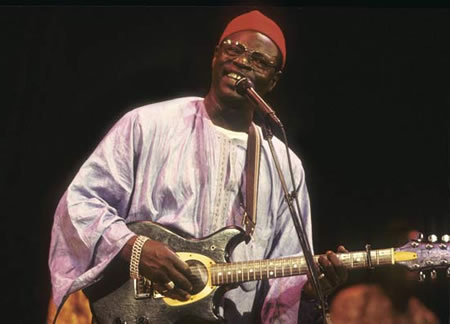
I’m playing, for the umpteenth time, my favourite among Touré’s albums. I’ve written elsewhere about this astonishing musician [Thinking of Timbuktu; Ali Farka Touré, Toumani Diabaté In Perfect Sync;Ali Farka Touré and Ry Cooder Talking Timbuktu]. This album is a tribute to his beloved Niger River roots, with song lyrics jumping casually between Bambara, Temazhek and French. Tracks like “Cinquante Six” and “Yenna” demonstrate his absolute mastery of the guitar, with the perfect timing that made him a legend. My favourite track is the song “Dofana”, in which he wistfully evokes a small village, “a paradise on Earth, only twenty kilometres from here”, threatened only by the “idiocy of politicians”. Touré, on becoming a successful recording artist, eschewed the migration to Paris or London, and instead became the mayor of just such a village. Most of the money he made went into supplying it with clean water and electricity.


First-time listening for January, 2009
Posted by Phil Paine
on January 31, 2009
No comments
19430. (Charles Ives) Symphony #5 “Universe Symphony” [reconstructed by Larry Austin]
19431. (Scratch Perverts) FabricLive 22
19432. (Oasis) Definitely Maybe [Japanese release with two extra songs; original at 2447]
19433. (Charlie Haden & the Liberation Music Orchestra) Dream Keeper
19434. (Deerhunter) Cryptograms
19435. (Jean Sibelius) “Svarta Rosor [Black Roses]”, Op.36 #1 [s. Anne Sofie von Otter]
Read more »
READING JANUARY 2009
Posted by Phil Paine
on January 31, 2009
No comments
17078. (David Liss) A Conspiracy of Paper
17079. (Darrell Markewitz) [in blogHammered Out Bits] Blacksmithing Skills in the Viking Age
. . . . . [article]
17080. (Lithium Cola) [in blog Daily Kos] Hits and Misses 2008 [article]
17081. (Lithium Cola) [in blog Daily Kos] Of ICBMs, Sesame Street, and Arrogance [article]
17082. (Lebanon Daily Star) Beirut Seems to Have Upper Hand Against Extremists [article]
17083. (Juan Cole) [in blog Informed Comment] Top Ten Good News Stories in the Muslim
. . . . . World, 2008 {That Nobody Noticed} [article]
Read more »