If one examines closely the speech that Stephen Harper gave to an American conservative think-tank, before he became our Prime Minister [1], one is struck immediately by this: our Prime Minister hates Canada and despises Canadians. We are, in his own words “a second-rate country”[2]. In statement after statement, Mr. Harper made it clear that his only loyalty is to the rich and powerful in other countries, and not to Canada or Canadians. For most of his life, the Rich and Powerful lived in the United States, and that is where his spirit has hovered. The United States that he worships, with the most abject and slavish servility, is not, of course, the real United States, the one embodied in the Declaration of Independence, or in its two centuries of struggle for freedom and justice. No, what Mr. Harper worships is the current, King George’s version of the United States, the one that has been betrayed, degraded, debauched and bankrupted by a generation of Conservative treason. Read more »
Monday, September 15, 2008 — Of Oil and Elections
(Cragg 2007) Boston Legal: Ep.77 ― No Brains Left Behind
 Boston Legalhas been doing a good job of opposing the status quo in the United States, and is brilliantly funny in the process. My thanks go to Isaac White for drawing my attention to this series, and bringing over files of it to watch. This particular episode is the funniest I’ve seen, and the best example of standing up to the morons. It not only takes on the Iraq War, but Bush’s idiotic and destructive education policies. While all the acting is good in this series, the best parts are when James Spader and William Shatner interact. Shatner has, over the years, matured into a brilliant comic actor.
Gavin Taaffe: Sad Songs
It can be awkward to review an album when the musician is a personal friend, especially when one of the songs references events one has personally witnessed, but not in this case. The music speaks for itself. This compilation of songs composed over the last eight years confirms Gavin Taaffe’s status as an upcoming singer-songwriter worth comparing to Bruce Cockburn or Sufjan Stevens. The lyrics are intelligent, subtle, supple… and, yes, sad. You should have a taste for concentrated pessimism tempered by a sense of survival to enjoy them. Ineffable feelings of disappointment, loss, and longing are captured in crisp verbal images and piquant melodic phrases and guitar licks. Recommended for late-night listening.
16505. (Graeme Barker) The Agricultural Revolution in Prehistory ― Why did Foragers Become Farmers?
This work brings me up to date on the current state of evidence and theory concerning the transition to agriculture. Graeme Barker summarizes many reports that I haven’t seen, including foreign language ones that I couldn’t have. On the whole, it is gratifying to me, as it shows that both the weight of evidence and the weight of opinion have been gradually shifting towards my own views. The genetic, paleobotanical, and paleoisotopic evidence is all pushing it in that direction. I’m happy to see that fishing is now accorded the prominent position that it deserves. In the long run, I think that further evidence will force the professionals to make the “leap” that I feel is necessary. Currently, prehistoric trade networks, while recognized, are still seen as incidental, or irrelevant to the transition. A few theorists posit that they play a role in fostering elites and sedentarism ― with the assumption that acquisition of “prestige goods” was the essence of such trade. I believe, on the other hand, that the process of substituting goods formerly imported through this trade system by local production, is the heart of the matter. Prehistoric trade, I think we will discover, was overwhelmingly concerned with food staples, widely used products, and “mass market” technology, with “prestige goods” merely a side-effect. The spread of agriculture was merely one aspect of an ongoing macro-economic process that has its roots in the early development of homo-sapiens, and not a disruption of a static or “non-economic” pre-agricultural society, coming out of the blue. None of the prevailing “push” or “pull” visualizations of the adoption of agriculture recognize the importance of this process. The archaeological evidence, especially in northern Europe, screams out to be interpreted in this way. It will merely take a small conceptual shift to make it happen. I would really love to sit down with some of the people who are closeto making the leap, and argue them into it.
Ali Farka Touré and Ry Cooder Talking Timbuktu
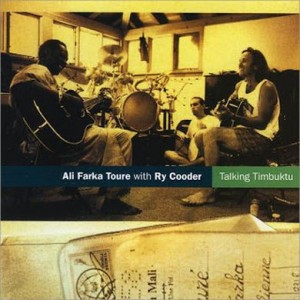 I’ve written elsewhere of my love for the music of Ali Farka Touré, whose every chord calls back memories of the Sahara, and whose spirit hovered above Timbuktu like an angel. His was a profound and subtle art, which turned the “blues” into a clarion of sublime affirmation. His native Mali suffered the exploitation of dictatorship and the horrors of civil war, but he remained undaunted in his optimism. While other Malian musicians fled to Europe and America to pursue their careers, Touré stuck it out at home. The overthrow of dictatorship produced a renaissance of Malian music. Touré was the very solid rock on which that renaissance was founded. True to his character, he spent the last years of his life serving as mayor of a small village near Timbuktu, spending the money from his international recordings to provide it with sewerage and electricity. My favourite album of his will always be The Source(1993), but jostling against it for that position is this wonderful 1995 collaboration with American guitarist Ry Cooder, Talking Timbuktu. Unlike some of the rather patronizing duets between African artists and European or American superstars, this one is an easy-going session between two professional musicians who have little patience with stage-egos or manufactured images. Cooder is as American as they come, and Touré as African as they come, and both understood how those two places are musically and spiritually intertwined. America could not have become America without Africa. It would just have been one more place where they danced with wooden clogs in 4/4 time, and played the accordion. It could not have brought forth Ellington, Gershwin, Satchmo, Goodman and Chuck Berry and all that came from them. Listen to the marvelous performances of “Ai Du” and “Diaraby” on this album, and you’ll hear that brotherhood.
Haydn’s Symphonies “A” and “B”
Since I found a set of scores for Haydn’s first fifty symphonies (published in Germany, and apparently withdrawn from the Mannes College of Music in New York City sometime in the 1960s), it behooves me to listen to them with score in hand. I’m not sure why the first two are not numbered, but labeled “A” and “B”, but I presume it’s because their attribution is doubtful. “B” certainly sounds like Haydn. “A” is plodding and mechanical, and could have been composed by anybody. The role of the composer in the first half of the 18th century was rather like that of a rave dj. He was expected to “spin” whatever was at hand, and much material was recycled from his own (or others’) output. Nobody kept track of who composed what, except as an after-thought. Composers where constantly fired and rehired by patrons, and hopping from one princely court to another created opportunities for purloining works, or rehashing one’s own. When necessary, baroque music could be manufactured in minutes, by assembling cookie-cutter patterns. Some baroque composers, like Giuseppe Torelli, seem to have “composed” more music than could be played end-to-end over their lifetimes. Someone used to the modern idea of a “symphony” would barely recognize these pieces as such. Later on, Haydn himself, and the young Mozart, would create the complex form of that name, by expanding the orchestration and creating structural unity beyond the mere lumping together of vaguely similar pieces. The symphonies of this period were what we would call “suites” today. But that doesn’t mean that they couldn’t be intelligent and entertaining.

First-time listening for August, 2008
18962. (Franz Josef Haydn) Symphony “A” in B‑flat [1762]
18963. (Franz Josef Haydn) Symphony “B” in B‑flat [1765]
(Ruth Golden, soprano) Silent Noon: Songs of Ralph Vaughan Williams
. . . . 18964. (Ralph Vaughan Williams) House of Life, Six Songs to Poems of Dante Gabriel
. . . . . . . . Rossetti for Baritone and Piano [arr. for soprano and piano] [see original at 16063]
. . . . 18965. (Ralph Vaughan Williams) Four Last Songs to Poems of Ursula Vaughan Williams
. . . . 18966. (Ralph Vaughan Williams) “Linden Lea”, song for voice & orchestra (“In Linden Lea”;
. . . . . . . . “A Dorset Song”) [arr. voice & piano]
Read more »
READING – AUGUST 2008
16395. (Thomas T. Allsen) The Royal Hunt in Eurasian History
16396. (Philip K. Dick) The Zap Gun ― Being that Most Excellent Account of Travails and
. . . . . Contayning Many Pretie Histories By Him Set Foorth in Comely Colours and
. . . . . Most Delightfully Discoursed Upon as Beautified and Well Furnished Divers
. . . . . Good and Commendable in the Gesiht of Men of That Most Lamentable Wepens
. . . . . Fasoun Designer Lars Powderdry and What Nearly Became of Him Due to
. . . . . Certain Most Dreadful Forces
16397. (Charles Allen) God’s Terrorists ― The Wahhabi Cult and the Hidden Roots of
. . . . . Modern Jihad
16398. (Peter Ackroyd) Thames ― Sacred River
16399. (Michael H. Shuman) The Small-Mart Revolution ― How Local Businesses are
. . . . . Beating the Global Competition
16400. (Robert McCloskey) Homer Price
16401. (David K. Wyatt) Thailand, a Short History
16402. (Edward Schneier) Crafting Constitutional Democracies ― The Politics of Institutional
. . . . . Design
16403. (Jana Švábová & Tomáš Rygl) Prague
16404. (Jonathan Jarrett) [in blog A Corner of Tenth-Century Europe] Interdisciplinary
. . . . . Conversation: Vegetable Barter [article]
16405. (Steve Muhlberger) [in blog Muhlberger’s Early History] The Pennsic War [article]
(Rich Coad –ed.) Sense of Wonder Stories ― Issue Zero, February 2007 [zine]
. . . . 16406. (Rich Coad) What This Country Needs [preface]
. . . . 16407. (Bruce Townley) Model Citizen [article]
. . . . 16408. (Rich Coad) The Built a Crooked Universe [article]
. . . . 16408. (Rich Coad) Spung! [article]
. . . . 16409. (Ian Maule) I Dood It ! [article]
(Rich Coad –ed.) Sense of Wonder Stories # 1, 2007 [zine]
. . . . 16410. (Rich Coad) Wondertorial [preface]
. . . . 16411. (Randy Byers) The Early Days of a Better Genre [article]
. . . . 16412. (Bruce Townley) The Shadows Out of Space [article]
. . . . 16413. (Robert Lichtman) Lovecraft In The Real World [article]
. . . . 16414. (Bill Burns) Thomas Edison and the Electric Pen [article]
. . . . 16415. Letters from Chris Garcia, Mark Plummer, Harry Bell, John Purcell, Jerry
. . . . . . . . Kaufman, Claire Brialey, and Cy Chauvin [letters]
(Rich Coad –ed.) Sense of Wonder Stories #2, July 2008 [zine]
. . . . 16416. (Rich Coad) Wondertorial [preface]
. . . . 16417. (Bruce Gillespie) The Good Soldier: George Turner as Combative Critic [article]
. . . . 16418. (Bruce Townley) A Dream Flight [article]
. . . . 16419. (Peter Weston) Heresy, Maybe? [article]
. . . . 16420. (Graham Charnock) J. G. Ballard, A Journey of Inference [article]
. . . . 16421. Letters from Robert Lichtman, John Purcell, Eric Mayer, John Nielsen-Hall, Jim
. . . . . . . . Linwood, Mog Decarnin, James Bacon [letters]
16422. (Eric L. Jones) Cultures Merging ― A Historical and Economic Critique of Culture
(Robert A. Heinlein) The Unpleasant Profession of Johnathan Hoag:
. . . . 16423. [3] (Robert A. Heinlein) The Unpleasant Profession of Jonathan Hoag [story]
. . . . 16424. [3] (Robert A. Heinlein) The Man Who Traveled in Elephants [= The Elephant
. . . . . . . . Circuit] [story]
. . . . 16425. [4] (Robert A. Heinlein) “All You Zombies—” [story]
. . . . 16426. [2] (Robert A. Heinlein) They [story]
. . . . 16427. [2] (Robert A. Heinlein) Our Fair City [story]
. . . . 16428. [2] (Robert A. Heinlein) “—And He Built a Crooked House” [story]
16429. (Marjorie Mandelstan Balzer) The Tenacity of Ethnicity: A Siberian Saga in Global
. . . . . Perspective
(Yaron Matras, Peter Bakker & Hristo Kyuchukov –ed.) The Typology and Dialectology of Romani:
. . . . 16430. (Peter Bakker & Yaron Matras) Introduction [preface]
. . . . 16431. (Peter Bakker) Athematic Morphology in Romani: The Borrowing of a
. . . . . . . . Borrowing Pattern [article]
. . . . 16432. (Viktor Elšik) Towards a Morphology-based Typology of Romani [article]
. . . . 16433. (Yaron Matras) The Typology of Case Relations and Case Layer Distribution in
. . . . . . . . Romani [article]
. . . . 16434. (Vít Bubeník) Object Doubling in Romani and the Balkan Languages [article]
. . . . 16435. (Norbert Boretzky) Suppletive Forms of the Romani Copula: “ovel /avel”
. . . . . . . . [article]
. . . . 16436. (Milena Hübschannová & Vít Bubeník) Causatives in Slovak and Hungarian
. . . . . . . . Romani [article]
. . . . 16437. (Birgit Igla) The Romani Dialect of the Rhodopes [article]
. . . . 16438. (Petra Cech & Mozes F. Heinschink) The Dialect of the Basket-Weavers
. . . . . . . . [Sepečides] of Izmir [article]
. . . . 16439. (Victor A. Friedman) Linguistic Form and Content in the Romani-language Press
. . . . . . . . of the Republic of Macedonia [article]
. . . . 16440. (Ian F. Hancock) George Borrow’s Romani [article]
16441. (Steve Muhlberger) [in blog Muhlberger’s Early History] Exciting Views on Scholarship
. . . . . [article]
16442. (Michael Drout) [in blog Wormtalk and Slugspeak] A Model ―But Would it Work if it
. . . . . Were Generalized? [article]
16443. (Michael Drout) [in blog Wormtalk and Slugspeak] Method: Push the Metaphor Until it
. . . . . Breaks ― or, Mocking “Imbricated” Yet Again [article]
16444. (Tu Thanh Ha, Bill Curry & Anne McIlroy) Inspectors Failed to Adopt More Rigorous
. . . . . U.S. Measures [article]
16422. (Eric L. Jones) Cultures Merging ― A Historical and Economic Critique of Culture
“Culture” is a slippery concept, used in many different ways by historians, anthropologists and economists. Jones’ book is more a survey than the critique implied by the title, but it is an extremely useful and well-presented survey. I prefer this, since it is best to start off with some idea of who has thought and said what about the subject before plunging into debates. Presumptions about culture, especially about whether it determines how people act economically, or merely shapes itself on the basis of how people mustact economically, underlie all sorts of theories and descriptions in the three fields. Usually these presumptions are shared by some group of thinkers without them being explicitly stated. Arguments between different groups, with different presumptions, usually result in confusion. But a number of works, in all three disciplines, either illustrate or make explicit particular ideas of culture’s relation to behaviour and economies. Scholars have taken their cues from these seminal works, and policy-makers adhered to any of several contradictory attitudes generated by them. Some have been downright silly (such as “the end of history” and “clash of civilizations” tom-foolery). Jones presents most of them fairly dispassionately, but he is obviously impatient with the stupider ones, and does not hide it. Of special interest to me is his sensible discussion of the “Asian Values” mystique, promoted by many East Asian economists and politicians, and often uncritically accepted elsewhere. (He cites Steve Muhlberger and myself in this discussion, so I could hardly fail to find it interesting.) On the whole, Jones gets the horse in front of the cart rather than the other way round. He plumps for common-sense causation when it is possible, and holds back his conclusions when causation cannot be discerned, rather than appeal to enigmatic collective properties.