One of the creepiest documentaries I’ve ever seen. It follows the activities of a fundamentalist childrens’ camp that employs grotesque brainwashing techniques to indoctrinate children, largely for obvious political ends. The organizer, a monstrously evil woman, makes you sick with every word she spouts. Also included are a famous pastor, Ted Haggard, one of the most influential evangelicals in the country, preaching anti-gay hatred at the children. Haggard was later discovered having sex and doing hard drugs with gay hustlers, and resigned. Another disgusting scene involves children babbling “in tongues” while worshiping a card-board cutout of George Bush, Jr. It should be noted that the movement’s leaders considered the documentary to be a fair representation of their views.

(Hélène Claudot-Hawad) “Éperonner le monde” ― Nomadisme, cosmos et politique chez les Touaregs
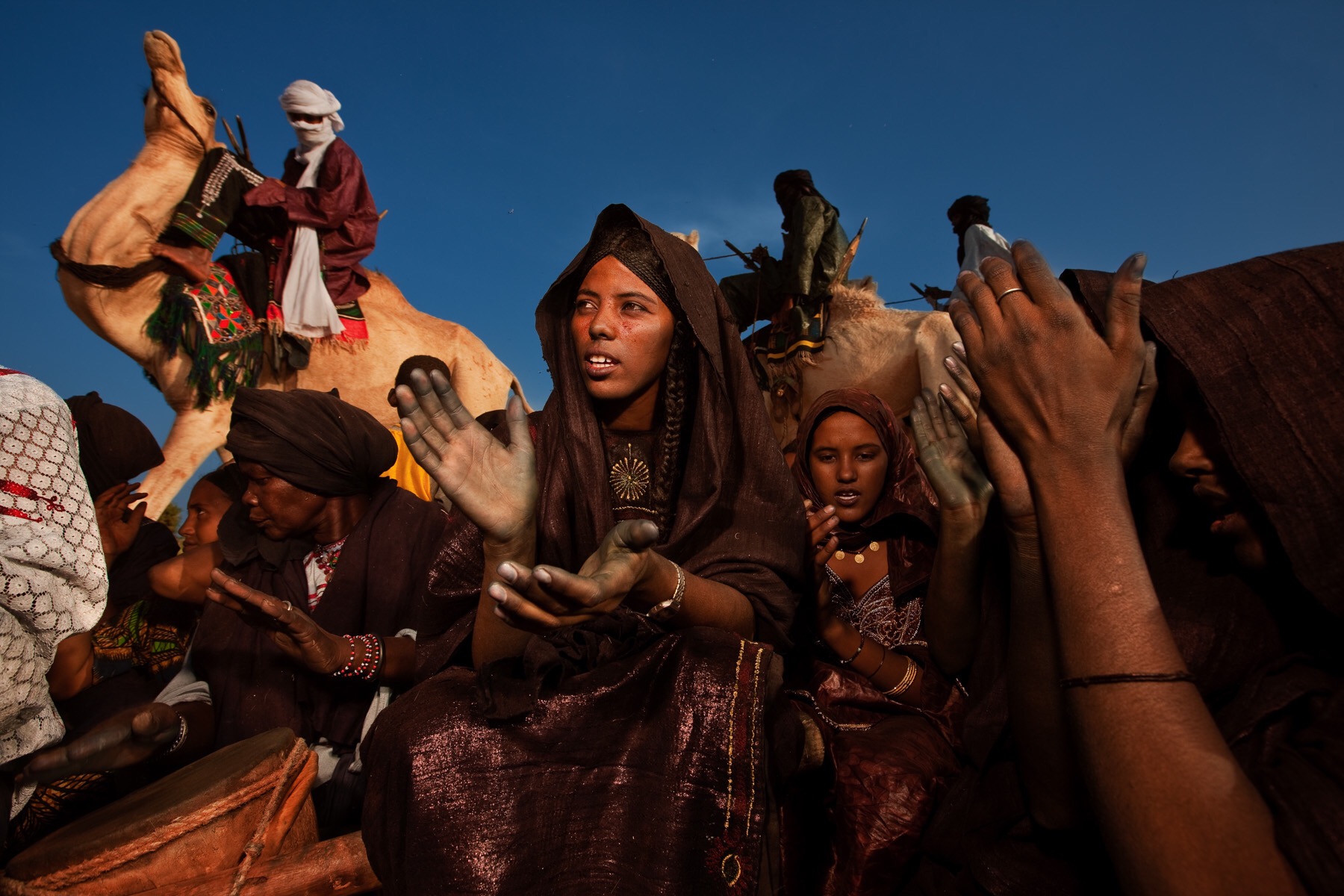
Ténéré daféo nikchan .… yes, I’m back there again. The smells, the sounds, the wind. This collection of articles, written over a decade by a leading authority on the politics of Saharan nomads, was an absolute delight for me to read. It deals with the very people (not just the same ethnic group, but the particular segment of them, the kel-Aïr of Niger) who first awakened me to the nature of proto-democratic institutions. I read these articles with a tremendous wave of nostalgia. When as a naive toubab, I came to that part of Africa, many years ago, I had been led by the small amount of literature available on the subject to believe that the Tuareg represented a strictly stratified society, rigid and traditional — the last place to look for any kind of proto-democratic elements. But what I saw confused me, and ultimately enlightened me: a maze of conciliar institutions, both formal and informal, embodying all the elements from which democratic theory evolved in less exotic places. Good and bad things, but the same stew-pot of good and bad from which our best institutions ultimately evolved. I also saw that much that had been written or assumed was blind to this, shaped by presumptions that desert nomads where either chaotic beings without “complex” political institutions, or a rigid, changeless hierarchy in which discussion, representation, and equality played no part. My eyes told me that neither presumption was valid. It was this experience that got me interested in the issue of the universal roots of democratic practice, and triggered decades of reading. Sadly, when Steve Muhlberger and I began our first work on the subject, there was no published work on the Tuareg usable for our purpose. This book, had it existed then, would have been a centerpiece of our discussion. Read more »
SEVENTH MEDITATION ON DEMOCRACY (written October 1, 2008)
A few days ago, I was in the subway, and I overheard a conversation about our current national election. Two boys who, from their appearance, could have been no further along in school than grade nine or ten, were discussing the televised debates between the leaders of the five major political parties. What struck me, as I listened in, was that the discussion was cogent and intelligent. One of the boys, who seemed the youngest, was particularly articulate, and his opinions were not the simple parroting of some adult he had heard, or the pursuit of a party line. In fact, his analysis of the debate showed keener observation and judgment than that of the professional commentators who dissected the debate after the broadcast.
Read more »
FILMS JULY – SEPTEMBER 2008
(Chaffey / McGoohan 1967) The Prisoner: Ep.1 ― Arrival
(Honda 1966) The War of the Gargantuas [ American release version of Furankenshutain no
. . . . kaijû: Sanda tai Gaira]
(Cregeen 1999) MidSomer Murders: Ep.10 — Death of a Stranger Read more »
First-time listening for September, 2008:
18988. (Hugo Alfvén) Swedish Rhapsody # 2, Op.24, R58 “Uppsala”
18989. (Hugo Alfvén) Symphony #1 in F minor, Op.7, R 24
18990. (Hugo Alfvén) Drapa, Op. 27 “In Memoriam King Oscar II”
18991. (Hugo Alfvén) Uppenbarelsekantat “Revelation Cantata”, Op. 31: Andante religioso
18992. (Hugo Alfvén) Symphony #2 in D major, Op.11, R 28
18993. (Pixies) Wave of Mutilation: Best of Pixies
18994. (Zap Mama) Sabsylma
18995. (Hugo Alfvén) Swedish Rhapsody #3, R 120 “Dalarhapsodien”
18996. (Hugo Alfvén) Symphony #3 in E major, R 54
18997. (Hugo Alfvén) The Prodigal Son [Den forolade sonen], ballet suite, R 214
18998. (Ashley McIsaac) Helter’s Celtic
18999. (Arctic Monkeys) Whatever People Say I Am, That’s What I’m Not
18900. (Gavin Taaffe) Sad Songs
19001. (Ornette Coleman) The Shape of Jazz to Come
READING – SEPTEMBER 2008
(Peter Bakker, et al.) Basque Pidgins in Iceland and Canada:
. . . . [——] (Gidor Bilbao) Glossaria Vasco-Islandica-ren aurkezpen gisakoa [preface]
. . . . 16445. (Jose Ignacio Hualde) Foreword to Glossaria duo Vasco-Islandica [preface]
. . . . [——] (Nicolaas G. H. Deen) Glossaria duo Vasco-Islandica [text in Basque] [article]
. . . . 16446. (Jose Ignacio Hualde) Icelandic Basque Pidgin [article]
. . . . 16447. (Peter Bakker) “Las lengua de las tribus costeras es medio vasca” ― Un pidgin
. . . . . . . . . vasco y amerindio utilizado por europeos y nativos americanos en Norteamérica,
. . . . . . . . . h. 1540‑h. 1640. [text in Spanish] [article] Read more »
(George Woodcock) Letter From the Khyber Pass and Other Travel Writing
I would happily take George Woodcock as a model for travel writing. He himself outlines the sources of his style: eighteenth century English models of clarity and precision, the writings of early naturalists and scientists, and the direct influence of his close friend, George Orwell. Woodcock is best known as a historian of anarchist theory, and in Canada as a champion of Canadian literature (especially that of the western provinces), but for decades he put bread on the table by traveling to remote corners of the Earth and writing about it in his crisp, evocative prose. A fine description of Salish spirit dance, for which he only had to travel a few miles from his doorstep, and a keenly observant tour of the Canadian arctic show that he didn’t have to leave the country to create the sense of wonder. But the strongest stuff is when he writing about India, especially the Tibetan Exile communities that he himself helped fund and organize, and in the jungle temples of Cambodia. Read more »
A radio adaptation of The Day the Earth Stood Still
Radio drama continued longer than people generally imagine. Lux Radio Theatre’s last broadcast was on April Fool’s Day, 1954, and they chose a dramatization of the classic 1951 science fiction film, The Day the Earth Stood Still. Michael Rennie reprised his film role as the alien visitor Klaatu. Jean Peters performed the role taken by the husky-voiced Patricia Neal. From the voice, it sounds to me like Billy Gray also reprised his role from the film, as the curious young boy Bobby. His performance was critical to the film’s effectiveness, but this is seldom acknowledged. Gray went on to a solid film career as a supporting player, and some success as a speedway motorcycle racer and the inventor of the F‑1 guitar pick. The radio adaptation kept close to the film script, merely tweaking the lines when visual elements had to be evoked. Rennie sounded a little tired, but on the whole, it was a fine translation of the film into a different medium.
Tuesday, Sept 16, 2008 — More On Terms Misused
“Laissez-faire” is one of many terms that are consistently misunderstood, misused, and distorted.
The term originated in 17th century France. Under the rule of Louis XIV, France had a centralized, state-managed economy. Virtually all key economic decisions were in the hands of Louis’ intendant (“manager” is a better translation than “minister”), Jean-Baptiste Colbert. Colbert directed the country’s industries with absolute authority, punishing the disobedient with brutal sanctions. He suppressed what little labour organization there was. He encouraged the creation of giant corporations, and he gave out military contracts, monopolies, subsidies and privileges to those he liked. The corporations grew fat on the proceeds of Louis’ incessant wars. France was a sort of Haliburton’s Heaven. As a consequence, after a brief boom created by the initial concentration of capital, France’s technology and economy stagnated, the gap between rich and poor widened, and those at the bottom starved, just as it has transpired in all such dirigiste regimes. Read more »