First-time listening for July, 2007
Posted by Phil Paine
on July 31, 2007
No comments
17395. (Aztec Camera) Stray
17396. (Johannes Brahms) Piano Trio #1 in B, Op.8
17397. (Johannes Brahms) Piano Trio #2 in C, Op.87
17398. (Johannes Brahms) Piano Trio #3 in C Minor, Op.101
17399. (Johannes Brahms) Piano Trio #4 in A, Op. Posth.
(Homayun Sakhi) The Art of the Afghan Rubâb:
. . . . 17400. (Homayun Sakhi) Raga Madhuvanti
. . . . 17401. (Homayun Sakhi) Raga Yaman
. . . . 17402. (Homayun Sakhi) Kataghani
17403. (Karol Szymanowski) Violin Concerto #1, Op.35
Read more »
READING – JULY 2007
Posted by Phil Paine
on July 31, 2007
No comments
15105. (Joseph-Charles Taché) Des provinces de l’Amérique du Nord et d’une union fédérale
(Stephen Leacock) Nonsense Novels:
. . . . 15106. (Ross Beharriell) Introduction [preface]
. . . . 15107. (Stephen Leacock) Author’s Preface [preface]
. . . . 15108. [2] (Stephen Leacock) Maddened by Mystery:or the Defective Detective [story] Read more »
FIRST MEDITATION ON DEMOCRACY (written Wednesday, July 25, 2007)
Posted by Phil Paine
on July 25, 2007
No comments
All philosophies stand on choices that cannot be justified by proof. Any amateur Socrates can demonstrate that I can’t prove that two and two are four, or that freedom is desirable, or even that I exist. Ultimately, ideas, no matter how passionately held, rest on assumptions that cannot be known with absolute certainty. It does not follow from this that we should avoid acting on significant assumptions, or that we should abandon the analysis of ideas. If I’m standing in the middle of the street, and see a twelve-ton truck hurtling in my direction, I don’t stand there, paralyzed by epistemological uncertainty. I jump out of its way. Later, seated on a comfortable couch, with a cold beer in my hand, I might indulge in the luxury of reflecting that the truck may have been an illusion, or that I cannot prove with certainty that being hit by a truck is worse than not being hit by a truck. All of us must choose our basic assumptions, either in a conscious process, guided by reason, or unconsciously. Read more »
Sandy Scofield
Posted by Phil Paine
on July 25, 2007
No comments
One of the finest singers in Western Canada, Sandy Scofield glides effortlessly from her Métis and Cree musical roots into a high-level synthesis of jazz, blues, rock and pop. Long known in aboriginal music circles, she deserves to break out into the global music scene. Her music is original, refined, and intelligent. I possess three of her four albums, Dirty River (1994), Riel’s Road(2000), and Ketwam (2002). I have yet to hear all of this year’s release, Nikawiy Askiy, but I’ve heard three songs from it, and they clearly indicate that her musical evolution is continuing without hindrance. Riel’s Roadis probably the best introduction to her work, opening with the stunning “Beat the Drum (Gathering Song)”, and going on to explore emotionally the aftermath and consequences of the most dramatic events in post-Confederation Canada’s history, the Métis uprising and death of Louis Riel. However, most of the songs on this album have a folk-jazz feeling. On Ketwam, which focuses on much more traditional aboriginal-métis material, she collaborates with the vocal trio Nitsiwakun, of which she is one member (the other two are Lisa Sazama and Shakti Hayes), with fiddle Daniel Lapp, and with vocalist Winston Wuttunee. The Cree-language songs are the most powerful. The album is truly collaborative. Some are the finest moments belong to Hayes on “Nitsimos” and to “Wuttunee” on “Tapweh” (a traditional round dance that would fit in at any western powow).
(Cordwainer Smith) You Will Never Be the Same
Posted by Phil Paine
on July 23, 2007
No comments
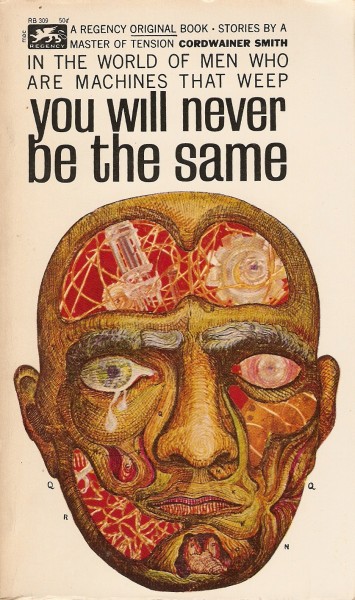 As the numbers in brackets indicates, I’ve read all the stories in this book several times. I read Cordwainer Smith whenever I want to be reminded of what Science Fiction once was: a field in which intellect, imagination, and artistic integrity combined to transcend the limitations of contemporary culture. Nobody was better equipped to think unconventionally than was “Cordwainer Smith”, who was really Paul Myron Anthony Linebarger. American born, but raised in China (where he was known as 林白楽 [Lin Bai-lo] ), France and Germany, Linebarger was at various times a spy, expert in psychological warfare, academic, and adviser to the White House on Asian affairs (though refusing to be involved in the Vietnam War). He was, odd as it seems, Sun Yat-sen’s godson, and negotiated international treaties when he was teenager. Yet his identity remained a secret to the science fiction community when his stories appeared in the magazines.
The stories he wrote were far in advance of their time. In 1945, these words appeared at the beginning of “Scanners Live In Vain”:Martel was angry. He did not even adjust his blood away from anger. Read more »
Friday, July 13, 2007 — Cheering News
Posted by Phil Paine
on July 13, 2007
No comments
Three very pleasant items in tonight’s news.
Criminal financier Conrad Black, who is also a member of the British House of Lords, has been found guilty on four counts (racketeering, obstruction of justice, money laundering, and fraud) in a Chicago court, and may face prison time. While he is probably not a big name in the United States, and the trial drew only moderate coverage from American media, it was followed with great interest in Canada, where he has been despised by most decent people for decades. Read more »
15132. (Marshall Kirk & Hunter Madsen) After the Ball: How America Will Conquer Its Fear and Hatred of Gays in the ’90s
Posted by Phil Paine
on July 13, 2007
No comments
This fascinating book dates from 1989, when the Gay Rights movement was in confusion and transformation. The authors, who came from a background of neuropsychology and mathematics (Kirk), public relations and advertising (Madsen), where among the minority of gay intellectuals who felt that the stagnation that their cause had suffered during the resurgence of religious fundamentalism in the U.S. owed more to flaws and failures in the gay community than to the strength of its enemies. They felt that there was a clearly trodden path by which despised minorities had historically won a place in American society, and that their generation of gay activists had failed to follow that path, and become their own worst enemies. In retrospect, much of their argument now seems common sense. Considerable progress has been made in this area (though much more in Canada than in the United States), and it has been made largely by the growth of a new mindset among gays. Kirk and Madsen presaged this new mindset. Read more »
15131. (Jules Verne) Le château des Carpathes
Posted by Phil Paine
on July 12, 2007
No comments
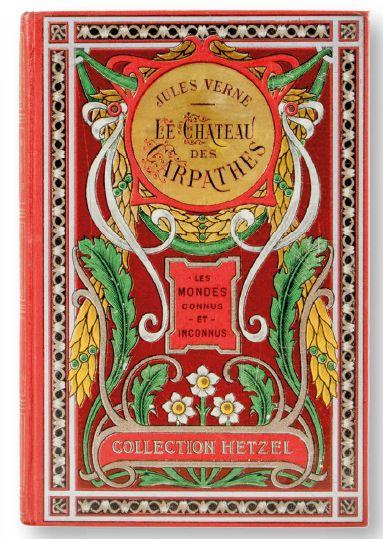 This is a minor work by Jules Verne, but it entertained me greatly because it’s set in Transylvania, where I have just been hiking and touring. In fact, the main action takes place precisely in the place I was exploring on foot with my friend Isaac White ― the mountains of Hunedoara. Here he places a mysterious castle, and a mad scientist who has invented television. The book was written in 1893, and counts as one of the first fictional speculations on this idea that did not involve the supernatural. However, the story is pedestrian by Verne’s standards, and consists mostly of dissertations on the flora, fauna, geology, and history of the region, in the style that Verne fell back on when he wrote on autopilot.
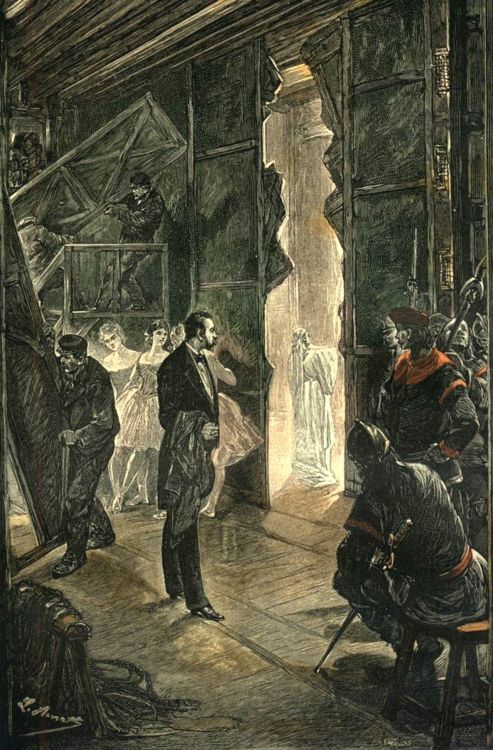
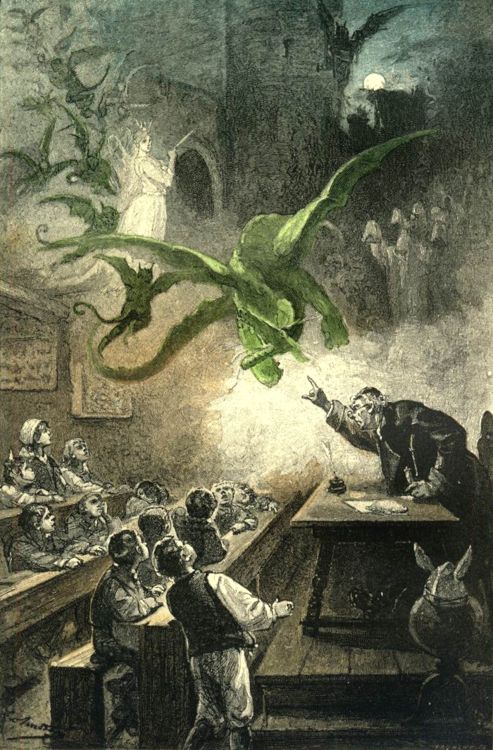
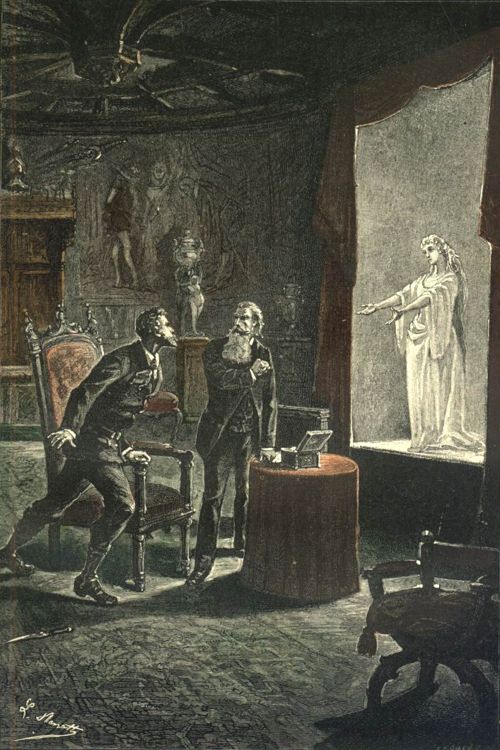
illustrations by
Léon Benett
Holy Fuck
Posted by Phil Paine
on July 11, 2007
No comments
One reviewer describes Holy Fuck as “strangely melodic and pulse pounding free-form fusion of the heavy chug and groove rock of Trans Am and the quirkiness of Beck rolled into one mesmerizing viewing and listening experience.” Well, I don’t know if you can form any plausible impression from that description, but it’s fairly accurate. A more comprehensible way of describing this Toronto band is to say that they try to duplicate, live, using physical instrumentation, without pre-taping or splicing, the sounds that you would think could only be done by computer. I think they achieve this admirably, judging from the recording I have of their eponymous debut allbum. Here, band members Brian Borcherdt, Graham Walsh, Mike Bigelow, Loel Campbell, Kevin Lynn, Glenn Milchem, Robbie Kuster, Matt Schulz are joined by Laurence Currie and Dave Newfeld (of Broken Social Scene). Something like this should be seen live. I haven’t had the chance to, yet, but a hint of it can be seen in the videos available on their Myspace site.