 This bizarre documentary about a Northern Ontario inventor who is determined to produce a grizzly-bear-proof suit is one of the funniest things I’ve seen all year. What makes it funny is that there is no spoof involved. The man really exists, and he has devoted his life and fortune to developing a product which is not only absurd in conception, but completely useless. With a circle of friends, some doubtful, some indulgent, some caught up in his vision quest, he submits his prototypes to a series of extreme tests. He develops a fire-proofing coating for the suit, in which one of the active ingredients in the formula is diet pepsi. One of the drawbacks of the suit is that you can’t walk in it if there is a slope or a rough surface, and you can’t get up if you fall over. However, you will be safe from bears.
(Lynch 1996) Project Grizzly
(James E. Gunn) Station In Space
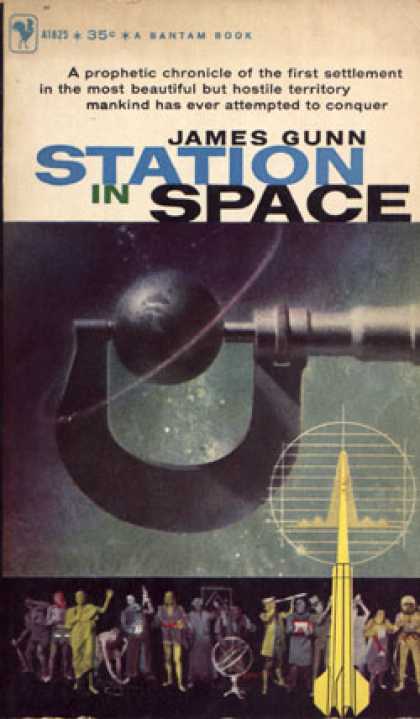 James Gunn was writing “hard science fiction” in the 1950’s, and was in some ways the precursor of people like Ben Bova and Larry Niven. The connected stories in this book are Gunn’s attempt to envision the construction of an orbiting space station, at a time when “serious” scientists still dismissed talk of space exploration as mere fantasy. Unlike many who had written stories in which eccentric scientists built space ships in their back yards, Gunn understood that such a project would require engineering and financing on a mammoth scale, and would involve political complexities. The stories are quaint, now, but will interest anyone who reads fiction with a historical perspective.
contents:
15119. (James E. Gunn) The Cave of Night [story]
15120. (James E. Gunn) Hoax [story]
15121. (James E. Gunn) The Big Wheel [story]
15122. (James E. Gunn) Powder Keg [story]
15123. (James E. Gunn) Space Is a Lonely Place [story]
15105. (Joseph-Charles Taché) Des provinces de l’Amérique du Nord et d’une union fédérale
The Separatist movement in Québec has managed to train an entire generation into thinking that Québec’s entry into Confederation was some sort of conspiratorial swindle, but the truth of the matter is that the very idea of Confederation originated in that province, and was largely promoted by French Canadian intellectuals seeking a strategy to defend and preserve their culture. The fact is that the principle threat to the language and distinct culture of French Canada was, in the 19th century, the possibility of the absorption of Canada by the United States. The first detailed and systematic proposal for a Canadian Confederation was this treatise by Taché, published in 1858. Taché was a doctor practicing in the lumber camps of the wilder parts of the Gaspé peninsula, where he became enamored with aboriginal culture, and collected folklore. His later career in journalism focused on the development of a strong and distinct French Canadian literature, preferably one that “ventured into the unknown.” As a matter of principle, he refused to wear any article of clothing not manufactured in Canada. He was, in effect, a romantic nationalist of the 19th century mode. Not altogether progressive, he preferred a timid reform of the archaic system of seigniorial land tenure, rather than the complete abolition that the public clamored for. This lost him support in his political career, though in other issues he remained highly popular. Read more »

FILMS APRIL-JUNE 2007
(Jones & Upton 1999) Wild Europe: Ep.6 ― Wild Cities
(Chow 2004) Kung Fu Hustle
(Vicente, Chasse & Arntz 2004) What tHe βLєєP Dө wΣ (k)πow!?
(Gold 1987) Inspector Morse: The Remorseful Day
(G. W. Pabst 1929) Die Büchse der Pandora [Pandora’s Box]
(Sales 1990) The Silk Road: Khotan, Oasis of Silk and Jade
(Zauberman 1993) Moi Ivan, toi Abraham
(Davis 1997) Nova: Curse of T. Rex
(Grint 1984) The Adventures of Sherlock Holmes: The Crooked Man
(Proyas 2004) I, Robot
*(Boyle 2007) Sunshine
Read more »
First-time listening for June, 2007
17311. (Elvis Costello) The Very Best of Elvis Costello and The Attractions
17312. (Nicolae Guţǎ) Selected Romanian Manele Songs
17313. (Bohuslave Martinů) Symphony #1
17314. (Bohuslave Martinů) Inventions for Large Orchestra [Invence Symfonická skladba o
. . . . . třech vĕtách]
17315. (Ján Šimbracký) Congrati sunt inimici nostri
17316. (Ján Šimbracký) Angelis suis mandavit dete
Read more »
READING – JUNE 2007
(Fritz Leiber) Swords and Deviltry:
. . . . 15064. (Fritz Leiber) Introduction [preface]
. . . . 15065. (Fritz Leiber) Induction [story]
. . . . 15066. (Fritz Leiber) The Snow Women [story]
. . . . 15067. (Fritz Leiber) The Unholy Grail [story]
. . . . 15068. [2] (Fritz Leiber) Ill Met In Lankhmar [story]
15069. (Robert Benchley) Happy Childhood Tales [story] Read more »
Shanghai Lounge Divas

Li Xiang-Lan
Between the two World Wars, Shanghai was one of the most cosmopolitan and sophisticated cities in the world. It was also one of the world’s hotspots for Jazz. The great jazz bands toured there, and there was a considerable pool of local talent. Pre-eminent among the local artists were the “Lounge Divas”, female singers who owed their original inspiration to American stars like Billie Holiday and Bessie Smith, and to European cabaret singers like Edith Piaf, but who quickly developed their own, individual styles. Among the greatest of these divas were Li Xiang-Lan, Bai Kwong, Chang Loo, and Chow Hsuan. All had glorious voices. I recently acquired a fascinating 2‑cd set. The first cd has the original recordings from the 1930’s. The second has modern remixes of the same songs, done up to suit the current taste for dance music in Asia. I have no objection to these. The dance remixes are perfectly legitimate, and reasonably well done. But the originals are far more interesting. They take you on an amazing journey to a place and era lost in dim light and a haze of cigarette smoke.
A number of years ago, I was walking across the plaza of Toronto’s City Hall. Designed in the 1960’s by Finnish architect Viljo Revell, it’s a pleasant place, filled with skaters in the winter (when the ornamental pond is frozen), and music concerts in the summer. On this particular occcasion, a Big Band was playing music from the 1930’s and 1940’s. Folding chairs had been set up in the plaza, and there was a reasonably large crowd enjoying the music. When I sat down among them, I noticed that almost everyone there was a) very old, and b) Chinese-Canadian. I turned to a dignified-looking elderly couple, and asked them why so many Chinese had come to this concert. With a twinkle in his eye, the man said: “This is the music of our youth. We listened to this in Shanghai, when we were just married.” Listening, now, to Chang Loo singing “All the Stars in the Sky”, I think I can understand what that twinkle in his eye was all about.
15087. (Philip Zimbardo) The Lucifer Effect ― Understanding How Good People Turn Evil
Psychologist Philip Zimbardo devised and supervised one of the most famous experiments in social dynamics, the Stanford Prison Experiment. A group of college students were cast in the roles of “guards” and “inmates” in a mock prison. Intense abuses spontaneously developed, as the “guards” quickly evolved into sadistic monsters.
But this book is not just about his landmark experiment. Zimbardo was asked to testify as an expert witness in abuse of power and the psychology of turture during the investigations of the abuses in Abu Ghraib. It was this experience that prompted him to put together a comprehensive study of all the social psychology experiments, such as Milgram Experiment, which led up to his own work, and to blend it with a detailed analysis of Abu Ghraib. Read more »
(Fritz Leiber) Swords and Deviltry
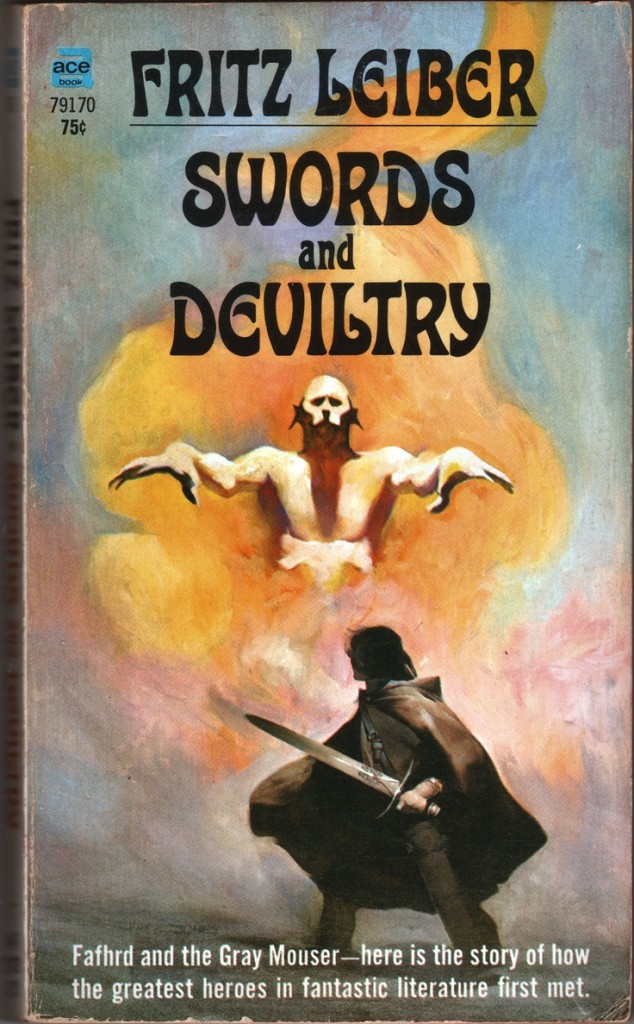 God only knows how much “sword &sorcery” type fantasy is in print. But if, like me, you find very little of it appealing to either your imagination or your intelligence, then it’s nice to be reminded that some of the classics of the field remain fresh and satisfying. Few people can claim to have written better heroic fantasy than Fritz Leiber, whose Fafhrd and the Gray Mouserstories where written with wit and sophistication. He wrote with an adult sensibility, avoiding the prissiness and infantile repression that were common in the field. These stories, which were written over several decades, were collected in several volumes, of which this is the first. The last story, “Ill Met In Lankhmar”, is just about as good as a story about a muscular barbarian hero can get. Read more »