15036. (Simon Schama) Rough Crossings ― Britain, the Slaves, and the American Revolution
15037. (Timothy Finn) Three Men {Not} in a Boat and Most of the Time Without a Dog
15038. (Don Aker) Stranger At Bay
15039. (George Santayana) Classic Liberty [article]
15040. (Tony Karon) Condi’s Free Ride: The Fantasy of American Diplomacy in the Middle
. . . . . East [article]
15041. (Glen Greenwald) Your Modern-day Republican Party [article]
15042. (Neil McKenna) The Secret Life of Oscar Wilde
Read more »
READING – APRIL 2007
Posted by Phil Paine
on April 30, 2007
No comments
(Wilcox 1956) Forbidden Planet
Posted by Phil Paine
on April 28, 2007
No comments
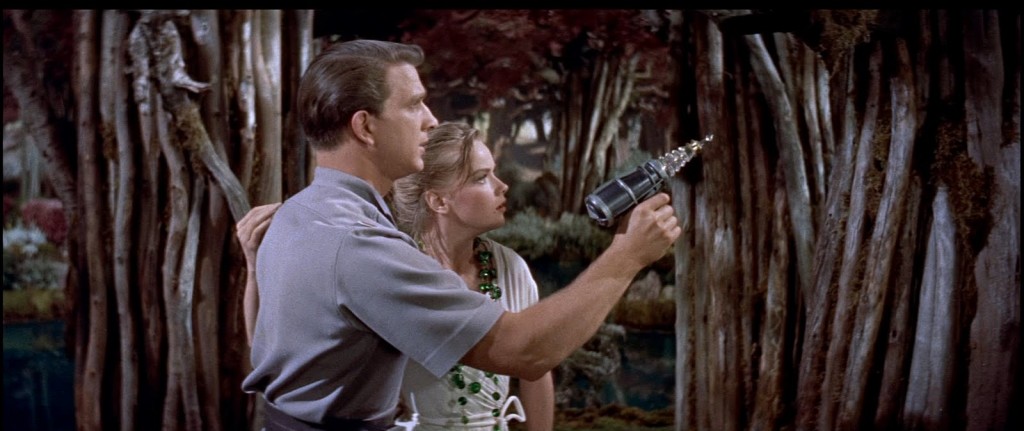 How many times have I seen Forbidden Planet? I’m not sure, but it is one of my earliest childhood memories. Despite much that is quaint and embarrassing, it still holds up as one the few films with the essential “sense-of-wonder” component central to literary Science Fiction, but almost always absent from SF on film.
Some trivia about the wonderful, pioneering electronic score by husband and wife team Louis and Bebe Barron: The film’s producers originally wanted Harry Partch to score the film. The Barrons were only supposed to make a few effects. But the first sample they produced convinced the producers to go with them for the entire film. During the film’s preview, when the first electronic “tonalities” came on, the audience broke out in spontaneous applause. Many people at the time found the quite terrifying. Unfortunately, the musicians union would not recognize what they were doing as “music”, and the Barrons never did another film score.
Crowded House, Split Enz, Neil Finn, Tim Finn
Posted by Phil Paine
on April 20, 2007
No comments
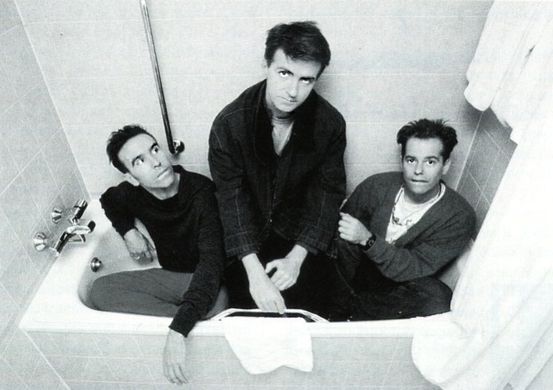 Crowded House has a tremendous personal significance for me. I have not had many days of undiluted happiness, but perhaps the best of them ended with putting on Temple of Low Men for the first time. For some strange reason, I had never heard it, though I had been familiar with other Crowded House albums for years. So I can’t be objective about the song “Into Temptation”. But I think that even without the personal associations, I would recognize it as a superbly crafted song. And that about sums up Neil Finn’s songwriting: superb craftsmanship and intelligence applied to intensely emotional subjects. I am not a sentimental person, and musical treatments of the joys and disappointments of love don’t usually tug at my heart. But nothing seems artificial or childish when Neil Finn writes it.
For this Focus, I’m listening to the entire corpus of Crowded House, and and much it’s predecessor Split Enz, as well as the solo work of brothers Tim and Neil Finn. My collection is fairly complete. I have all of the original Crowded House studio albums [ Crowded House (1986); Temple of Low Men (1988); Woodface (1990); Together Alone (1993)], as well as the post-breakup singles collection Afterglow (1999) and the compilation album Recurring Dream (1996), which also included three unreleased songs. In addition, I have the Bonus Live album which had a limited release as a promotion for Recurring Dream . This contains some unusual live performances, some of which eclipse the studio versions. The ten minute reworking of “Hole in the River” is a complete metamorphosis. In addition, I have a personal anthology of downloads of miscellaneous live performances, including odd-ball collaborations with Sinead O’Connor and Cheryl Crow. The only thing I’m missing is Farewell to the World (1996), their last live concert in Sidney. This is not even listed on Amazon.com, so I presume it can be found only in Australia or New Zealand. Read more »
(Jarmusch 2005) Broken Flowers
Posted by Phil Paine
on April 10, 2007
No comments
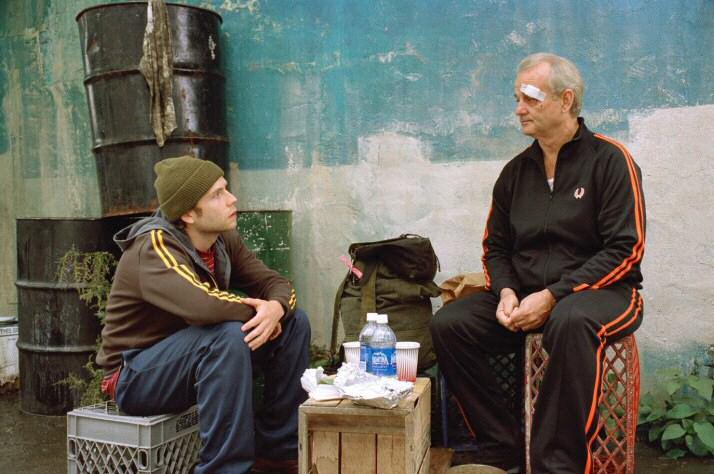 My friend Skye Sepp brought this film to my attention. I’ve been burnt a few times by movies starring Bill Murray. But he is perfect in this one. The film is a character comedy. It isn’t a “romantic comedy”, since there is no successful romantic resolution. It has a very contemporary feeling. The characters and setting are definitely now — that is, the United States as it really is in 2005, and not some behind-the-times facsimile generated by writers and film-makers who have lost touch with the culture. Jim Jarmusch wrote and directed the film, and it’s obvious that he keeps his eyes and ears open, and knows his own society. Any American who knows how to use Ethiopian pop music in a film, in a way that shows a little respect, plainly has his finger on the pulse.
Ursula K.LeGuin’s Earthsea books
Posted by Phil Paine
on April 4, 2007
No comments
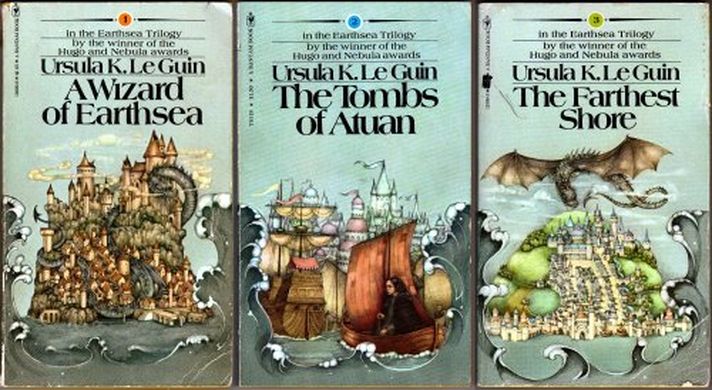 I decided to read through the well-known series of juvenile fantasy that I never got around to reading. Lequin’s Earthseabooks are widely admired. Certainly, the first volume starts off well. The fantasy world is well-constructed, with the geography meticulously thought out. Things move along quickly, because the prose style is very lean, with only the odd bit of concrete, sensory description thrown in judiciously. I would never right that “thin” a prose myself, but LeGuin seems to be able to get away with it. The main character, Ged, is a bit of a stick of wood. I found myself picturing him as Wesley Crusher dressed up in a wizard cloak. The dragon is the best character. The second book was unfocused, the third was a good read, but recycled the themes of the first, and the fourth, written a full twenty-two years after the first, was downright boring. There was a fifth, published in 2001, which I haven’t even looked for. I would have to say that only the first volume really inspired me, and that it supplied all that I needed from the series.

FILMS JANUARY-MARCH 2007
Posted by Phil Paine
on March 31, 2007
No comments
(Sweete 2002) Timothy Findlay’s Elizabeth Rex[tv play, w. Diane D’aquila, Peter Hutt, Brent Carver]
(Resnais 1955) Nuit et brouillard
(Fisher 1959) The Hound of the Baskervilles
(Guillermin 1978) Agatha Christie’s Death on the Nile
(Sales 1990) The Silk Road: In Search of the Kingdom of Lou-Lan
(Lambert 1992) Pet Sematary
(Freundlich 2004) Catch That Kid
(Carpenter 1978) Halloween
(Heston 1993) Needful Things
Read more »
First-time listening for March, 2007
Posted by Phil Paine
on March 31, 2007
No comments
17059. (Luigi Boccherini) Quintet for Guitar and Strings in E Minor [arr. of Piano Quintet G.407]
17060. (Luigi Boccherini) Quintet for Guitar and Strings in C “La Ritirada di Madrid”, G.453
. . . . . [arr. of Piano Quintet, G.409]
17061. (Vishwa Mohan Bhatt) The Best of the Cord, Vol.2
17062. Gamelan Semar Pegulingan from the Village of Ketewel, Bali, Recorded by Wayne Vitale
17063. (Alfred Schnittke) Concerto Grosso #3 for Two Violins and Chamber Orchestra
17064. (Alfred Schnittke) Concerto Grosso #4 [aka Symphony #5]
17065. (Lu Chunling) Eight Masterpieces of Jiangnan Folk Music [Jiang nan si zhu ba da ming qu]
17066. (Franz Shreker) Overture to Mennon [Vorspiel zu einer grossen Oper Mennon]
Read more »
READING – MARCH 2007
Posted by Phil Paine
on March 31, 2007
No comments
15000. (Jerome K. Jerome) Three Men in a Boat, To Say Nothing of the Dog
15001. (John Markoff) What the Doormouse Said ― How the 60s Counterculture
. . . . . Shaped the Personal Computer Industry
15002. (Garry Wills) Inventing America ― Jefferson’s Declaration of Independence
15003. (Bill Patterson) One Diachronic Conversation in the Odd Genre [article]
15004. (Chris Leslie) Space Cadets and Interstellar Citizens [article]
Read more »
Liu Xing
Posted by Phil Paine
on March 16, 2007
No comments
A large repertoire of “new age” music has come out of China in the last few years. There, the term seems to mean more or less what “electronica” means in North American parliance. Some of it is equivalent to the soothing stuff called “new age” here, but much of it is quite different. You can find dance and techno mixed with Chinese pop vocals, both Asian and European classical elements, and the kind of spooky electronic stuff that used to come out of academic music labs. Liu Xing (not to be confused with the young gomaster of the same name) is one of the big shots in this genre, and I’ve got two of his albums: Indefinable, and To Do Nothing, as well as three pieces on compilations. Indefinable definitely fits into the “spooky experimental” category. To Do Nothing is essentially a showcase for Liu performing on the zhongruan, a traditional stringed instrument. He is famous for his proficiency on this instrument, and composed a concerto for it, which I have not yet had the pleasure of hearing. In this album, this instrument comes across like a sort of mellow spanish guitar as if Joaquin Rodrigo had somehow picked up sheet music of traditional Chinese melodies while stoned, and gone with the flow. The album’s title cut “To Do Nothing” is a good example. I liked best “Chaishi Festival” which has a sort of Vaughan Williams feeling to it, although “Late Autumn Rain” came a close second. Some of the stray pieces I have, like “Still Clouds and a Solitary Crane”, and “Fading Village”, which can be found on the compilation “China Chill” are immediately appealing popular music, with strong melodies etched out against sharp pizzicati. Both would be extremely evocative music in an appropriate movie. Liu was born in northern Manchuria, studied and first flourished in Shanghai, and made his first impact with a concerto subtitled “memories of Yunnan”, which gives him about as broad spiritual roots in China as anyone could manage. He was one of pioneers who struggled to open Chinese music to cosmopolitan music, and is now giving back as good as he got.