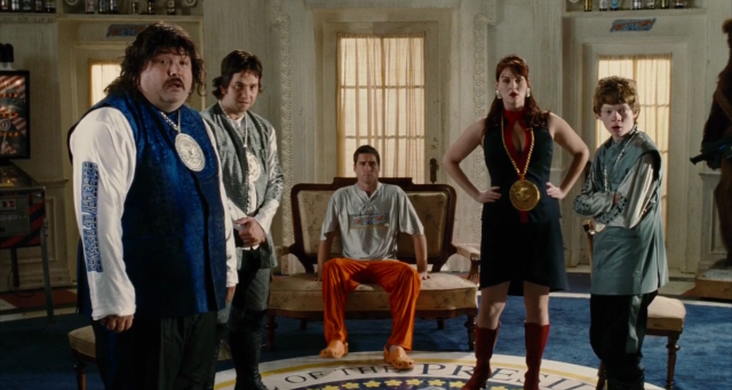
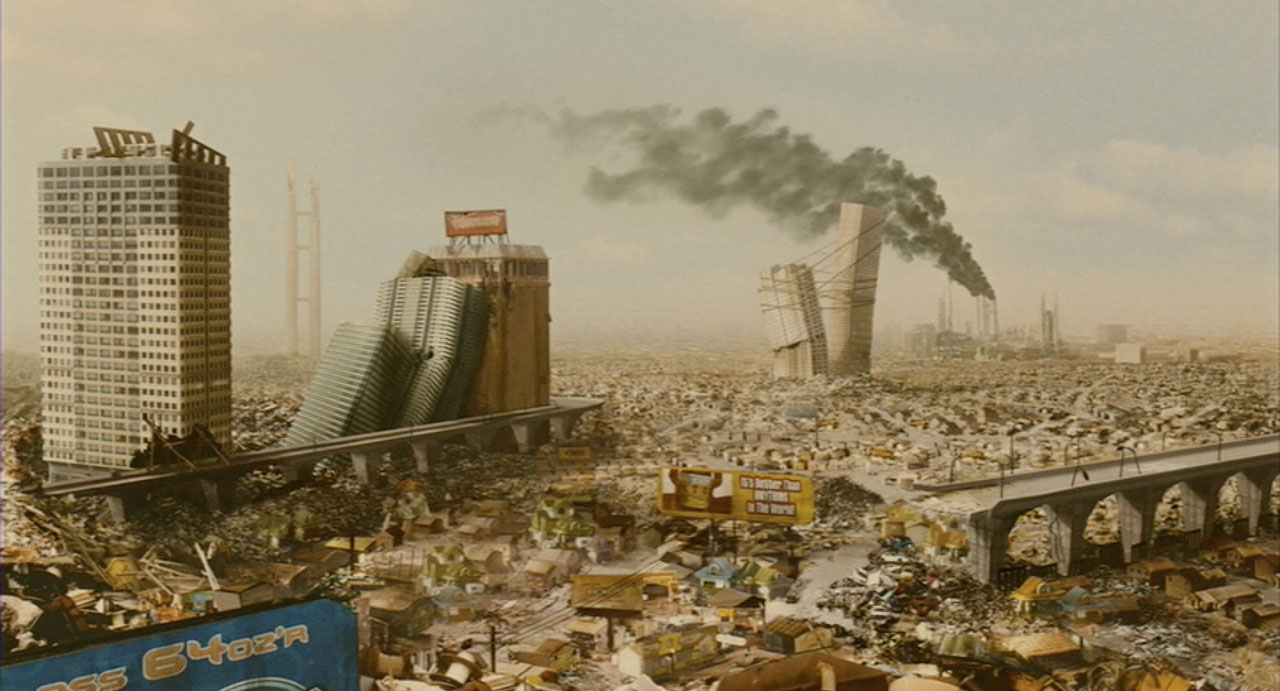
Mike Judge’s Idiocracyseemed reasonably funny to me, though this may have been influenced by the herb partaken while seeing it. It’s more or less a science fiction satire in the manner of an old L. Sprague deCamp story. A man awakens from cryogenic storage to find that the U.S. has bred itself into idiocy. Though himself selected for the cryogenic experiment because of his astonishing averageness, in this brave new world he is the smartest man in the country. He saves the nation from famine by determining that crops should not be irrigated with Gatorade. Most of the comedy is in sight gags embedded in the set design. Anyway, rent this for some stoner party and stock up on taco chips to go with it.
(Judge 2006) Idiocracy
Josef Bohuslav Foerster
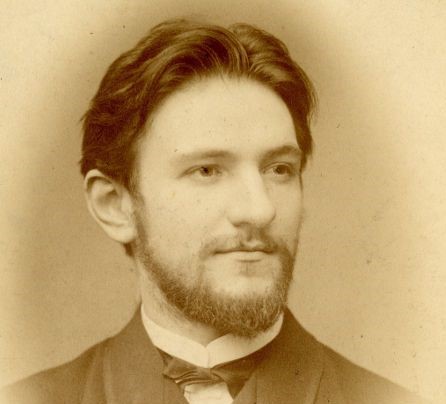
Foerster (1859–1951), a contemporary of Janáček, does not share his fame outside of the Czech Republic. His long life encompassed everything from the pomp and waltzes of Franz Josef’s Rakousko-Uhersko Empire to the beginnings of the Communist regime. He was a close friend of Mahler and of Tchaikovsky. His oeuvre includes five symphonies and five operas, as well as liturgical and chamber music. You can hear some samples of his work in a brief article on the Radio Prague website. Like his friend Mahler, Foerster’s life was haunted by the deaths of friends, family, and a child. He sought solace in his Catholic faith, and was instrumental in reviving the old Slavonic mass.
All I have to represent him, in my collection, is his Fourth Symphony in C minor, Op.54, subtitled “Easter”. It certainly shows a mastery of the orchestra. His influences are obvious, and in a curiously chronological sequence. The first movement sounds like Schubert, the two middle ones are very Dvořák, and the last one distinctly Mahleresque. But the symphony is no mere pastiche or imitation. The rich polyphonic texture is etched out with a small orchestra, each instrument given a clear and distinct role. It is deeply emotional music, drifting effortlessly between lyrical nostalgia and tragedy. All these qualities are hallmarks of Czech music, and it is remarkable to me that he remains obscure in the English-speaking world.
Addendum, added June 14, 2007: While in Prague, I picked up a vinyl of two piano trios by Foerster, one in F Minor, Op.8, and one in B, Op.38. They are fine pieces, and confirm my impression that he deserves more serious listening outside of his homeland. Both of the trios have very delicate feelings, and fine melodies, though the later one is noticeably more melancholy. Has any compose ever gotten more cheerful with age? Perhaps Ralph Vaughan Williams.
First-time listening for February, 2007
17026. (Yothu Yindi) Freedom
17027. (John Adams) Violin Concerto
17028. (John Adams) Shaker Loops
17029. (Hot Hot Heat) Elevator
17030. (Johannes Brahms) Hungarian Dance #1 in G Minor for Piano Four-hands
17031. (Johannes Brahms) Hungarian Dance #2 in D Minor for Piano Four-hands Read more »
READING – FEBRUARY 2007
14940. (Thomas Jefferson) Original Draft of the Declaration of Independence [article]
14941. [4] (Thomas Jefferson, et. al.) The Declaration of Independence [article]
14942. (Orson Scott Card) Empire
14943. (Anthony Shadid) With Iran Ascendant, U. S. is Seen At Fault ― Arab Allies in Region
. . . . . Feeling Pressure [article]
14944. (Garry Wills) At Ease, Mr. President [article]
(William Tenn) The Seven Sexes:
. . . . 14945. (William Tenn) Author’s Note [preface]
. . . . 14946. (William Tenn) Child’s Play [story]
. . . . 14947. (William Tenn) The Malted Milk Monster [story]
. . . . 14948. [2](William Tenn) Errand Boy [story]
. . . . 14949. (William Tenn) The House Dutiful [story]
. . . . 14950. (William Tenn) Mistress Sary [story]
. . . . 14951. (William Tenn) Sanctuary [story]
. . . . 14952. (William Tenn) Venus and the Seven Sexes [story]
. . . . 14953. (William Tenn) Bernie the Faust [story]
14954. (William Irwin Thompson) Passages About Earth [story]
14955. (Tony Taylor) Seeing the Writing on the Wall Graffiti in History — from Pompeii to Belfast
14957. (Mervin Peake) Titus Alone
Read more »
el hadj N’diaye — XEL
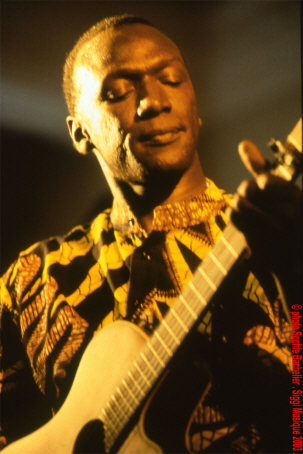
Even within the fabulous cornucopia of West African music, el hadj N’diaye’s Xel(2001) is a exceptional treasure. N’diaye takes a journey beyond the familiar mbalaxbeat of Senegal’s popular music to explore more varied territory. Some of the rhythms and guitar work could have come out of a Clapton album. But they are blended perfectly with African drums and balofon. The balofon solo on the song “Casa di mansa” is particularly beautiful. This is a tragic song about the ill-fated secessionist movement in southern Senegal, sung in French and English. Most of the songs on the album are sung in Wolof, Senegal’s primary language. But the emotions in them are so powerful that you have the odd feeling that you understand every word. “Yoon wil”, “Xale bi” and “Yu sew yii” moved me in particular. This entire album combines a refinement and precision of performance with intense emotions: bitterness, sadness, yearning, remorse. I will play this album over and over again, and I’ll do my best to find more of N’diaye’s work.
14957. (Mervyn Peake) Titus Alone
I got tremendous pleasure finishing Mervin Peake’s enigmatic fantasy series. I was warned that the last volume would be a disappointment, but when I got around to it, I did not think it so. It’s true that it has a significantly different “feel” from the first two, and shifts focus to other matters. Peake was near death, and quite ill, when he wrote it, so it contains some lapses in style and internal inconsistencies. But it does not merit the scorn it faced on publication, or the dismissal it gets from fans of Gormenghast. Titus, who is more or less a place-marker in the imagistic maze of the first volumes, acquires much more of an internal voice Titus Alone. The issues and imagery of this volume curiously anticipate the cyberpunk and steampunk styles of a half century later.
Wax [K‑Pop]
For quite some time, Cool and Wax dominated Korean pop music. Wax is the stage name for a talented female vocalist with a very expressive, and sometimes beautiful voice. Her arrangements range from cheesy synthesizer pop to fairly raunchy rhythm and blues. In some cases, genres are bizarrely mixed, such as when a chorus of grunting male metal voices inexplicably fill in the spaces between verses of a Britney Spears-ish love song. This may all sound pretty trashy to a North American listener, but there’s no law against musical synchretism, and in any case, East Asian pop plays by its own rules. I’m told that a lot of her success comes from the perspicacity of her songwriters, Choi Joon Young and Kim Gee Hoonong. It can’t all be in the lyrics: Wax’s popularity extends far beyond the K‑pop scene, to the much broader East Asian pop scene covering China, HK, Taiwan, Vietnam, Singapore and Japan. My exposure is through the double compilation album Best Day &Best Nightand the third album from 2002, Wax 3.
14940. [2] (Thomas Jefferson) Original Draft of the Declaration of Independence [article] 14941. [7] (Thomas Jefferson, et. al.) The Declaration of Independence [article]
I have not yet seen Gary Wills’ renowned study of the Declaration. But I did read Carl Becker’s work on the same subject when I was a kid. I have made a small reputation by trying to show the global origins of the democratic idea, as opposed to the connect-the-dots Greece-Rome-Britain-America sequence that is still a major component of the currently confused understanding of democracy. However, that doesn’t mean that I consider documents like the Declaration to be unimportant. Far from it. It was so important, in fact, that minor variations in its phrasing would have made a profound difference in the subsequent history, not only of the United States, but of the world. Because the Declaration was in the pocket, so to speak, of every American, it could have repercussions, and utility, far beyond any philosophical essay. Frederick Douglas, whose character and intellect make most of the more famous thinkers of the 19th century seem puny by comparison, wrote movingly of the impact its wording had on him. When you are a plantation slave, as Douglas was, the words “We hold these truths to be self-evident, that all men are created equal…” are not just a snappy slogan. They are hope, enlightenment, destiny, righteous anger, humanity, solace, and conciliation compounded in a single sentence. That sentence is important to anyone who wishes to free themself from slavery, and is a precious gem in humanity’s strongbox, not just for Americans.
So it’s interesting to compare Jefferson’s first draft with the final article. The first version follows the conventions of mid-eighteenth-century prose more closely. It is said that Thomas Paine had some influence on the revision, and it does shift to blunter, more Quakerish phrasing that would seem unusual in a cultured Virginian like Jefferson. But I think it more likely that Jefferson realized he was thinking in a new way, and that it had to be said in a new way. The first version is a product of a writer to be read in a book. The final version is a product of a man tapping a moral dimension of the universe. The sad thing is that Jefferson himself could not live up to his own inspiration. The man who did more than anyone except John Woolman to lay down the moral argument against slavery himself kept slaves. It is true that the Virginia legislature, fearful of his example, had declared that if Jefferson attempted to free his slaves, they would be seized and sold to other, doubtless crueler masters, but Jefferson, being an undoubted genius, could surely have devised some stratagem to circumvent this. No, it was just another sad case of a brilliant intellect capable of imagining, but not of doing what reason demands.