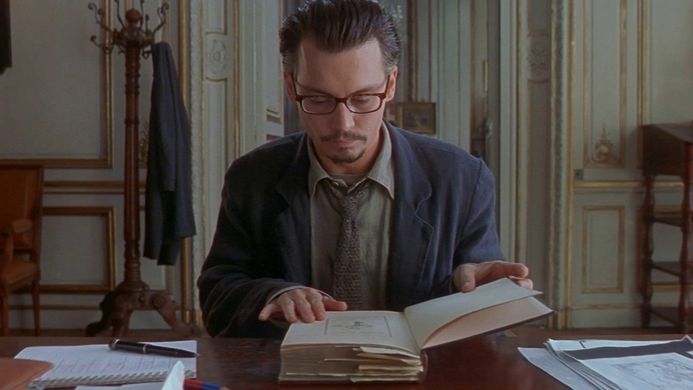
 I don’t understand what motivated Polanski to make this muddled supernatural thriller. It’s the sort of thing that works fine in a book, but makes a terrible movie. You can sort of guess what is going on at the end, but doubtless most of the audience left the theatres scratching their heads. A pity, because Johnny Depp’s performance is, as usual, extremely professional. He wrings as much out of the emotionally ambiguous character as he can. Most of us who love books would have been charmed to see an entertaining film in which rare book collectors and dealers are given a fictional life involving murder, intrigue, and hot sex, however inaccurately the technical details of book collecting are presented. But this film doesn’t entertain. Half-way through, one becomes bored with the enigmas, sensing, correctly, that they will not lead to any interesting conclusion.
(Polanski 1999) The Ninth Gate
14735. (Peter D. Edward) Gorgon ― Paleontology, Obsession, and the Greatest Catastrophe in Earth’s History
Edward is a paleontologist who did important work on the Permian Extinction, a period in Earth’s history that seems to have undergone a catastrophe even more spectacular than the better known Cretaceous meteor impact that turned the dinosaurs to toast. In the mass extinctions that took place 248 million years ago, ninety to ninety-five percent of marine species were eliminated, and on land a complex proto-mammalian fauna was wiped out.Edward’s book contains only a simplified summary of the science. It’s primarily autobiographical. He did most of his research in the Great Karoo region of South Africa, and his visits there coincided with dramatic periods in South Africa. He describes the totalitarian atmosphere during the late Apartheid era, and then the chaotic one of the post-Apartheid era. This, and description of the physical and emotional challenges of doing hard science in the field are the reason to read the book.
[If you want to learn more about the Permian Extinction Event, a good place to start is the Hooper Virtual Natural History Museum, run by Carlton University, Ottawa. It’s a user-friendly site, geared to the general public. A section devoted to “Creationism” makes no attempt to pussyfoot with the tide of ignorance: it begins with a primer on the fourteen most common logical fallacies of argument, straight out of Aristotle]
Monday, August 14, 2006 — Good …Not Respectable
When Joseph Milo, an out-of-work conductor and pianist in Montreal, learned that his building’s doorman was an out-of-work cellist, and that his pizza was delivered by an out-of-work bassoonist, he had an inspired idea. Montreal is full of immigrant musicians who have knocked at the doors of the gold-plated and respectable institutions, and gotten nowhere. Are they down-and-out because they are poor musicians? Or just because our society is too dumb to employ their talents? The evidence of my ears points to the latter. Now the Montreal Musicians of the World Symphony Orchestraplays in the basement of Côte St-Luc municipal building. It’s not the Montreal Symphony’s hundred-million-dollar venue, but the music is good, and the blue-collar, blue-jeans audience gets a good show. Surprise, surprise! — if good music is played at a logical price in an atmosphere that isn’t rancid with pomposity, people flock to hear it.
Another small victory in the endless war we must fight against the sclerotic forces of Respectability.
14734. (Robert Swindells) Brother in the Land
Written in 1984, when the Cold War was heating up again, this is a narrative of an English teenager’s survival after a nuclear war. Swindell attempts to convey the utter hopelessness of the situation. Steeped in the British class system, he assumes that the rich and powerful would do everything to protect themselves. and simply exterminate anyone inconvenient to them. Perhaps this would have been true — I don’t know British society well enough to judge. The book gives a reasonably accurate portrayal of the effects of a nuclear war on an ordinary region (at least in terms of the scientific knowledge then available). As personal drama, it is very effective. People who now imagine that the world is a newly terrifying place, merely because a handful of terrorists can plant bombs in planes, have either forgotten, or are incapable of imagining, the kind of anxiety people lived under during the periods when the imminent incineration of the planet was something to worry about.
(Rapper 1944) The Adventures of Mark Twain
While this corny Hollywood biopic is highly inaccurate, Frederick March is absolutely perfect as Twain, able to play him equally well as a young and an 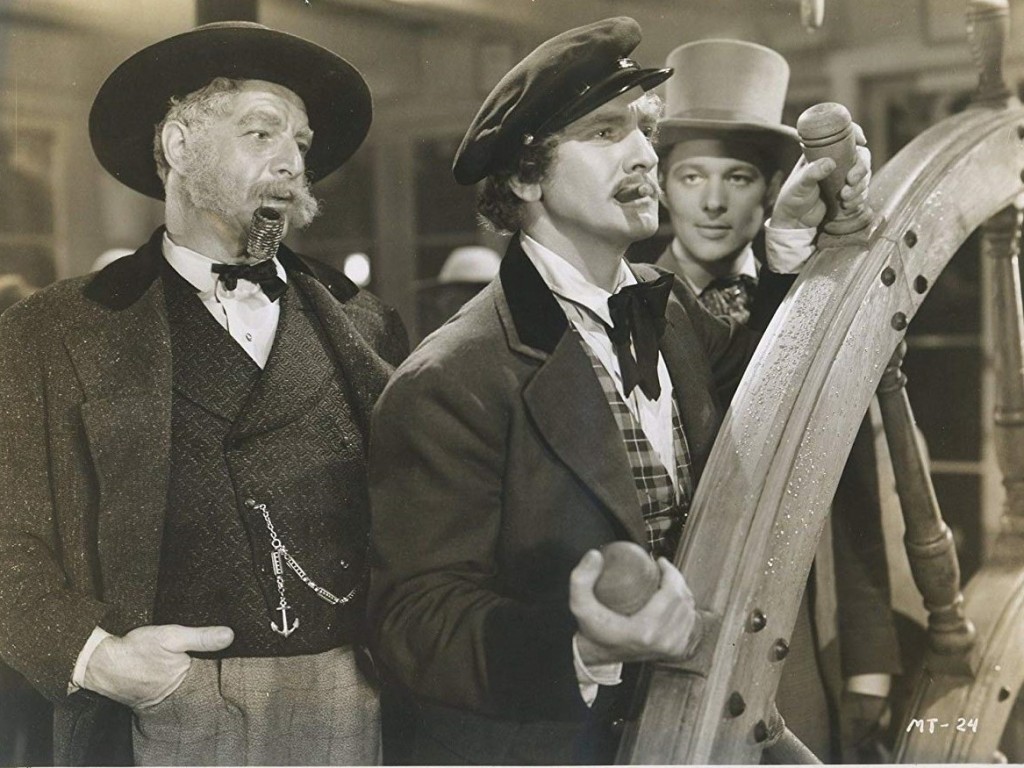 old man. The Max Steiner score is one of his finest.
14730. (Karl E. Meyer) The Dust of Empire: The Race for Mastery in the Asian Heartland
Meyer provides a basic primer on the history of Central Asia and the Caucasus. It’s a short volume, so it can only sumarize the complexities. Still, even a well-educated reader is likely to know nothing about this large portion of the Earth. Newshounds usually refer to the post-Soviet Central Asian republics as “the Stans”. Well, at least a flippant nickname is more attention than these places got before.
Despite its low profile in public discourse, Central Asia has gotten plenty of attention from geopolitical schemers and imperial powers, invariably creating disasters. Something about the place generates fantasies and delusions. And no country is more prone to living in fantasy than the United States, the latest imperial power to decide it is going to bring enlightenment to the land of the mountain warrior clan and the poppy. As Meyer demonstrates, the delusional chatter coming from Washington is identical to that which emanated from Britain and Romanov Russia, and the Soviet Union when they began the same disastrous projects, ending in defeat for themselves and endless misery for the people of the region. Read more »
Monday, August 7, 2006 — Things We Can Do to Ensure Canada’s Future
Do everything possible to make it cheap and easy for anyone under 25 to travel in Canada. Our present facilities for backpackers and student travelers are woefully inadequate. Every young Korean, Estonian, or Peruvian who backpacks across Canada at the age of 18, and has a good experience, is a future fountainhead of investment, trade, publicity and goodwill for this country. This is bread cast upon the waters that will come back five-fold after many days.
Equip a large number of high schools across the country to function as youth travel hostels in the summer holidays. The techniques for operating travel hostels are well established. It should be made possible for any high school, university, or community college student to stay overnight at a minimal charge in any such hostel, anywhere in the country. Additional travel hostels should be established in native reserves, national parks, and in remote wilderness areas. Hopefully, the next generation will actually know our country, and outgrow the petty regional squabbling that embarrasses us before the rest of the world.
Make it extremely easy for any student to spend a school term in any other city in the country. Read more »
(Briand 2002) La Turbulence des Fluides
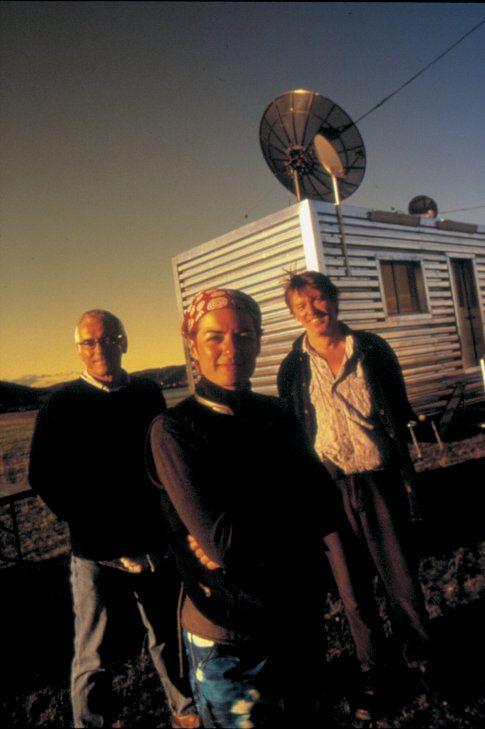 I rather like this attempt at a Shyamalanesque thriller by director Manon Briand. Unfortunately, it’s way too slow-moving to satisfy a big audience, and it telegraphs its ending. It focuses on a seismologist, long exiled to Japan, who returns to the town of her birth, Baie-Comeau (on the remote North Shore coast of Quebec) to investigate some anomalies. The town is haunted by the death of a woman in a freak accident, and is full of psychological, as well as physical anomalies. While the film is weak as drama, it is delightful visually and sensually. Both the heroine, Alice Bradley (played by Pascales Buissière) and her jealous lesbian friend (played by Julie Goyet) are extremely beautiful.
Thursday, August 3, 2006 — Hardships There the Hardest to Recall
Earlier in the evening (Aug.2), the CBC National News covered the very issues I discussed in my last posting (Aug.1). I am very pleased, especially because the camera work from the venerable ice-breaker Louis Saint-Laurent was of fabulous quality. The political issues are complex. You can’t expect people to care about them unless they can visualize the vast, dangerous, and extraordinarily beautiful land that is at stake.
Someone has a poetic soul at the CBC. Nunavut is one of those places, like outer space, that forces even the most phlegmatic person to turn to poetry. Over a magnificent montage of images from the Passage, they played an old Canadian folk by Stan Rogers:
(Low 1988) Beavers
 It may come as a surprise to film buffs, but Stephen Low’s 1988 documentary film about the life of a family of beavers in Alberta is the most successful Canadian film of all time. With a budget of one million dollars, it grossed over 80 million playing in 230 IMAX theatres. Low’s Montreal-based production company has produced most of the top IMAX format films. His much more recent film, Volcanoes of the Deep Sea, was not run in many U.S. theatres because it contains references to Evolution (yes, rub your eyes and gasp, but that is the level of imbecility that things have sunk to, there). Now, nothing could be more quintessentially Canadian than a documentary about Our Friend the Beaver ―we all had to endure them repeatedly in grade school. Beaver documentaries are probably the equivalent for Canada of the Western for Hollywood, and the samurai epic for Japan. But nothing prepared me for this. The film is brilliant. It is powerful, emotional, moving. It is inspiring. It is beautiful. The cinematography is brilliant. Some of the shots, if they had been devised by Kubrick or Fellini, would be studied in film schools. The composition, colour, and editing are superb. And the acting, by beavers who are apparently professionals trained at Stratford, is top-notch. The love scene, with young amorous beavers dancing in the moonlight, is among the most romantic ever filmed.
And it’s a documentary about beavers.
Honest. I kid you not.