Toronto has been subject to a higher level of gun-crime this year, largely instigated by American organized crime moving in. Youth street gangs are being pumped, armed and financed systematically. There was one dramatic incident, where a teenage girl was killed by gang crossfire at a major downtown intersection, which particularly upset people. Read more »
Wednesday, July 12, 2006 — Beware of Guardian Angels
Posted by Phil Paine
on July 12, 2006
No comments
14706. (N. A. M. Rodger) The Command of the Ocean ― A Naval History of Britain, Volume Two, 1649–1815
Posted by Phil Paine
on July 12, 2006
No comments
The two hefty volumes of Rodger’s history of the British Navy bring the story only up to 1815. But this lifetime scholarly work is well-balanced with readability. Rodger thinks strategically more than tactically. He knows that the economics of getting ships on the sea, administering and supplying them, and making sure they do something useful is the heart of the matter. Britain had exercised considerable sea power in the northern world in Anglo-Saxon times, but the land-lubbing, horse riding Norman aristocracy used ships very crudely. Even in the Renaissance, there was no real “navy”, but merely inconsistent attempts to put together fleets for various temporary purposes, and naval tactics remained primitive. Henry VIIIwas particularly irresponsible and destructive, as he was with everything else. Elizabeth’s reign was dominated by “privateering”. It was only during Cromwellian times, when the ruling dictatorship feared disloyalty among seamen, that the first attempts were made to organize and administer what would fit our modern notions of a national navy. Much of the story, of course, involves the more economically advanced Dutch, with whom British political, military and economic relations were interwoven for centuries. Rodgers is very adept at sorting out these complexities.
(Franklin 1995) Devil in a Blue Dress
Posted by Phil Paine
on July 12, 2006
No comments
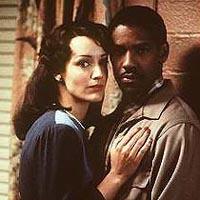
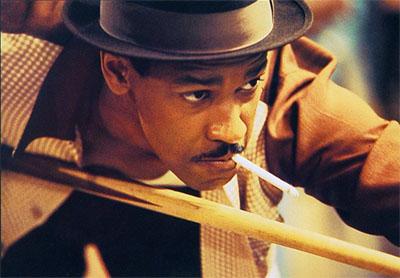 I just recently discovered the fiction of Walter Mosley[see review of “47”]. I haven’t yet read any of his “Easy Rawlins” series of mysteries, but I just saw this film,.made from the first one. Why hadn’t I heard of this film? It’s a superb Chandleresque thriller, with fine acting in every role. The scenes between Denzel Washington and Don Cheadle are particularly fine. The setting, Los Angeles in the 1940’s, when thousands of African-Americans had recently migrated from the Deep South to work in the aircraft plants, is meticulously recreated.
Monday, July 10, 2006 — Rabbits and Cats
Posted by Phil Paine
on July 10, 2006
No comments
Violent storms and tornadoes (25 of them were counted) are circling Toronto, adding spice to the hot weather. I sit here, working to pull out of a financial miasma, but the desire to travel gnaws at me. . To be back on the move, again, that would be so good. I even find myself playing Ian Tyson’s “Four Strong Winds”, the Canadian anthem of wanderlust.
Stampy the Rabbit is my most frequent companion. He’s a gorgeous slate-grey breed with fur as fine as a mink. He is nothing like the dull rabbits kept in cages. I let him have free run of the apartment, and he lives a life of adventure. He is perfectly housetrained, using either of two boxes of wood shavings. When I am reading on the couch, he will climb onto my chest and beg treats, and he goes into ecstasies when I massage him… but that’s an effect I can create on many creatures, large and small. When on the alert, he will stand on his haunches like a gopher, ears alert. There is a mouse somewhere in the apartment. It is too clever to be caught in any of the traps I’ve set. I think Stampy monitors his subsonic squeaks. They are building a 44-story condo next door to my building. Weird construction noises and vibrations shake the apartment in mid-afternoon. I wonder how Stampy interprets them?
For many years, I had a cat who would hitch-hike with me. I got lots of rides merely from the appeal of his poking his head out of my backpack. Think of the effect that a rabbit would have in the same role! But I don’t think he would take to it. Actually, I don’t think I could manage to get him into a bag without a violent struggle that would result in broken limbs and furniture. Stampy may be gentle when he sits on my chest, but he has the heart of six lions and the fierceness of a komodo dragon.
14698. (Raymond W. Baker) Capitalism’s Achilles Heel: Dirty Money and How to Renew the Free-Market System
Posted by Phil Paine
on July 6, 2006
No comments
This book, by the authoritative expert on global money laundering, outlines the involvement of the governments, corporations, and banks in the processing of criminal money on a vast scale. But he is more concerned with the system of false bookkeeping with which the world’s poorest regions are systematically drained of capital. Baker is no philosophical lightweight: he remains trapped in a false system of definitions and terminology, but he knows that there is something wrong with it. He correctly points out that the current Conservative ideology of global finance has nothing to do with Adam Smith’s theories of free markets, which it violates in every particular, but is descended, instead, from the moral blankness of Jeremy Bentham’s platophistries. But he cannot pull himself out of his received framework to make the necessary next steps in analysis. There is no doubt, however, of his basic decency..
(Curtiz & Keighley 1938) The Adventures of Robin Hood
Posted by Phil Paine
on July 6, 2006
No comments
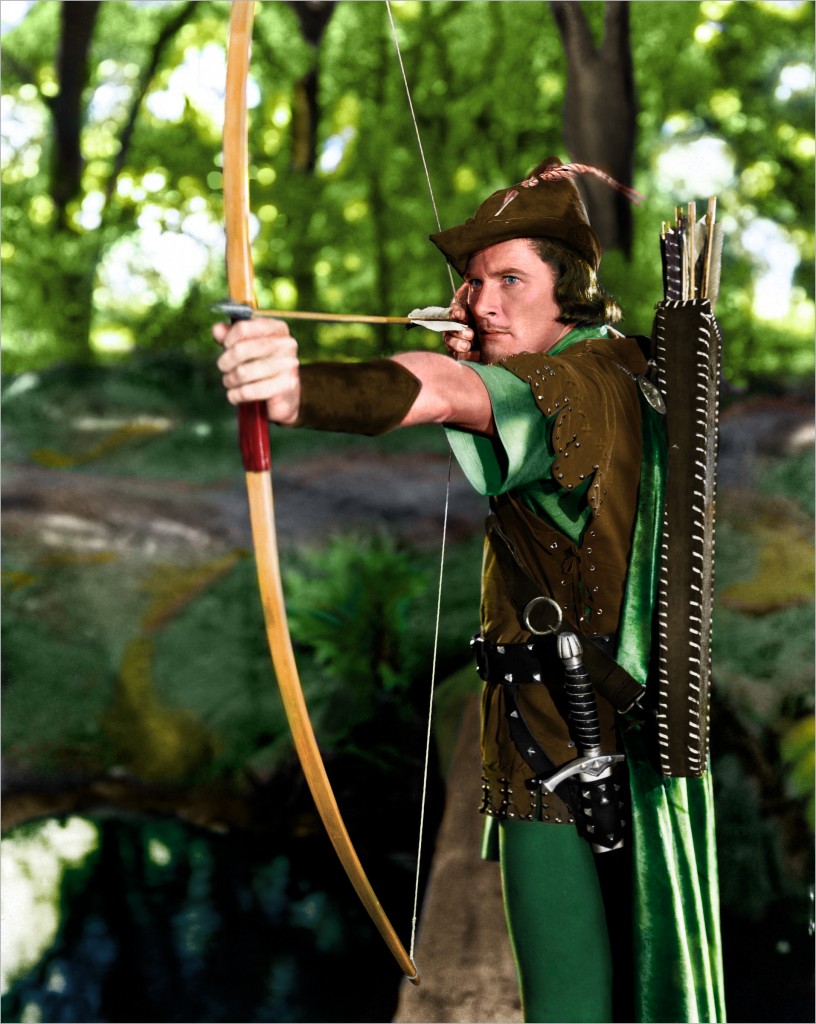 It’s doubtful that anyone will ever match the charm that Errol Flynn brought to the role of Robin Hood in 1938. The film still holds up well as an entertaining adventure, after 68 years. It helps that it was done in the superb colour process of that era — better, but more expensive, than the process used in the 1950’s and 1960’s. The Robin Hood tales are supposed to take place in the Twelfth Century, but they first appear in a series of folk ballads that emerged centuries after the time, though Piers Ploughman, written in 1370, refers to “the rhymes of Robin Hood”. The Robin Hood of the film, our Robin Hood, is essentially the one created by the Nineteenth Century children’s writer and (brilliant) illustrator, Howard Pyle. The film is fairly consistent with Pyle’s Robin. But for millions of people around the world Robin Hood will always be Errol Flynn, and the mythical hero of Britain incarnate in a roguish and ribald Tasmanian.
14697. (Jon George) Faces of Mist and Flame
Posted by Phil Paine
on July 5, 2006
No comments
A very good show for a first novel: A young prodigy at Cambridge uses her discovery of bodiless time travel to enter the mind of a young American soldier at the invasion of Guam during World War II. The story is told in parallel with the classical Greek myth of the Labours of Hercules, and also draws on the native folklore of Guam. George pulls you into the story quickly and treats his characters with sensitivity. I especially respect this kind of work because it requires real research to pull off. Getting things right, historically, psychologically, and culturally, has not been a big goal in the big SF publishing houses, lately, and this is an encouraging exception. I found only a few choices of words that I would quibble with.
Saturday, July 1, 2006 — Thoughts on Multiculturalism on Canada Day
Posted by Phil Paine
on July 1, 2006
No comments
Back to the blog! The last month has been rough, with an overwhelming workload. But things are easing off.
Canada Day, today, and I rode my bike around downtown, aimlessly, to enjoy the perfect weather and look at the crowds everywhere, picnicking, listening to concerts in parks, and generally enjoying the national holiday. People seem to be happy. If they are supposed to be terrified by the discovery of a “terrorist cell” a few weeks ago, they show no sign of it.
The “terrorist cell” business, was seized on by American politicians as proof that Canada is a “hotbed of terrorism” because of its “liberal immigration laws” (!). But it was taken with remarkable calmness by the Canadian public. Most people could see at a glance that there had never been any significant danger. The “cell” consisted of a handful of extremely stupid suburban teenagers who would have had difficulty organizing a surprise birthday party, let alone “beheading the prime minister” or blowing up skyscrapers in the financial district.
But one of the annoying side-effects was the incredibly stupid kind of “journalism” that followed. Was “multi-culturalism” to blame? Did it bring Canadian policies of “multi-culturalism” into question? What nonsense. Read more »

FILMS APRIL-JUNE 2006
Posted by Phil Paine
on June 30, 2006
No comments
(Leiner 2000) Dude, Where’s My Car?
(Scott 2005) Kingdom of Heaven
(Douglas 1954) Them!
(Lester 1966) A Funny Thing Happened On the Way To the Forum
(Armstrong 1999) MidSomer Murders: Ep.9 — Blood Will Out
(Page 2002) Into the Great Pyramid [documentary series]
(von Scherler Mayer 2002) Guru
Read more »