15845. (Frank Mills) The Poet and I
(Mike Oldfied) Working Towards a Climax [personal compilation by William Breiding]:
. . . . 15846. (Mike Oldfield) “The Lake”
. . . . 15847. (Mike Oldfield) “Crises”
. . . . [3478] (Mike Oldfield) “QE2”
. . . . 15848. (Mike Oldfield) “Music From the Balcony”
. . . . 15849. (Mike Oldfield) “The Wind Chimes, Pt.2”
Bluvan Tues ― Sounds From Tuva [compiled by Spider Robinson]:
. . . . 15850. (Kongar-Ol Ondar) “Alash Khem (The Alash River)”
. . . . 15851. (Kongar-Ol Ondar & Paul “Earthquake” Pena) “What You Talkin’ About?”
Read more »
First-time listening for June, 2006
Posted by Phil Paine
on June 30, 2006
No comments
READING – JUNE 2006
Posted by Phil Paine
on June 30, 2006
No comments
14673. (Anthony Boucher) The Case of the Seven Sneezes
14674. (Marshall McLuhan) The Gutenburg Galaxy
14675. (Gerald Posner) Secrets of the Kingdom ― The Inside Story of the Saudi‑U.S. Connection
14676. (Evangeline Walton) The Children of Llyr
14677. (Nancy Phelan & Michael Volin) Sex and Yoga
14678. (Jared Diamond) Guns, Germs and Steel
Read more »
14694. (Shoma A. Chatterji) Subject: Cinema, Object: Woman, a Study of the Portrayal of Women in Indian Cinema
Posted by Phil Paine
on June 28, 2006
No comments
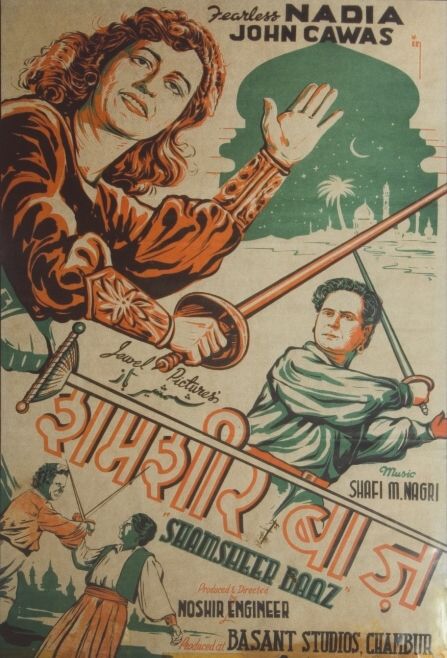 Who would have guessed that, as early as the 1930’s, there was an action heroine in Indian cinema, who did all her own stunts, and defied all the conventions of passive and simpering femininity, and played second fiddle to no male? That’s the most remarkable information in this study. Starting with Hunterwali (1935), Fearless Nadia starred in a series of extremely popular adventure films. “The female protagonist entered the scene on horseback, with the clarion call of ‘Hey-y-y‑y’, hand raised defiantly inn the air, riding in with the pride and arrogance that was more befitting of Douglas Fairbanks.” This remarkable actress had started out as a steno-typist, but, inclined to be plump, took dancing lessons. Then she joined a traveling circus, and a ballet troop. Her amazing film stunts (all real) included hoisting strong men on her back, fighting four lions, swinging from chandeliers, leaping from cliffs into waterfalls. She rode, swam, tumbled, wrestled and fenced her way through numerous films, often with a mask and a whip, until she was nearly fifty.
(Cuesta 2001) L. I. E. [Long Island Expressway]
Posted by Phil Paine
on June 27, 2006
No comments
 This is an intelligent film, with characters much more complex than you would expect. A youth in suburban Long Island, living with a widowed father, escapes boredom through his friendship and attraction to a classmate. He is too naive and unprepared to consummate the relationship, though everyone who knows them assumes they have. The other boy is actually pretty creepy, and leads him into committing burglaries. Because of one such burglary, he finds himself in an emotional tug-of-war with an older man. The story is a melodrama, but it does not follow the expected formulas. Acting, production values, and direction are all first-rate. Paul Dano gives an excellent lead performance.
14693. (Walter Mosley) 47
Posted by Phil Paine
on June 26, 2006
No comments
I’ve been remarking that some of the best written books, in recent times, have been published in the “juvenile” market. This book proves my point. It’s a beautifully written, emotionally powerful, and highly imaginative demonstration of what it means to be a slave. No topic is closer to my heart, and, frankly, I wish that I had written this book. “47” is a plantation slave, who, in the 1830’s, encounters an alien being who is stranded on earth. He tells his tale from the viewpoint of now, since he has become effectively immortal, and still retains the 14-year-old body. But the science fiction element of the story is underplayed. Mosley concentrates on making the reader hear, taste, smell, and feel the reality of slavery. It’s a fine piece of work.
DJ Qmar
Posted by Phil Paine
on June 20, 2006
No comments
The worldwide Tamil diaspora supports a thriving dance and club scene. Among the young Tamil DJs, none has been more innovative than Kumar Narayanasamy, better known as “DJ Qmar”. He was born in Jaffna, Sri Lanka, but grew up in Denmark, where he is still based. I have both his Tamil Vibrations albums, which you can often hear in my neighbourhood (the oldest Tamil neighbourhood in Toronto). There are no lame remixes of American rap on these gems! These mixes are bold. http://www.tamilstar.dk/djqmar
(von Báky 1943) Münchausen [Murnau Foundation 114 minute restored version]
Posted by Phil Paine
on June 18, 2006
No comments
In 1943, Germany’s UFAstudios spent a gigantic amount of money to create a film version of the absurd fantasy,Adventures of Munchaussen, which is loosely based on the extravagant “whoppers” attributed to the real life Karl Friedrich Hieronymus, Freiherr von Münchhausen (1720 –1797). The film was in colour (at that time a very expensive process) and the special effects where the best possible at the time. Readers of this site are probably familiar with the fairly recent Terry Gilliam version of the story. The von Báky film is very good. The scenes that take place on the Moon are particularly charming.  One of the oddest things about the film is that there were several Black actors in it. What on earth was it like to be a Black actor in Berlin in 1943? What became of them? Surely there is a fascinating documentary that could be made on this subject.
(J. R. R. Tolkien) Tree and Leaf
Posted by Phil Paine
on June 16, 2006
No comments
The first item, the essay “On Fairy Stories”, is essential reading for anyone with a serious interest in Tolkien. It makes clear exactly what he was doing, and why. It was written during the height of the dominant position of “realism” in literature, when anything even remotely imaginative was considered trash by literary people. Tolkien was particularly annoyed by those who saw fantasy, especially the particular kind of fantasy that he called “fairy-story”, as exclusively for children. He writes:
Among those who still have enough wisdom not to think fairy stories pernicious, the common opinion seems to be that there is a natural connexion between the minds of children and fairy-stories, of the same order as the connexion between children’s bodies and milk. I think this is an error; at best an error of false sentiment, and one that is therefore most often made by those who, for whatever private reasons (such as childlessness), tend to think of children as a special kind of creature, almost a different race, rather than as normal, if immature, members of a particular family, and of the human family at large. Actually, the association of children and fairy-stories is an accident of our domestic history. Fairy stories have in the modern world been relegated to the ‘nursery’, as shabby or old-fashioned furniture is relegated to the play-room, primarily because adults do not want it, and do not mind if it is misused.
Touché. I can still remember when that attitude was gospel, when a good science fiction writer like Kurt Vonnegut had to vociferously deny that he wrote SFso he could be taken seriously, and the encyclopedias described H. G. Wells as the author of Tono Bungay, Mr. Brittling Sees It Through, and, embarrassingly, “some scientific romances”.
contents:
14691. [2] (J. R. R. Tolkien) On Fairy Stories
14692. [3] (J. R. R. Tolkien) Leaf by Niggle
Jesse Cook
Posted by Phil Paine
on June 10, 2006
No comments
 Nueva Flamencois a style of guitar music that incorporates jazz, latin pop, and middle-eastern elements into traditional flamenco. Jesse Cook, born in France of Canadian parents, and now operating out of Toronto, has been a superb practitioner of this style for a decade. The only one of his seven albums I have is Nomad(2003), which features wonderful vocals by the Egyptian singer Maryem Tollar on the song “Qadukka-l-Mayyas”, perhaps the best item. The album incorporates so many world influences, with guest contributions from Hossam Ramzy, Flora Purim, the Afro Celts, and even the BoDeans (!), that the flamenco element is sometimes nearly invisible. Cook is such a fine guitarist that he feels no need to be a constant center of attention –— in several of the tracks he provides only a modest accompaniment while other members of the large ensemble take the spotlight. But when he does move into the spotlight, his guitar work is stunning, and his vocals pleasant. http://www.jessecook.com
14682. (Tim Wynne-Jones) The Knot
Posted by Phil Paine
on June 10, 2006
No comments
I’ve enthused before about the work of Tim Wynne-Jones. This is an early novel of his. His writing was not quite as sharp as it has since become, but this novel still held my attention. In part, it’s because the story (a sort of fusion of Charles Dickens and Raymond Chandler) focuses on my own neigbourhood in Toronto, and concerns the underside of that neighbourhood at the very time when I was myself part of that underside. I recognize and remember almost every physical feature in the book. Some of the places, buildings, and social configurations no longer exist, but reading this novel brought them back to me with the intensity of the smell of piss in a dark city alley.