21350. [2] (Frederik Pohl) The Midas Plague
21351. [3] (Aristotle) Nichomachean Ethics
21352. (Joan McCarter) What the 1 Percent Thinks About You [article]
21353. (Ian Reifowitz) How Are the Rich Getting Richer? The More They Make, the Lower the
. . . . . Income Tax Rates They Pay. Face Palm [article]
Read more »
READING – NOVEMBER 2013
Posted by Phil Paine
on November 30, 2013
No comments
Sunday, November 3, 2013 — “I no doubt deserved my enemies, but I don’t believe I deserved my friends.” — Walt Whitman
Posted by Phil Paine
on November 3, 2013
No comments
I don’t put much of my private social life into this site, but in this case “a picture is worth a thousand words.” I have been friends with Filip Marek for a quarter of a century. Despite our living on different continents, we have managed to see each other fairly often — most recently in Spain. We first came to know each other through Filip’s involvement in the Czech Revolution, and the friendship was subsequently built up from a series of shared adventures (in places as disparate as Crete and the shores of the Arctic Ocean) and shared intellectual interests. We make a rather Cervantean team. I am a little man, while Filip is a tall, muscular giant. This picture, recently taken* in the sort of place Filip can often be found, is so evocative that I could not resist putting it up here.

*Filip has just informed me that it was taken two days ago, in Switzerland
(Barker 1914) The Wrath of the Gods
Posted by Phil Paine
on November 3, 2013
No comments
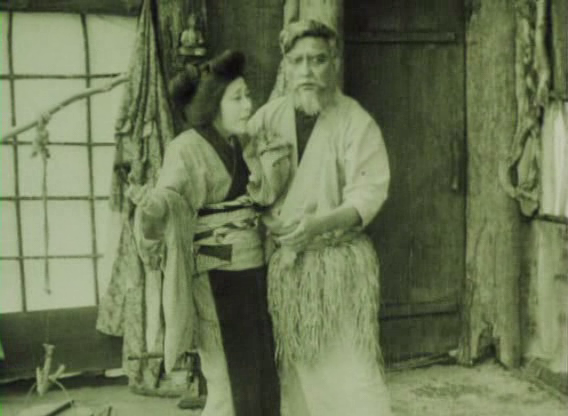 While he is best known for his role as the Japanese camp commander in The Bridge on the River Kwai, and other films of the 1950s, Sessue Hayakawa was a superstar in the silent era. Among Hollywood’s highest payed stars, he was in the same league with Fairbanks, Chaplin and Valentino. He founded his own production company because he resented the misrepresentation of Asians in Hollywood films. A meticulous actor, he was highly influential in transforming film acting methods from the broad gestures inherited from stage acting to the more restrained techniques appropriate to film. This film, the second one in which he appeared, was a story with a Japanese setting. A castaway sailor courts a young girl who has been forbidden to marry by a temple prophecy. Hayakawa was a young man, having just dropped out of the University of Chicago, where he studied economics, but he appears in heavy makeup as the heroine’s elderly father. The film displays the older, melodramatic style of acting that Hayakawa was soon to change. The leading female role was played by Tsuru Aoki, whom Hayakawa fell in love with and married during the production. Despite the dated acting techniques, the film holds up well, with some exciting action scenes at sea, and some moving moments.
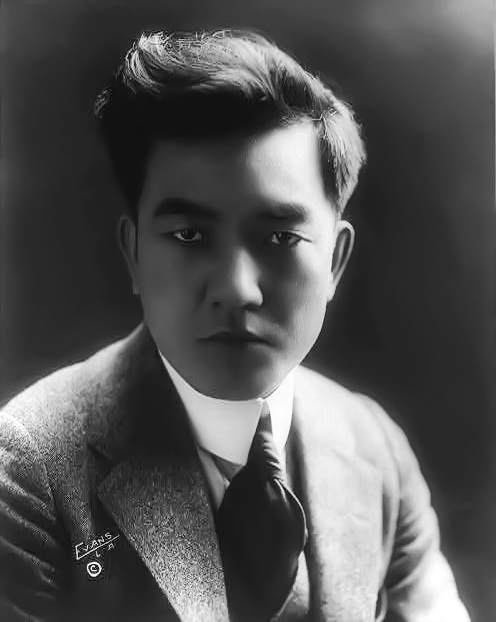
Hayakawa in 1918, four years after this film was made.
Hayakawa led an interesting life. As a teenager in Japan, he attempted seppuku after failing to qualify for the naval career his upper class family had planned for him. He played quarterback in American college football. He stumbled into acting by accident while waiting for a ship home, rocketing to stardom with his good looks. He made fortunes and lost them gambling, lived extravagantly, and became a social lion by buying up a huge stock of liquor just before Prohibition was enacted. He wrote several plays and a novel. He produced a version of The Three Musketeers in Japan. For awhile, broke and out of work, he supported himself by painting watercolours. He moved to France to make films in which he would not be racially stereotyped — and ended up fighting in the French Resistance. As an middle-aged man, he was able to take on a crowd of young Mexican toughs in a brawl and defeat them handily. He retired to become a Zen master and tutor. Some of his roles won him accolades as a mature actor, but he was never popular in Japan, where he was considered “too American.”
- .
Asian actors in Hollywood faced complex challenges, performing in the limelight of a society that held bizarre and sometimes disgusting attitudes about race and ethnicity. In the 1920’s, America’s anti-miscegenation laws influenced all casting, script-writing and performance. In the 1930’s the rise of anti-Japanese sentiments and the pervasive censorship of films did further damage. To weave their way through these obstacles, Asians had to be resourceful and strong. Their achievements should not be forgotten.

FILMS – OCTOBER 2013
Posted by Phil Paine
on October 31, 2013
No comments
(Klimov 1965) Welcome, or No Trespassing [Добро пожаловать, или Посторонним
. . . вход воспрещён]
(Honda 1958) The H‑Man
(Addiss 1956) Alfred Hitchcock Presents: Ep.21 ― Safe Conduct
(Baker 1967) Quatermass and the Pit [Hammer version] Read more »
First-time listening for October, 2013
Posted by Phil Paine
on October 31, 2013
No comments
24044. (Gioacchino Rossini) Demetrio e Polibio [complete opera; d. Carraro; Gonzales, Surjan]
24045. (Giacomo Puccini) Manon Lescaut [complete opera; d. Rahbari; Gauci, Kuladov, Saudinero]
24046. (Social Distortion) Mommy’s Little Monster
24047. (El Ten Eleven) Every Direction Is North
24048. (Giuseppe Verdi) La traviata [complete opera; d. Toscanini; Albanese, Peerce, Merrill] Read more »
READING – OCTOBER 2013
Posted by Phil Paine
on October 31, 2013
No comments
21284. (David W. Maurier) The American Confidence Man
21285. (Peter J. Boettke, Daniel J. Smith & Nicholas A. Snow) Been There Done That:
. . . . . The Political Economy of Déja Vu [article]
21286. (Maurizio Viroli) From Politics to Reason of State — The Acquisition and
. . . . . Transformation of the Language of Politics 1250–1600
21287. (David W. Maurier) Speech Peculiarities of the North Atlantic Fishermen
. . . . . [article]
21288. (Steven G. Horwitz & William J. Luther) The Great Recession and Its Aftermath
. . . . . from a Monetary Equilibrium Theory Perspective [article]
21289. (J. E. King) Four Theses on the Global Financial Crisis [article]
21290. (Thomas E. Sheridan) Landscapes of Fraud — Mission Tumacácori, the Baca
. . . . . Float, and the Betrayal of the O’odham
Read more »
Saturday, October 5, 2013 — California Dreaming.…. It’s Back
Posted by Phil Paine
on October 5, 2013
No comments
 For several generations, the State of California has been the barometer of social trends in the United States. It was the state Americans moved to because they were young, gay, creative, or just because they were sick and tired of working in coal mines or being screamed at by bible-thumping assholes. If you have been sinking into acute depression thinking of the antics of the Republicommies and their Tea Party zombies, and other signs of senility in American culture, then this should refresh your faith in the American people: Bill Maher- California is leading
FILMS – SEPTEMBER 2013
Posted by Phil Paine
on September 30, 2013
No comments
(1900) Sherlock Holmes Baffled
(Kostanski 2011) Manborg
(Groening & Sandoval 2012) Futurama: Ep.106 ― Fun on a Bun
(Krishna DK & Nidimoru 2013) Go Goa Gone
(Attenborough 1977) A Bridge Too Far Read more »