(Hespèrion XX) El Cancionero de Palacio, 1474–1516 — Música en la corte de los Reyes
. . Católicos:
. . . . 22419. (Francisco de la Torre) Danza Alta [instrumental]
. . . . 22420. (Gabriel Mena) Aquella Mora Garrida
. . . . 22421. (Francisco de Peñalosa) Por las sierras de Madrid
Read more »
First-time listening for September, 2013
Posted by Phil Paine
on September 30, 2013
No comments
READING – SEPTEMBER 2013
Posted by Phil Paine
on September 30, 2013
No comments
21219. (Patricia Highsmith) The Talented Mr. Ripley
21220. (Soraj Hongladarom) Exploring the Philosophical Terrain of the Digital Divide [article]
21221. (J. Marugán-Lobón, L. M. Chiappe & A. A. Farke) The Variability of Inner Ear
. . . . . Orientation in Saurischian Dinosaurs: Testing the Use of Semicircular Canals as a
. . . . . Reference System for Comparative Anatomy [article]
Read more »
Sunday, September 15, 2013 — Homes Needed
Posted by Phil Paine
on September 15, 2013
No comments
I will have to find homes for my cat Gravitino’s litter. The kittens — Champlain, Thompson, Mackenzie, and Brulé — are all in good health. Brulé has already been adopted.

Dvořák’s First Quartet
Posted by Phil Paine
on September 6, 2013
No comments
String Quartet No. 1 in A major, Op. 2 was Dvořák’s second chamber work. He was only 21 when he completed it, in 1862. It was not performed, however, until he revised it in 1888. The revisions seem to have been confined to some cuts to make it “leaner”, so it is probably representative of his musical thinking and abilities at that early stage. If that’s the case, then his genius shines out. It isn’t a great work, especially when compared to the divine quartets of his maturity, but it shows many of his signature qualities: the playfulness, effortless melodic invention, and the ability to communicate beauty and even sweetness without cloying. The first of the four movements has a catchy melody, but develops it very conventionally. It’s in the third movement, Allegro scherzando, that the future Dvořák is most evident. Its trio section could have been composed by no one else. The animato of the final movement is vigorous and confident. This first quartet can be played strictly for the pleasure it affords, not just for its presentiments of greatness. My best copy is brilliantly performed by the Kvarteto města Prahy.
Thursday, September 5, 2013 — Frederik Pohl, 1919–2013
Posted by Phil Paine
on September 5, 2013
No comments

Frederik Pohl (middle) in 1938
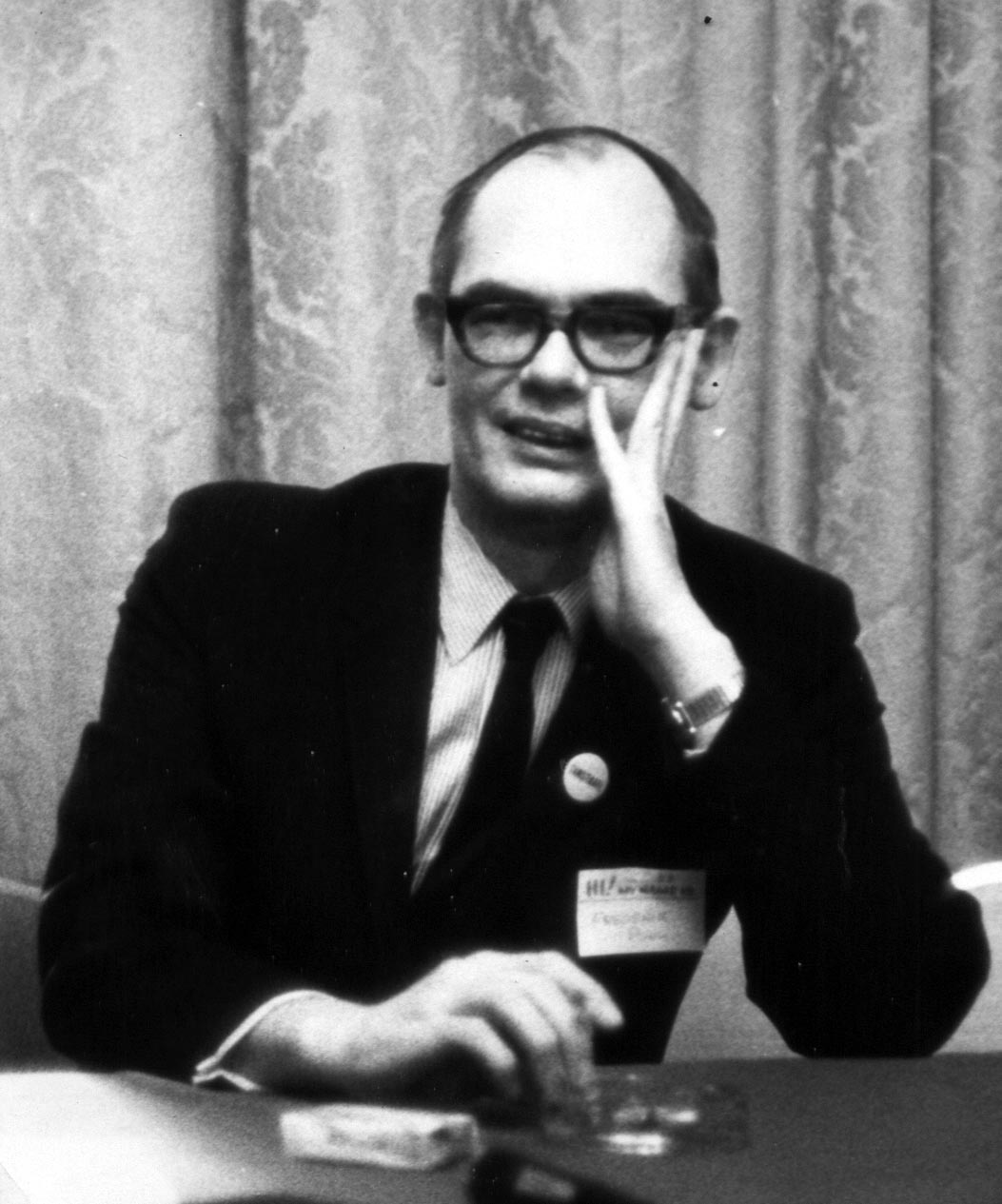
Frederik Pohl in 1968
To remain culturally relevant for seventy-six years is a rare accomplishment for any writer. Frederik Pohl’s career as a professional writer began in 1937, and ended this last Monday with his death. His last published novel was in 2011, and he was working on a second volume of autobiography when he died. His blog, The Way the Future Blogs, was one of my favourites on the web in recent years — and his stories and novels were among my favourites when I was growing up. He found new readers with each decade of his long career. His influence as an editor was equally significant. The field of Science Fiction owes much to him, though he was never a flashy attention-getter, never the subject of a personality cult. At SF conventions, he remained just a fan, someone to chat with amiably at a party, who did not care whether you were a big shot or a pimply teenager. I can vouch for that from personal experience. Ascerbic wit co-existed with gentleness and humanity in his demeanor. He was, as they used to say on the stage, “a class act.”

Naxi Music from Lijiang
Posted by Phil Paine
on September 2, 2013
No comments
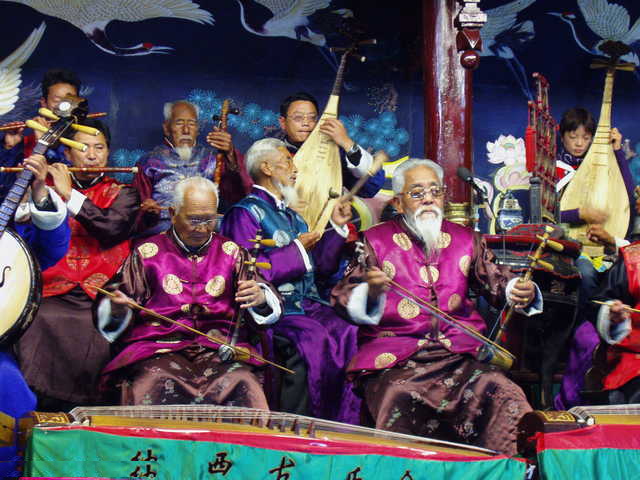
Dayan Ancient Music Association performing
Of all the provinces of China, it is Yunnan that has fascinated me most. Remote and mountainous, and forgotten by the world in the last few centuries, it once played a critical role in world history by being the first region to transmit major cultural and technological influences between East Asia and South Asia. The oldest known hominid fossils of East Asia were found there. Before the famed Silk Road was established in the north, trade and ideas wormed their way through the precipitous mountain passes of Yunnan, across northern Burma, then over the Naga hills to the valley of the Brahmaputra in India. Rice cultivation probably entered India by this route in prehistoric times, and possibly the technology of casting bronze. Some magnificent bronze art survives from the 3rd Century BCE. From that time to the Yuan era, though sometimes controlled by Tibetan or Han Chinese empires, Yunnan was most often the center of its own kingdoms, such as Dian [滇國], Nangzhao [南诏], and Dali [大理国]. A melting pot of peoples spoke various Tibeto-Burman, Tai-Kadai, and Miao-Yao languages. The historically important Bai language’s classification is disputed. These aboriginal languages survive and thrive despite the influx of Chinese speakers to the region, as do many ancient traditions. Shamanism, Taoism, Buddhism, Christianity, and even Islam have been influences on local beliefs. A synchretistic religion called Dongba, related in some way to the shamanistic Bön faith that preceded Buddhism in Tibet, is still practiced. It focuses significantly on the sacredness of trees, and once provided the spiritual basis for careful (and sustainable) practices in logging. The Communist Party attempted to crush the faith, not only for ideological reasons, but to facilitate clear-cutting and destructive exploitation of the forests. The religion, however, survives. Read more »
Image of the month: The Storm on the Sea of Galilee
Posted by Phil Paine
on September 1, 2013
No comments

Rembrandt’s Storm on the Sea of Galilee (1633) 160 cm × 128 cm. The painting was stolen from a gallery in 1990 and its whereabouts are unknown. It probably sits on the bedroom wall of some gangster billionaire.
FILMS – AUGUST 2013
Posted by Phil Paine
on August 31, 2013
No comments
(Lawrence 1958) The Crawling Eye [Mystery Science Theatre version]
(Lester 1980) Superman 2
(Florea 1976) The Astral Factor
(Tulio 1938) The Song of the Scarlet Flower [Laulu tulipunaisesta kukasta]
(Goldstein 2000) 2001: A Space Travesty Read more »
First-time listening for August, 2013
Posted by Phil Paine
on August 31, 2013
No comments
22333. (School of Ecclesiastic Music, Mt. Lebanon) The Divine Byzantine Liturgy of the
. . . . . Antiochian Holy Church
22334. (Hector Berlioz) Te Deum, Op.22
22335. (tUnE-yArDs) BiRd-BrAiNs
Read more »
READING – AUGUST 2013
Posted by Phil Paine
on August 31, 2013
No comments
21138. (Robert Graves) Count Belisarius
21139. (Adam Nicky) Treasure Hunters Ruining Jordan’s Artifacts [article]
21140. (Olav Eikeland) Why Should Mainstream Social Researchers Be Interested in Action
. . . . . Research? [article]
Read more »