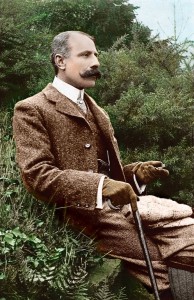
 Edward Elgar fell out of fashion after World War I, and his existence was barely acknowledged by music historians for the next fifty years. He was so firmly associated with British Imperialism, that his music became the subject of sneers. This is particularly sad, because Elgar himself was a gentle, sensitive soul whose primary inspiration was nature, and he grew to loathe every performance of “Land of Hope and Glory”, the bombastic anthem that had been made from one of his marches. In the 1890’s he had been a very patriotic Empire booster, along with everyone else. But he was bitterly disilusioned by World War I and sought solace in his beloved English countryside. He never much cared for his role as Britain’s Official Composer.
But despite all the scorn heaped on him, the First Symphony, the Cello Concerto, and the Enigma Variations continued to be performed in serious concerts, while the Pomp and Circumstance Marches lived on in the Pop Classics repertoire. The Second Symphony, not at first successful, slowly came to be played as often as the first. At his death, he left sketches for a third symphony, and in 1998, these were transformed into a complete work by the respected composer Anthony Payne. Read more »