More images of West Mainland: Read more »
Tuesday, September 28, 2010 — A West Mainland Gallery (part 2)
Posted by Phil Paine
on September 28, 2010
No comments
Tuesday, September 28, 2010 — A West Mainland Gallery (part 1)
Posted by Phil Paine
on September 28, 2010
No comments
Images of West Mainland, Orkney (part 1) Read more »
Tuesday, September 28, 2010 — West Mainland, Orkney
Posted by Phil Paine
on September 28, 2010
No comments
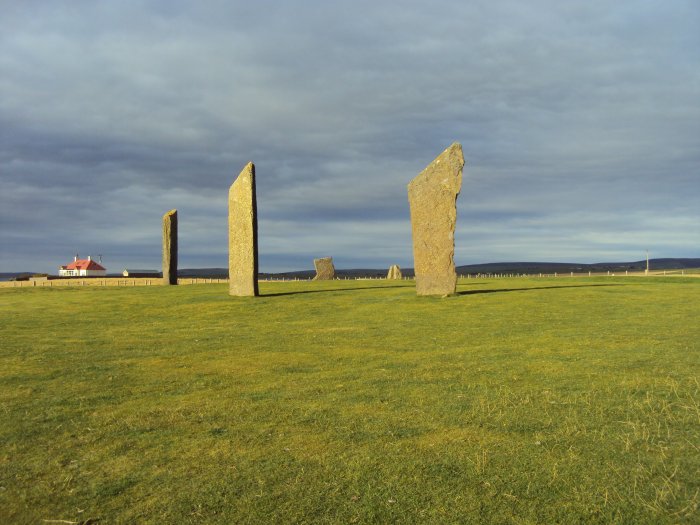
I was eager to get to some of the key archaeological sites, so I hoisted my pack and set out on foot. I soon got a lift with a cheerful Orcadian, and was dropped off at the base of the narrow arm of land that separates the Loch of Stenness from the Loch of Harray. This was the most active center of Neolithic Orkney. It was but a short walk to the Stones of Stenness. These date from around 3000 BC. The physical setting, between two lochs and at the centre of a vast bowl of land surrounded by high, bare hills, is marvelous. I was beneath a particularly fine mix of sun and clouds, and there was nobody about to spoil the sense of mystery and awe.
Monday, September 27, 2010 — Stromness, Orkney
Posted by Phil Paine
on September 27, 2010
No comments
 Stromness is a pleasing little harbour with many grey stone building climbing a steep hill. Smack in the middle, however, is a hideous glass box, an example of just the kind of esthetic crime I complained about in the last post. The main commercial street is a narrow , winding lane, paved with flagstones, and hemmed in by mostly eighteenth and nineteenth century houses. Pedestrians share it, anarchically, with automobiles. Most parts only have room for a car going in one direction, but there are occasional wider spots where oncoming traffic can negotiate precedence. Read more »
Monday, September 27, 2010 — Isle of Hoy, Orkney
Posted by Phil Paine
on September 27, 2010
No comments
I crossed the Pentland Firth to Orkney on the Hamnavoe, a finely appointed, Finnish-made ship which sails to the Orcadian port of Stromness. But before it reached the Orkney “Mainland,” * it passed close to the western end of the Isle of Hoy. Here are the United Kingdom’s highest sea-cliffs, as high as 350 m/1150 f. Struck by the afternoon light, they were extraordinarily beautiful. If my trip had ended at this place, I would have pronounced it entirely worthwhile. We passed by the Old Man of Hoy, a stone stack separated from the cliffsthat rises 137 m/450 f from the waves. Read more »
Monday, September 27, 2010 — Scabster, Scotland
Posted by Phil Paine
on September 27, 2010
No comments

Dunnet Head ( Ceann Dùnaid ) in Caithness, Scotland. The northernmost point on the British mainland. Latitude 58°40′21″N longitude 03°22′31″W.
The sea is calm, dappled with sunlight. I’m in the dockside “Peerie Cafe,” waiting for the ferry to Stromness, in Orkney. Through the window, I can see a bleak headland that is the northernmost point of the mainland of the United Kingdom. Closer to me, sheep are grazing on a sixty degree slope — something I’ve never seen before. The timid Merino breed that I’m familiar with would never do such a thing. This is the first calm meal and coffee that I’ve had since I left Toronto. It’s been a precipitent journey. Read more »
(Refn 2009) Valhalla Rising
Posted by Phil Paine
on September 17, 2010
No comments
 This is perhaps the oddest of the Medieval flics I’ve seen recently. Danish director Nicolas Winding Refn, best known for his Push series of thrillers, has created a relentlessly enigmatic, grim, and violent film set in the year 1000 AD. Read more »
Friday, September 10, 2010 — Homo Cinematis
Posted by Phil Paine
on September 10, 2010
No comments
I’ve collected films for a long time. Long before it was possible to keep them as computer files, I was accumulating videotapes by the gross. I love films of all kinds, good and bad, and will watch all sorts of things that puzzle my friends. Why, for instance, would anyone in 2010 want to watch Spooks Run Wild, starring the East End Kids, or a 1959 Swedish film about extraterrestrials invading Lappland? Well, quite apart from the direct, childish pleasure this sort of thing gives me, I can pretend I have more serious, and presumably laudable reasons.
There’s an unfortunate habit among historians to talk about such and such a point in time as marking the beginning of “modernity” ― a point fixed, according to fashion, anywhere from the proof sheets of the Epic of Gilgameshto the death of Kurt Cobain ― but there are two points in time where it can be convincingly argued that things did change for us quite drastically. After a mere thirty years of experiment, the technology of photography became widely available by the early 1850s. The sobering reality of the American Civil War leaps out at us from the photographs of Mathew Brady, and it wasn’t anything like war was depicted by the painter Jacques Louis David. Read more »
Lovesliescrushing
Posted by Phil Paine
on September 8, 2010
No comments
Lovesliescrushing is an interesting lo-fi ambient band based in Tucson. They produce some pleasantly eerie sounds with guitars (Scott Cortez), soft vocals (Melissa Arpin-Duimstra) and various unconventional noise-makers. There’s a bit of the spirit of 1950’s experimental and aleatoric art music, and definite influences of Einstürzende Neubauten and My Bloody Valentine, but I think they’ve crafted a sufficiently distinctive sound of their own. Apparently, they’ve been around for quite awhile, outside of my ken. The 2010 album I have, GIRL.ECHO.SUNS.VEILS, makes me want to dig up their earlier work.
