24112. (Michael Breen) The New Koreans
24113. (Konstantinos Kopanias & Sherry C. Fox) Headshaping and Identity at Tell Nader
. . . . . [article]
24114. (M. Ginolfi, et al) Where Does Galactic Dust Come From? [article]
24115. (Hergé) Tintin au Congo
24116. (John T. Koch) Hα C1α ≠ PC [The Earliest Hallstatt Iron Age Cannot Equal Proto-
. . . . . Celtic] [article]
Read more »
Author Archives: Phil Paine - Page 36
READING — MARCH 2019
Posted by Phil Paine
on March 31, 2019
No comments
(Richardson 1965) The Loved One
Posted by Phil Paine
on March 30, 2019
No comments
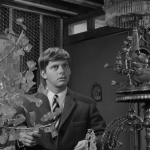
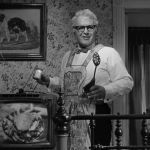 This is the kind of film that should be seen by happenstance. A deliberate viewing can’t match the delicious pleasure of stumbling upon it by chance. I really shouldn’t even be telling you about it.
In 1947, the British novelist Evelyn Waugh was approached by Hollywood for a possible filming of his novel Brideshead Revisited. The book’s two essential components were a heavy dose of the mystical upper-class Catholisism which exists only in England and bears no resemblance to Catholicism anywhere else, and a steamy homosexual yearning that manages to never mention homosexuality. The idea that this would have been made into a film even vaguely resembling the original was ludicrous, but Waugh was happy to let Hollywood give him an all-expense-paid trip to Los Angeles to haggle. Waugh had no intention of going through with the deal. Waugh was a snob — he was revolted that “lower-class” service people spoke to him as an equal, detested American informality, and complained about everything. But snobs often write the best satire (think Thackeray), as they have no compunctions about hurting people’s feelings. Hollywood is a bizarre, artificial, and goofy place even for Americans, and Waugh found plenty of material for his next satirical novel, The Loved One, which appeared in 1948. He was particularly fascinated by Americans’ peculiar attitudes towards death and (to a Brit) weird funeral customs. The plot is simple: A young Englishman with a posh education but no particular ambition wins a trip to Hollywood, and stays with an Uncle who is a stalwart in the expat British community in the film studios. His host commits suicide, leaving him to fend for himself on this alien planet. Attending to his uncle’s funeral, he becomes involved with Aimée Thanatogenos, an embalmer working at Whispering Glades Cemetery, a spectacularly vulgar Disneyland of Death created by the megalomaniac Blessed Reverend Glenworthy. He encounters an assortment of lunatics, all of them displaying extreme versions of American culture that Waugh found offensive and laughable. As in many of Waugh’s books, and many of the same ilk, the “hero” displays no noticeable virtues other than not being one of the loonies.
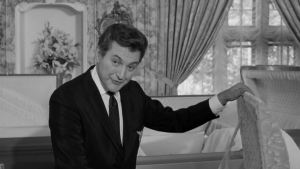
Tony Richardson, a British director who had scored big with critically acclaimed and financially successful films (Look Back in Anger; The Entertainer; A Taste of Honey; The Loneliness of the Long Distance Runner; Tom Jones) filmed the book in 1965. The script was written by the wildly unlikely combination of Terry Southern and Christopher Isherwood. Southern is not much read now, but in 1965 he was in literary vogue, and usually paired with Kurt Vonnegut as a satirist. Isherwood was a gay playwright and novelist who had chronicled the sexual underground of Weimar Germany, and would later reach a wide audience with Cabaret. Waugh had viciously caricatured Isherwood in one of his novels, but in that catty literary crowd such things apparently did not matter much. The film script sticks fairly close to the book, but adds a some scenes that make it fit in better with 1965. These additions would, I suspect, have been fine with Waugh. Visually, the film is a feast. Every shot fills the eye with details just as funny as the situations and the dialog. Every cut serves a satiric purpose. But the real bonanza is the casting. Aimée Thanatogenos is played to perfection by Anjanette Cormer, whose remarkable talent was never well-used by Hollywood. The English hero is played by Robert Morse, one of the few American actors at the time who could convincingly play an Englishman — while the vulgar American film mogul is played by Roddy MacDowall, then still best known as a former English child star. Liberace turns in a hilarious performance as a funeral director — he really missed a chance to be a great comic film actor. Jonathan Winters plays both the Reverend Glenworthy and his incompetent twin brother, making each character a gem. Rod Steiger chews the scenery with the mother-obsessed and nearly psychotic Mr. Joyboy. Paul Williams is a child rocket scientist. The actual Hollywood English Contingent (regularly cast as “Lords and butlers”) essentially play themselves: John Gielgud, Robert Morley, Alan Napier. Milton Berle, James Coburn, Margaret Leighton, Barbara Nichols, Lionel Stander, and Bernie Kopell do well-crafted bits. There are numerous Hollywood in-jokes that the audience could hardly have been expected to catch. For example, the cowboy film star who is being absurdly voice-coached by the studio to play an English Lord is played by Robert Easton. Easton was himself a voice coach, and one of the worlds greatest authorities on English dialects. Many in the cast were closeted gays. Tab Hunter plays a tour guide!
It’s extraordinary that this satirical film, made 54 years ago, based on a book written 71 years ago, remains relevant and bitingly funny.

FILMS — FEBRUARY 2019
Posted by Phil Paine
on February 28, 2019
No comments
(Kagan 1974) Judge Dee and the Monastery Murders
(Malle 1971) Murmur of the Heart [Le souffle au coeur]
(McNaughton 1973) Monty Python’s Flying Circus: Ep.37 ― Dennis Moore
(McNaughton 1973) Monty Python’s Flying Circus: Ep.38 ― A Book at Bedtime
(Wareing 1988) Doctor Who: Ep.678 ― The Greatest Show in the Galaxy, Part 1
(Wareing 1988) Doctor Who: Ep.679 ― The Greatest Show in the Galaxy, Part 2
(Ritt 1963) Hud
(Wareing 1988) Doctor Who: Ep.680 ― The Greatest Show in the Galaxy, Part 3
(Wareing 1989) Doctor Who: Ep.681 ― The Greatest Show in the Galaxy, Part 4
(Seltzer 1986) Lucas
(Guðmundsson 2014) Ártún
(Silberling 2004) Lemony Snicket’s A Series of Unfortunate Events
(Lourié 1953) The Beast from 20,000 Fathoms
(Elston 2013) The Other Pompeii: Life & Death in Herculaneum
(Marcus 2007) Roman Mysteries: Ep.3 ― The Pirates of Pompeii, Part 1
(Hitchcock 1936) Sabotage
(Liu & Li 2008) Justice Bao [包青天; Bāo Qīng Tiān]: Ep.1 ― Beating the Dragon Robe
Read more »
First-time listening for February 2019
Posted by Phil Paine
on February 28, 2019
No comments
25488. (Niccolò Paganini) Sonata #2 in D for Violin & Guitar “Centone di Sonate”, Op.64a
. . . . . MS112 #2
25489. (Niccolò Paganini) Grande Sonata for Violin & Guitar in A, Op.39 MS3
25490. (Niccolò Paganini) Sonata Concertata for Guitar & Violin in A, Op.61 MS2
25491. (Niccolò Paganini) Cantabile in D for Violin and Guitar, Op.17 MS109
25492. (Waka Flocka Flame) Big Homie Flocka
Read more »
READING — FEBRUARY 2019
Posted by Phil Paine
on February 28, 2019
No comments
24088. (Alberto Renzulli et al) Pantelleria Island as a Centre of Production for the Archaic ]
. . . . . Phoenician Trade in Basaltic Millstones [article]
24089. (Kenan Işik & Rifat Kuvanç) A New Part of Horse Trapping Belonging to Urartian King
. . . . . Minua from Adana Archaeology Museim and on Urišḫi-Urišḫusi-Ururda Words in
. . . . . Urartian [article]
24090. (Frida Beckman) Gilles Deleuze
Read more »
Two Wild Spirits: Heinrich and Ives
Posted by Phil Paine
on February 26, 2019
No comments
Charles Ives
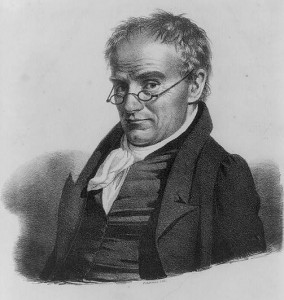
Anthony Heinrich
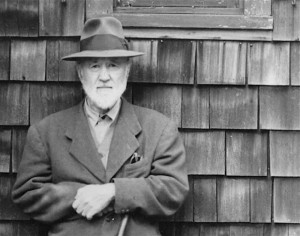
Those of us who admire a wild and irreverent spirit in music have long looked to Charles Ives (1874–1954) as our patron saint. With his multimetric chaos, his noisy brass bands, cheerful mixing of popular and classical themes, his temporal dyssynchronies and his startling flights into the infinite, he fulfilled every requirement for an eccentric genius ahead of his time. And he was profoundly, quintessentially American. But he was little known in his lifetime. The bulk of his compositions were written then tucked away, unperformed, in a New England barn while he pursued a more successful career as an insurance salesman. He also published pamphlets advocating what we would now call “direct democracy” and got into a heated argument with a young Franklin Roosevelt over his idea of promoting government bonds cheap enough for the ordinary citizen. But it was not until the 1960’s that his works were frequently played, and his name became familiar to classical musicians and listeners. Much of this change came about through the ardent advocacy of conductor Leonard Bernstein. It is possible to listen to a performance of Ives’ Symphony #4 today and experience it as “modern, avant-garde music” even though it was composed in the 1910s! (It wasn’t performed until 1965).
But fascinating as Ives is, he is not alone in the story of American music. Another composer, living a full century before him, shared many of Ives’ characteristics. Like Ives, he was self-taught, eccentric, experimental and ahead of his time. Like Ives, he wore his patriotism on his sleeve, loved loud noises and order disguised as chaos, and was drawn to transcendental themes. He died 13 years before Ives was born, and Ives probably never heard of him. Unlike Ives, however, he has found no high-profile champion. His works are played only occasionally and few people have heard them.
The man in question was Anthony Philip Heinrich. He was born in 1781, in the northernmost village of Bohemia, in what was then a predominantly German-speaking part of that land. Like Ives, he pursued a successful career as a businessman, relegating music to a hobby. But the Napoleonic wars ruined him, and he found himself penniless in Boston in 1810. He plunged into a new life enthusiastically, determined to be a wandering musician on the opening frontier. He traveled mostly on foot, living rough, through Pennsylvania, Ohio and Kentucky. This experience instilled in him a profound love of nature and an idealistic patriotism for his adopted country. Finally he settled in a log cabin in Kentucky and began to compose. America as yet had no real symphony orchestras and few trained musicians. His larger compositions could only be played in Europe. Eventually, he participated in founding the New York Philharmonic, and achieved some public success, but this quickly faded, and he died, reduced again to poverty, in 1861.
His music not only drew on American folk music and on the melodies and rhythms of Native Americans [Comanche Revel; Manitou Mysteries; The Cherokee’s Lament; Sioux Galliarde], but it was saturated with the signature element of American music: improvisation. Musicologists would no doubt classify him as his century’s most consistent practitioner of musical indeterminacy. Bird song filled his music, which often sported spectacularly grand ornithological titles: The Columbiad, or Migration of American Wild Passenger Pigeons and The Ornithological Combat of Kings. Perhaps the piece that sums him up is the vocal/orchestral suite, The Dawning of Music in Kentucky, or, the Pleasures of Harmony in the Solitudes of Nature. Nothing he composed followed the musical conventions of Europe. Altogether, I’ve heard 18 of his works, and all of them gave me pleasure, while some of them seemed to me both radical and profound. In other words, the qualities that drew me to Ives were present in Heinrich a century before.
It’s important, in this dark time for America, to remember that the nation that has sunk to the level of electing a scurrilous con-man, criminal and traitor to its highest office has in the past, over and over again, nurtured creative men and women imbued with the spirit of liberty, and will no doubt do so again. At this moment, I’m listening neither to Ives nor Heinrich, but to a country-rock album from 1968, The Wichita Train Whistle Sings. It’s by Mike Nesmith, remembered mostly as being one of television’s Monkees, but actually a man of varied talents. You can hear many elements of Heinrich and Ives bubbling through this almost, but not quite forgotten album. And they are bubbling in many works by singers, composers, garage bands, rappers, and electronic artists today. To use another Mike Nesmith album title: And the Hits Just Keep On Comin’.

FILMS – JANUARY 2019
Posted by Phil Paine
on January 31, 2019
No comments
(Melville 1950) Les Enfants Terribles
(Arkush 1979) Rock’n’Roll High School
(Crossland 2011) Murdoch Mysteries: Ep.41 ― Kommando
(Dante 1984) Gremlins
(Trelfer 2016) Dark Corners Review: (54) Gremlins: The Greatest Christmas Horror Film
. . . Retrospective
(Dante 2011) Joe Dante Introduces Gremlins for the Ciné Nasty Series
(Sawall 2010) Etruscans: Glory Before Rome
(Hough 1978) Return from Witch Mountain
(Grinter & Hawkes 1972) Blood Freak
(Trelfer 2018) Dark Corners Review: (332) Blood Freak
(Copp 2010) Inside the Milky Way
(Mancori & Mann 1964) Son of Hercules in the Land of Darkness [RiffTrax version]
(Wise 1951) The Day the Earth Stood Still
Read more »
First-time listening for January 2019
Posted by Phil Paine
on January 31, 2019
No comments
25401. (Johannes Ockeghem) Requiem [Missa pro defunctis]
25402. (Paul Oakenfold) A Lively Mind
25403. (Richard Strauss) Salome, Op.54 [complete opera; d. Sinopoli; Studer, Terfel,
. . . . . Hiestermann]
25404. (Jon Hopkins) Singularity
25405. (Aztec Camera) Walk Out to Winter: The Best of Aztec Camera
Read more »