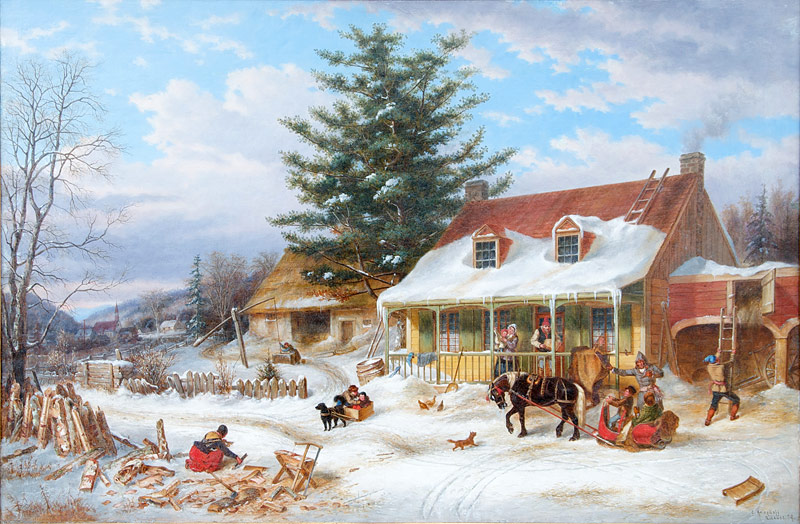
The Separatist movement in Québec has managed to train an entire generation into thinking that Québec’s entry into Confederation was some sort of conspiratorial swindle, but the truth of the matter is that the very idea of Confederation originated in that province, and was largely promoted by French Canadian intellectuals seeking a strategy to defend and preserve their culture. The fact is that the principle threat to the language and distinct culture of French Canada was, in the 19th century, the possibility of the absorption of Canada by the United States. The first detailed and systematic proposal for a Canadian Confederation was this treatise by Taché, published in 1858. Taché was a doctor practicing in the lumber camps of the wilder parts of the Gaspé peninsula, where he became enamored with aboriginal culture, and collected folklore. His later career in journalism focused on the development of a strong and distinct French Canadian literature, preferably one that “ventured into the unknown.” As a matter of principle, he refused to wear any article of clothing not manufactured in Canada. He was, in effect, a romantic nationalist of the 19th century mode. Not altogether progressive, he preferred a timid reform of the archaic system of seigniorial land tenure, rather than the complete abolition that the public clamored for. This lost him support in his political career, though in other issues he remained highly popular. Read more »
Category Archives: B - READING - Page 36
15105. (Joseph-Charles Taché) Des provinces de l’Amérique du Nord et d’une union fédérale
READING – JUNE 2007
(Fritz Leiber) Swords and Deviltry:
. . . . 15064. (Fritz Leiber) Introduction [preface]
. . . . 15065. (Fritz Leiber) Induction [story]
. . . . 15066. (Fritz Leiber) The Snow Women [story]
. . . . 15067. (Fritz Leiber) The Unholy Grail [story]
. . . . 15068. [2] (Fritz Leiber) Ill Met In Lankhmar [story]
15069. (Robert Benchley) Happy Childhood Tales [story] Read more »
15087. (Philip Zimbardo) The Lucifer Effect ― Understanding How Good People Turn Evil
Psychologist Philip Zimbardo devised and supervised one of the most famous experiments in social dynamics, the Stanford Prison Experiment. A group of college students were cast in the roles of “guards” and “inmates” in a mock prison. Intense abuses spontaneously developed, as the “guards” quickly evolved into sadistic monsters.
But this book is not just about his landmark experiment. Zimbardo was asked to testify as an expert witness in abuse of power and the psychology of turture during the investigations of the abuses in Abu Ghraib. It was this experience that prompted him to put together a comprehensive study of all the social psychology experiments, such as Milgram Experiment, which led up to his own work, and to blend it with a detailed analysis of Abu Ghraib. Read more »
(Fritz Leiber) Swords and Deviltry
God only knows how much “sword & sorcery” type fantasy is in print. But if, like me, you find very little of it appealing to either your imagination or your intelligence, then it’s nice to be reminded that some of the classics of the field remain fresh and satisfying. Few people can claim to have written better heroic fantasy than Fritz Leiber, whose Fafhrd and the Gray Mouser stories where written with wit and sophistication. He wrote with an adult sensibility, avoiding the prissiness and infantile repression that were common in the field. These stories, which were written over several decades, were collected in several volumes, of which this is the first. The last story, “Ill Met In Lankhmar”, is just about as good as a story about a muscular barbarian hero can get. Read more »
READING – MAY 2007
15055. (Captain Marryat) The Settlers In Canada
15056. (P. G. Wodehouse) Aunts Aren’t Gentlemen
15057. (Agatha Christie) Three-Act Tragedy
15058. [6] (Edgar Pangborn) A Mirror for Observers
15059. (P. G. Wodehouse) The Inimitable Jeeves
15060. (Gyula Kristó) Early Transylvania, 895–13245
15062. (Jan Kulich) Kutná Hora, St. Barbara Cathedral and the Town
15063. (P. G. Wodehouse) Jeeves in the Offing
READING – APRIL 2007
15036. (Simon Schama) Rough Crossings ― Britain, the Slaves, and the American Revolution
15037. (Timothy Finn) Three Men {Not} in a Boat and Most of the Time Without a Dog
15038. (Don Aker) Stranger At Bay
15039. (George Santayana) Classic Liberty [article]
15040. (Tony Karon) Condi’s Free Ride: The Fantasy of American Diplomacy in the Middle
. . . . . East [article]
15041. (Glen Greenwald) Your Modern-day Republican Party [article]
15042. (Neil McKenna) The Secret Life of Oscar Wilde
Read more »
Ursula K.LeGuin’s Earthsea books
I decided to read through the well-known series of juvenile fantasy that I never got around to reading. Lequin’s Earthsea books are widely admired. Certainly, the first volume starts off well. The fantasy world is well-constructed, with the geography meticulously thought out. Things move along quickly, because the prose style is very lean, with only the odd bit of concrete, sensory description thrown in judiciously. I would never right that “thin” a prose myself, but LeGuin seems to be able to get away with it. The main character, Ged, is a bit of a stick of wood. I found myself picturing him as Wesley Crusher dressed up in a wizard cloak. The dragon is the best character. The second book was unfocused, the third was a good read, but recycled the themes of the first, and the fourth, written a full twenty-two years after the first, was downright boring. There was a fifth, published in 2001, which I haven’t even looked for. I would have to say that only the first volume really inspired me, and that it supplied all that I needed from the series.
READING – MARCH 2007
15000. (Jerome K. Jerome) Three Men in a Boat, To Say Nothing of the Dog
15001. (John Markoff) What the Doormouse Said ― How the 60s Counterculture
. . . . . Shaped the Personal Computer Industry
15002. (Garry Wills) Inventing America ― Jefferson’s Declaration of Independence
15003. (Bill Patterson) One Diachronic Conversation in the Odd Genre [article]
15004. (Chris Leslie) Space Cadets and Interstellar Citizens [article]
Read more »
READING – FEBRUARY 2007
14940. (Thomas Jefferson) Original Draft of the Declaration of Independence [article]
14941. [4] (Thomas Jefferson, et. al.) The Declaration of Independence [article]
14942. (Orson Scott Card) Empire
14943. (Anthony Shadid) With Iran Ascendant, U. S. is Seen At Fault ― Arab Allies in Region
. . . . . Feeling Pressure [article]
14944. (Garry Wills) At Ease, Mr. President [article]
(William Tenn) The Seven Sexes:
. . . . 14945. (William Tenn) Author’s Note [preface]
. . . . 14946. (William Tenn) Child’s Play [story]
. . . . 14947. (William Tenn) The Malted Milk Monster [story]
. . . . 14948. [2](William Tenn) Errand Boy [story]
. . . . 14949. (William Tenn) The House Dutiful [story]
. . . . 14950. (William Tenn) Mistress Sary [story]
. . . . 14951. (William Tenn) Sanctuary [story]
. . . . 14952. (William Tenn) Venus and the Seven Sexes [story]
. . . . 14953. (William Tenn) Bernie the Faust [story]
14954. (William Irwin Thompson) Passages About Earth [story]
14955. (Tony Taylor) Seeing the Writing on the Wall Graffiti in History — from Pompeii to Belfast
14957. (Mervin Peake) Titus Alone
Read more »
14957. (Mervyn Peake) Titus Alone
I got tremendous pleasure finishing Mervin Peake’s enigmatic fantasy series. I was warned that the last volume would be a disappointment, but when I got around to it, I did not think it so. It’s true that it has a significantly different “feel” from the first two, and shifts focus to other matters. Peake was near death, and quite ill, when he wrote it, so it contains some lapses in style and internal inconsistencies. But it does not merit the scorn it faced on publication, or the dismissal it gets from fans of Gormenghast. Titus, who is more or less a place-marker in the imagistic maze of the first volumes, acquires much more of an internal voice Titus Alone. The issues and imagery of this volume curiously anticipate the cyberpunk and steampunk styles of a half century later.