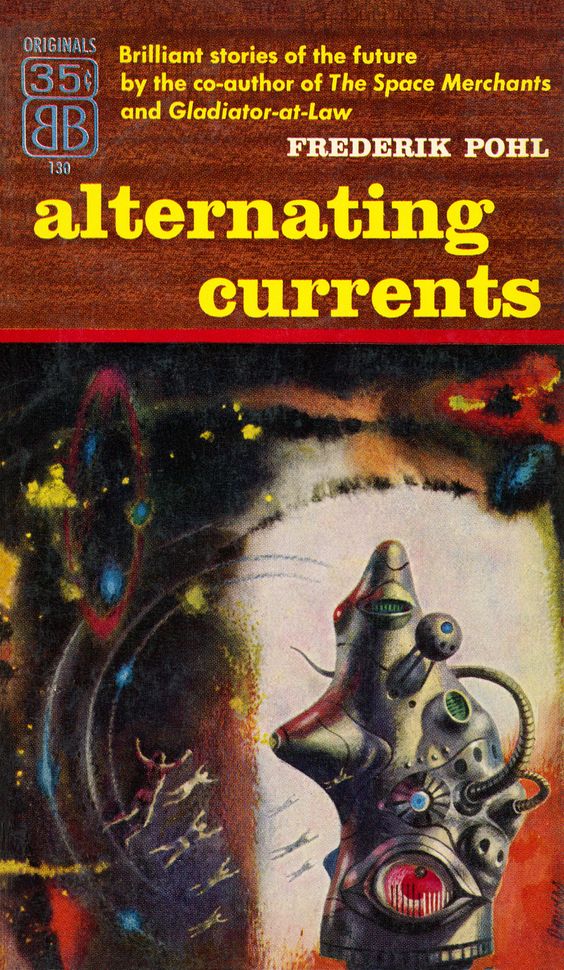
1956 Ballantine paperback of Frederik Pohl’s short story collection Alternating Currents. The cover art is by the inimitable Richard Powers.
1956 Ballantine paperback of Frederik Pohl’s short story collection Alternating Currents. The cover art is by the inimitable Richard Powers.
15137. (David Demchuk) Touch: A Play for Two [play]
15138. (H. Joseph Hebert) Tens of Thousands of U.S. Bridges Rated Deficient; Repair Costs
. . . . . Estimated in the Billions [article]
15139. (Norman F. Cantor) The Last Knight: The Twilight of the Middle Ages and the Birth
. . . . . of the Modern Era
15140. (Jonathan Steele) Good News from Baghdad at Last: the Oil Law has Stalled [article]
15141. (John Foot) The Rendition of Abu Omar [article]
15142. (Andy Griffith) The Day My Butt Went Psycho!
15143. (Robert A. Heinlein & Spider Robinson) Variable Star
Read more »
This short and entertaining account of life in fourteenth century England and France uses the life of John of Gaunt to illustrate its themes. Cantor is opinionated. He likes to make analogies with today’s social institutions, popular literature, and movies. This makes the book feel “unscholarly”, but it comes closer to the actual conversations that historians are likely to hold while discussing John of Gaunt in a pub. It”s the sort of book that should be read by a few friends one evening, then discussed over beer the next.
There are two attitudes that one can hold about a distant time. One is that “the past is a foreign country” — that we can’t really put ourselves in the shoes of fourteenth century people, because their experience was fundamentally alien to our own. The other is that the past is comprehensible to us psychologically, if our interpretations are based on common sense, because human nature and character remain constants. Things in our own experience will present themselves as clarifying parallels. Cantor is inclined to this last attitude, and so am I. I was not very surprised to learn that Cantor is not the usual Oxford don, but the son of a Manitoba rancher. An earlier book of his, which I greatly enjoyed, examined the personal experiences and attitudes of several twentieth century historians who interpreted the Middle Ages (Inventing the Middle Ages, 1992).
At the 2003 World Science Fiction Convention in Toronto, it was revealed that an outline existed for a novel that Robert Heinlein had chosen not to write. The outline, prepared in 1955, was detailed. It cried out to be completed, and veteran science fiction writer Spider Robinson was assigned the task. Variable Star, is the result.
I think that science fiction is in the middle of a process of self-destruction. While the global reading population has been expanding, the science fiction shelves in the bookstores have been shrinking. It is now almost impossible for a new writer to break into the field, and editorial policies are increasingly conservative and formulaic. At the same time, there’s a pervasive recycling of old material. One of the most annoying activities is the publication of endless sequels to old works, sometimes written by others after the death of the author, or works “set in the universe of” an established classic. Baroque stylistic convolutions are preferred. We have entered a kind of Hellenistic Alexandria, where the dead outrank the living and cleverness consists of saying what has been said before, only in a more confusing and duller way. Read more »
15105. (Joseph-Charles Taché) Des provinces de l’Amérique du Nord et d’une union fédérale
(Stephen Leacock) Nonsense Novels:
. . . . 15106. (Ross Beharriell) Introduction [preface]
. . . . 15107. (Stephen Leacock) Author’s Preface [preface]
. . . . 15108. [2] (Stephen Leacock) Maddened by Mystery:or the Defective Detective [story] Read more »
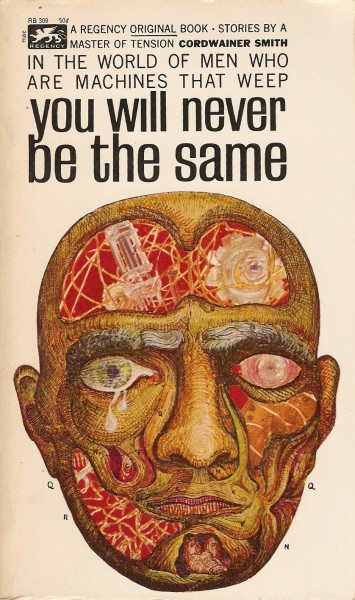 As the numbers in brackets indicates, I’ve read all the stories in this book several times. I read Cordwainer Smith whenever I want to be reminded of what Science Fiction once was: a field in which intellect, imagination, and artistic integrity combined to transcend the limitations of contemporary culture. Nobody was better equipped to think unconventionally than was “Cordwainer Smith”, who was really Paul Myron Anthony Linebarger. American born, but raised in China (where he was known as 林白楽 [Lin Bai-lo] ), France and Germany, Linebarger was at various times a spy, expert in psychological warfare, academic, and adviser to the White House on Asian affairs (though refusing to be involved in the Vietnam War). He was, odd as it seems, Sun Yat-sen’s godson, and negotiated international treaties when he was teenager. Yet his identity remained a secret to the science fiction community when his stories appeared in the magazines.
The stories he wrote were far in advance of their time. In 1945, these words appeared at the beginning of “Scanners Live In Vain”: Martel was angry. He did not even adjust his blood away from anger. Read more »
This fascinating book dates from 1989, when the Gay Rights movement was in confusion and transformation. The authors, who came from a background of neuropsychology and mathematics (Kirk), public relations and advertising (Madsen), where among the minority of gay intellectuals who felt that the stagnation that their cause had suffered during the resurgence of religious fundamentalism in the U.S. owed more to flaws and failures in the gay community than to the strength of its enemies. They felt that there was a clearly trodden path by which despised minorities had historically won a place in American society, and that their generation of gay activists had failed to follow that path, and become their own worst enemies. In retrospect, much of their argument now seems common sense. Considerable progress has been made in this area (though much more in Canada than in the United States), and it has been made largely by the growth of a new mindset among gays. Kirk and Madsen presaged this new mindset. Read more »
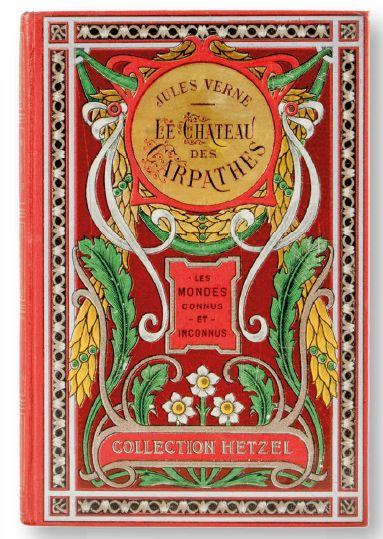 This is a minor work by Jules Verne, but it entertained me greatly because it’s set in Transylvania, where I have just been hiking and touring. In fact, the main action takes place precisely in the place I was exploring on foot with my friend Isaac White ― the mountains of Hunedoara. Here he places a mysterious castle, and a mad scientist who has invented television. The book was written in 1893, and counts as one of the first fictional speculations on this idea that did not involve the supernatural. However, the story is pedestrian by Verne’s standards, and consists mostly of dissertations on the flora, fauna, geology, and history of the region, in the style that Verne fell back on when he wrote on autopilot.
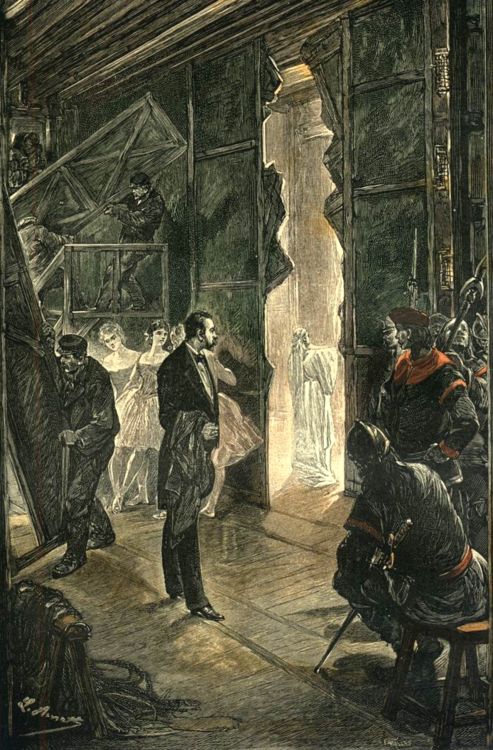
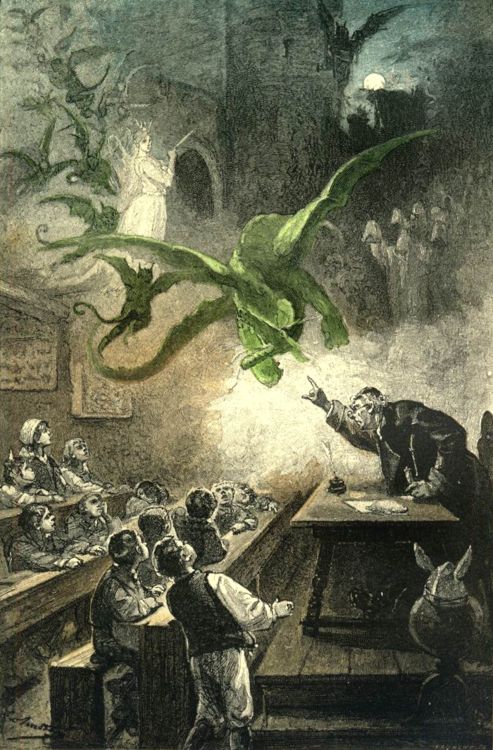
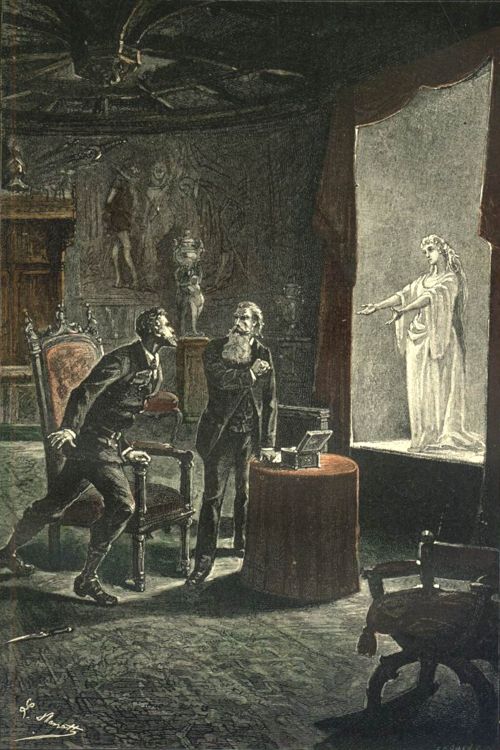
illustrations by
Léon Benett
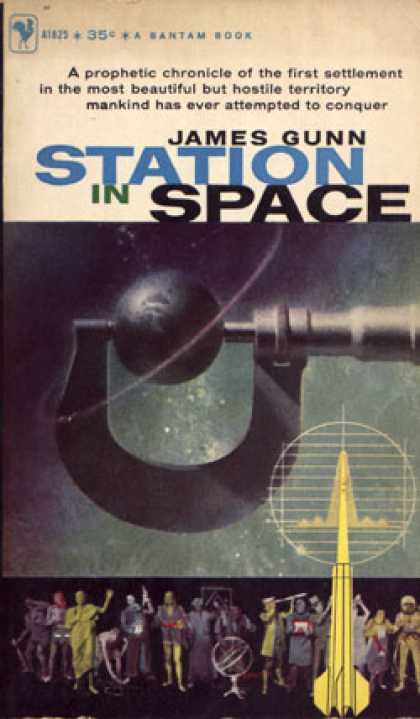 James Gunn was writing “hard science fiction” in the 1950’s, and was in some ways the precursor of people like Ben Bova and Larry Niven. The connected stories in this book are Gunn’s attempt to envision the construction of an orbiting space station, at a time when “serious” scientists still dismissed talk of space exploration as mere fantasy. Unlike many who had written stories in which eccentric scientists built space ships in their back yards, Gunn understood that such a project would require engineering and financing on a mammoth scale, and would involve political complexities. The stories are quaint, now, but will interest anyone who reads fiction with a historical perspective.
contents:
15119. (James E. Gunn) The Cave of Night [story]
15120. (James E. Gunn) Hoax [story]
15121. (James E. Gunn) The Big Wheel [story]
15122. (James E. Gunn) Powder Keg [story]
15123. (James E. Gunn) Space Is a Lonely Place [story]
The Separatist movement in Québec has managed to train an entire generation into thinking that Québec’s entry into Confederation was some sort of conspiratorial swindle, but the truth of the matter is that the very idea of Confederation originated in that province, and was largely promoted by French Canadian intellectuals seeking a strategy to defend and preserve their culture. The fact is that the principle threat to the language and distinct culture of French Canada was, in the 19th century, the possibility of the absorption of Canada by the United States. The first detailed and systematic proposal for a Canadian Confederation was this treatise by Taché, published in 1858. Taché was a doctor practicing in the lumber camps of the wilder parts of the Gaspé peninsula, where he became enamored with aboriginal culture, and collected folklore. His later career in journalism focused on the development of a strong and distinct French Canadian literature, preferably one that “ventured into the unknown.” As a matter of principle, he refused to wear any article of clothing not manufactured in Canada. He was, in effect, a romantic nationalist of the 19th century mode. Not altogether progressive, he preferred a timid reform of the archaic system of seigniorial land tenure, rather than the complete abolition that the public clamored for. This lost him support in his political career, though in other issues he remained highly popular. Read more »