(Jones 1975) A Boy and His Dog
(Muybridge / 1877–85 ) Homage To Eadweard Muybridge
(Edison 1894) Sandow [the Strong Man] Read more »
Category Archives: D - VIEWING - Page 23
FILMS JANUARY-MARCH 2009
Posted by Phil Paine
on March 31, 2009
No comments
(Tarsem 2006) The Fall
Posted by Phil Paine
on March 22, 2009
No comments
This interesting fantasy was filmed in India, Romania, Namibia, South Africa, Czech Republic, Indonesia, and other places. The cinematography is superb, reminding me of the crisp images of James Wong Howe. The director, Tarsem Singh, was trying for an adult approach to a psychological parable about suicide and death, illuminated by some of the most beautiful landscape and architecture in the world. It’s thick with cultural, scientific, and historical references best enjoyed by a well-read audience, though it can be enjoyed well enough without noticing them.
The story: in 1920’s Hollywood, a stuntman recovers from a serious injury, and rejection in love, in a hospital. Another patient is a young Romanian immigrant girl (perhaps ten years old). In order to bribe the child to get him morphine pills with which to commit suicide, the stuntman tells her a fantastic tale, with the flavour of the Masnavi or the Arabian Nights. The films intercuts to representations of this tale, which employ real landscapes and settings with fantastic costume and magical effects.
This film appeared and passed unnoticed in 2006.
(Verhaeghe 2006) Le Grand Meaulnes
Posted by Phil Paine
on January 26, 2009
No comments
If you have a certain frame of mind (which I have, and share with my friend William Breiding), you will naturally be drawn to the remarkable 1913 novel by Alain-Fournier [Henri Alban-Fournier, 1886–1914]. Le Grand Meaulnes is justly considered a masterpiece of French literature, and it captures the subtle tension between dream and reality, and between desire and fulfillment. The main character, Augustin Meaulnes, a seventeen-year-old student, gets lost and encounters a woman he falls in love with, then can’t find her, an event that determines the subsequent story. But the tale is told from the point of view of his fifteen-year-old friend François Seurel, and it’s this technique that makes the story brilliant, because the real point of the story is what it all means to Seurel. It’s an elegant, precisely written tale, and the author’s obvious genius was almost immediately extinguished on the battlefields of World War I. Read more »
(Jones 1975) A Boy and His Dog
Posted by Phil Paine
on January 10, 2009
No comments
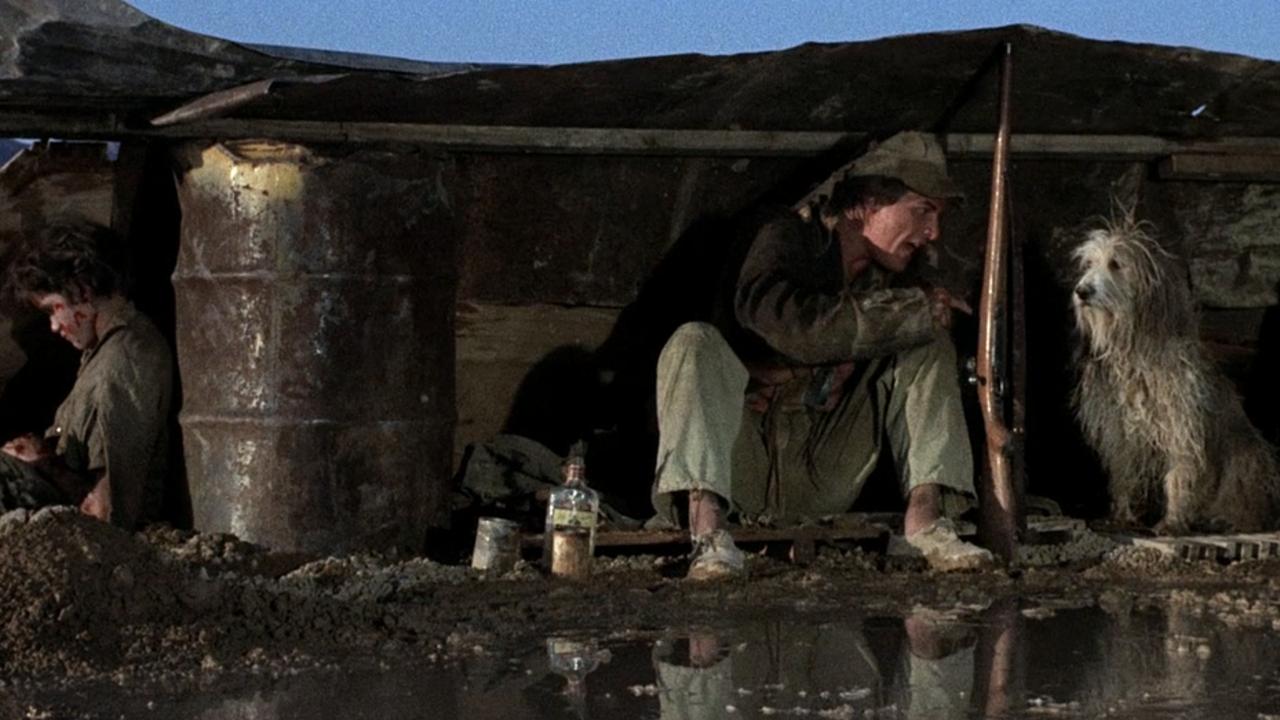 Harlan Ellison’s post-apocalyptic black comedy was written in 1969, and filmed in 1975, at the tail end of the wave of Hollywood eccentric films that briefly came out of Hollywood (after which things went back to Business As Usual). It is reasonably faithful to the story, and apparently won Ellison’s approval, except for the last line spoken in the film. Ellison felt it this line was mysoginist, a criticism that had been unjustly made against the story. The kind of bitter, cynical humour that was commonplace at the time probably doesn’t sit will with the audiences of today. The satirical dystopia of white-face-painted oligarchs ruling a Walt Disneyish Topeka, Kansas in an underground refuge will probably just puzzle anyone under thirty. But this kind of humour, updated in imagery, might be on the verge of a come-back. The lead actor, Don Johnson, later went on to star in the television Miami Vice. Jason Robards, a veteran star from the 1950s, played the sinister ruler of the underground Topeka. Under-rated veteran actor Tim McIntyre provided the voice of Blood, the telepathic dog.
FILMS OCTOBER – DECEMBER 2008
Posted by Phil Paine
on December 31, 2008
No comments
(Parker 2007) South Park: Ep.163 — Imaginationland, Part 1
(Parker 2007) South Park: Ep.164 — Imaginationland, Part 2
(Parker 2007) South Park: Ep.165 — Imaginationland, Part 3
(D’Elia 2004) Boston Legal: Ep.1 — Head Cases
(Ewing & Grady 2006) Jesus Camp
(Parker 2001) South Park: Ep.72 — Proper Condom Use
(Wincer 1996) The Phantom
Read more »
(Huston 1956) Moby Dick
Posted by Phil Paine
on December 2, 2008
No comments
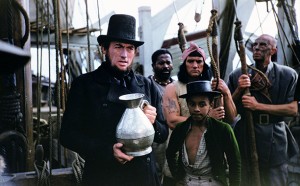 Critics were not kind to John Huston’s 1956 filming of Melville’s symbolic masterpiece, but it has much to commend it. Gregory Peck looked awkward in the role of Ahab, but in the scenes where he whips his crew into a collective frenzy (where Starbuck sees “a madman beget more madmen”) he was very effective. Ray Bradbury wrote the script, and I think it one of his most brilliant accomplishments, for it remains very true to the intentions and style of the book. Richard Basehart was fine as that simple soul, Ishmael, and Leo Genn performed brilliantly in the role of Starbuck. The special effects were superb for their time, though they might embarrass a film-maker today. Visual detail was accurate.
The world of the New Bedford whalers in the 1840s holds many surprises for a modern viewer. It was strikingly cosmopolitan — the whaling ships sailed every sea in the world, and Africans, Native Americans, Asians, Polynesians, and Europeans crewed the ships and walked the streets of New Bedford. People were genuinely, profoundly religious. Unlike the phony-balony “Christian fundamentalists” of modern America, who never actually read the bible, these people knew it by heart. Melville expected his readers to get every one of his thousands of biblical references in the novel. The movie captures both these elements exactly.
(Davidson / Palin 2004) Himalaya With Michael Palin [six episodes]
Posted by Phil Paine
on October 10, 2008
No comments
![08-10-06 VIEW (Davidson - Palin 2004) Himalaya With Michael Palin [six episodes]](http://www.philpaine.com/wp-content/uploads/2018/08/08-10-06-VIEW-Davidson-Palin-2004-Himalaya-With-Michael-Palin-six-episodes-300x197.jpg) I want to kill Michael Palin — purely out of envy. He gets to travel everywhere, see the coolest things, and talk to fascinating people, and makes a fortune doing it. Palin was recently ranked number nine in the list of the world’s top ten travelers of all time by Wanderlust Magazine. It’s been claimed that travel agencies anticipate sharp spikes in bookings for any destination that he visits, after an episode of one of his documentaries. Himalaya is his best documentary series to date. This one takes him to the Northwest Frontier states of Pakistan, to Amritsar in the Punjab, to Simla, to Kashmir and Ladakh, through Nepal into Tibet, and from thence eastward to Yunnan in China, back through Nagaland and Assam, into Bhutan, and finally to the shores of the Bay of Bengal. In this spectacular journey, he meets and talks to a variety of people: an enterprising dentist in Peshawar; the Dalai Lama; Namu, a pop singer from the matrilocal Mosuo people of Yunnan; a Southern Baptist headhunter in Nagaland; dancing monks in Assam. Palin’s easygoing affability gives everyone he talks to dignity, which I think is the secret of his success. You always get more than just scenery and platitudes. The series tiptoes around politics, but its focus on individual lives and personalities makes it an impressive document. For example, his visit to the Sikh Golden Temple doesn’t focus on the splendour of the building, but on the volunteers preparing the customary meal, given to anyone who comes to it.
I want to kill Michael Palin — purely out of envy. He gets to travel everywhere, see the coolest things, and talk to fascinating people, and makes a fortune doing it. Palin was recently ranked number nine in the list of the world’s top ten travelers of all time by Wanderlust Magazine. It’s been claimed that travel agencies anticipate sharp spikes in bookings for any destination that he visits, after an episode of one of his documentaries. Himalaya is his best documentary series to date. This one takes him to the Northwest Frontier states of Pakistan, to Amritsar in the Punjab, to Simla, to Kashmir and Ladakh, through Nepal into Tibet, and from thence eastward to Yunnan in China, back through Nagaland and Assam, into Bhutan, and finally to the shores of the Bay of Bengal. In this spectacular journey, he meets and talks to a variety of people: an enterprising dentist in Peshawar; the Dalai Lama; Namu, a pop singer from the matrilocal Mosuo people of Yunnan; a Southern Baptist headhunter in Nagaland; dancing monks in Assam. Palin’s easygoing affability gives everyone he talks to dignity, which I think is the secret of his success. You always get more than just scenery and platitudes. The series tiptoes around politics, but its focus on individual lives and personalities makes it an impressive document. For example, his visit to the Sikh Golden Temple doesn’t focus on the splendour of the building, but on the volunteers preparing the customary meal, given to anyone who comes to it.
(Ewing & Grady 2006) Jesus Camp
Posted by Phil Paine
on October 4, 2008
No comments

“Pastor” Ted Haggard in action

Worshipping George Bush, Jr at Jesus Camp
One of the creepiest documentaries I’ve ever seen. It follows the activities of a fundamentalist childrens’ camp that employs grotesque brainwashing techniques to indoctrinate children, largely for obvious political ends. The organizer, a monstrously evil woman, makes you sick with every word she spouts. Also included are a famous pastor, Ted Haggard, one of the most influential evangelicals in the country, preaching anti-gay hatred at the children. Haggard was later discovered having sex and doing hard drugs with gay hustlers, and resigned. Another disgusting scene involves children babbling “in tongues” while worshiping a card-board cutout of George Bush, Jr. It should be noted that the movement’s leaders considered the documentary to be a fair representation of their views.

“sinful” children repent…

.… the irony is painful.
FILMS JULY – SEPTEMBER 2008
Posted by Phil Paine
on September 30, 2008
No comments
(Chaffey / McGoohan 1967) The Prisoner: Ep.1 ― Arrival
(Honda 1966) The War of the Gargantuas [ American release version of Furankenshutain no
. . . . kaijû: Sanda tai Gaira]
(Cregeen 1999) MidSomer Murders: Ep.10 — Death of a Stranger Read more »
(Cragg 2007) Boston Legal: Ep.77 ― No Brains Left Behind
Posted by Phil Paine
on September 14, 2008
No comments
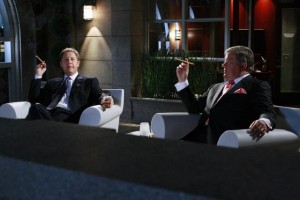 Boston Legal has been doing a good job of opposing the status quo in the United States, and is brilliantly funny in the process. My thanks go to Isaac White for drawing my attention to this series, and bringing over files of it to watch. This particular episode is the funniest I’ve seen, and the best example of standing up to the morons. It not only takes on the Iraq War, but Bush’s idiotic and destructive education policies. While all the acting is good in this series, the best parts are when James Spader and William Shatner interact. Shatner has, over the years, matured into a brilliant comic actor.