15574. (Yeah Yeah Yeahs) Fever To Tell
15575. (Matt Dusk) Two Shots
15576. (Wailin’ Jennys) 40 Days
15577. (Ludacris) Chicken-N-Beer
15578. (Gordon Downie) Battle of the Nudes
15579. (Anton Bruckner) Mass #1 in D Minor Read more »
Monthly Archives: April 2006
First-time listening for April, 2006
Posted by Phil Paine
on April 30, 2006
No comments
READING – APRIL 2006
Posted by Phil Paine
on April 30, 2006
No comments
(Dr. Seuss & Alexander Abingdon) The Omnibus Boners:
. . . . 14638. (Dr. Seuss & Alexander Abingdon) Boners, Being a Collection of Schoolboy
. . . . . . . . . Wisdom, or Knowledge as it is Sometimes Written, Compiled
. . . . . . . . . from Classrooms and Examination Papers by Alexander Abingdon &
. . . . . . . . . Illustrated by Dr. Seuss
14639. (Dr. Seuss & Alexander Abingdon) More Boners
14640. (Dr. Seuss & Alexander Abingdon) Still More Boners
14641. (Osamu Tezuka) Phoenix ― A Tale of the Future [graphic novel]
Read more »
14653. (Lili Réthi & William W. Jacobus) Manic 5: The Building of the Daniel Johnson Dam
Posted by Phil Paine
on April 26, 2006
No comments
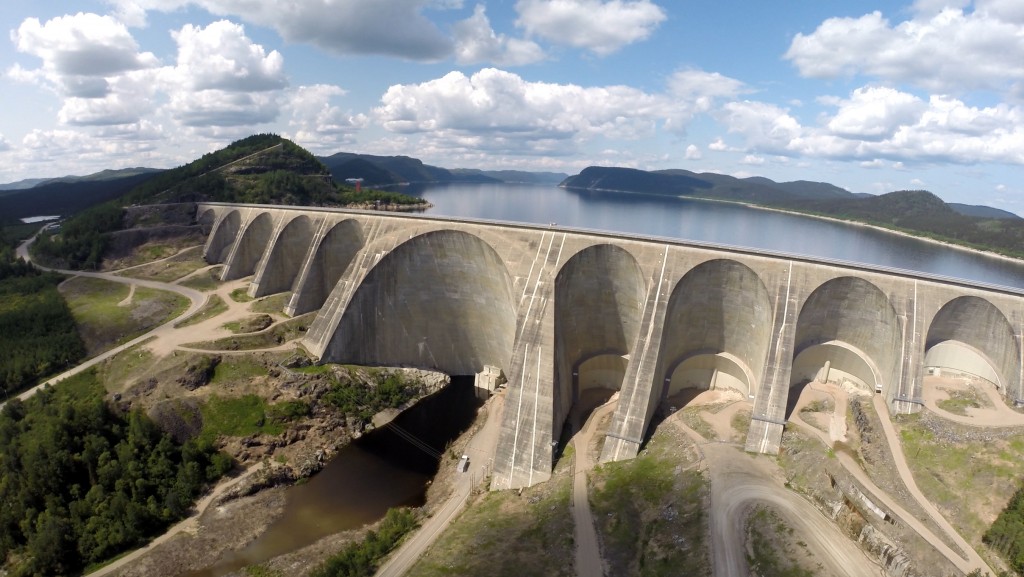
Giant hydro-electric dams are not exactly a popular subject, these days, but, ecological considerations aside, the building of Manic 5 certainly provides a heavy dose of awe and romance. Few tourists take the trouble to journey into the remote district in Northern Quebec where this huge structure is. It’s not just the gigantic statistics (even the 735,000-volt transmission lines were an engineering achievement on an unprecedented scale), but the human drama of its construction. The authors capture this in both prose and about a hundred beautiful drawings. Lili Réthi, who looked something like Miss Marple, was one of the greatest architectural and engineering artists, and she died shortly after completing the Manic 5 drawings. Her work, which is of great artistic value in my view, is known only to architects and engineers.
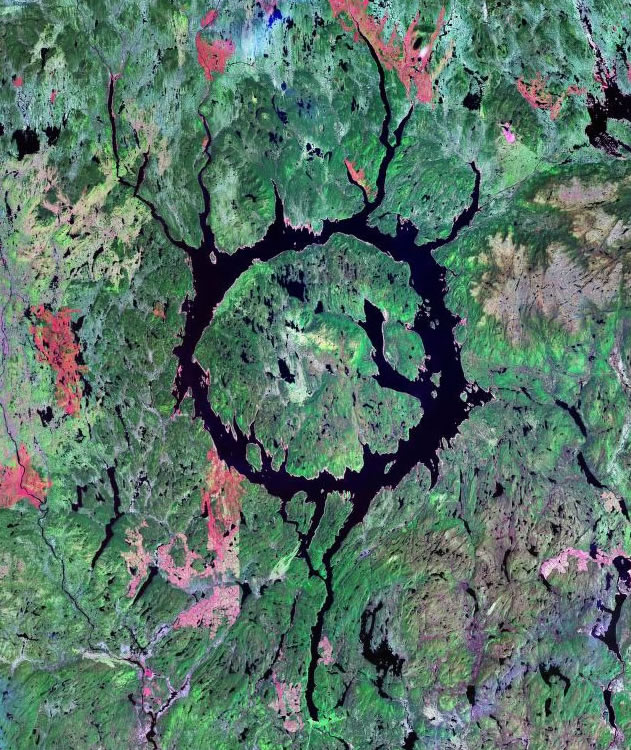
The reservoir created by Manic 5 is even more interesting than the dam. Anyone who has spent any time in Earth orbit is quite familiar with it, since it stands out like a bull’s‑eye, seen from space. The project flooded the impact crater created by a five km wide asteroid that struck Quebec towards the end of the Triassic. The Manicouagan lake acts as a giant hydraulic battery for Hydro-Quebec. In the peak period of the winter cold, the turbines are run all the time at peak load to meet the massive electrical heating needs of the province. During the summer, the surplus is sold to the New England grid. The island inside the lake is larger than Rhode Island. Some of the lakes within the island within the lake have large islands in them. As far as I know, there are no inhabitants.
Sunday, April 23, 2006 — The Cosmopolitan Dream
Posted by Phil Paine
on April 23, 2006
No comments
My friend, the artist Taral Wayne, recently showed me some ancient Indian coins and asked me what I could tell him about the city-state for which they were minted. He thought I might be interested because he was sure they were from one of the ancient republics. He thought it might be named “Yaudheva”, which was what was scrawled by the coin dealer on its mounting card. There was also another word describing the figure au verso, but neither Taral nor I could make it out clearly.
This was all a bit misleading. Yaudheva would mean something like ” — ? — which is godlike”, an unlikely name for a city. But after looking through my old notes on ancient Indian republics, it dawned on me that it must just be a mix-up between “v” and “y” by the dealer.
Once I knew that it was actually Yaudhiya, then it was simple to untangle. That is the name of one of the republican confederacies of north-western India. I have extensive notes on the Yaudhiya republics. They are not as well-known as the Audumbara republics, but they are reasonably well-recorded from the 5th Century BC onwards. They are mentioned in lots of ancient literature, including the Mahabharata, the Puranas and in Panini’s treatise on grammar. They acquired fame, and a reputation for valour, by defeating Alexander, halting his progress into India. The coin is probably from the Yaudhiyan republic of Rohtika (or Rohitaka), some ruins of which survive in the minor provincial city of Rohtak in the State of Haryana.
The Yaudhiyan confederacy was a collection of city states sharing the same tribal ancestry, much like the early Latin cities. The Yaudhiyan tribes spread across what it now the Punjab. They developed republican forms of government quite early, and maintained them quite late, despite temporary submissions to the Kushan kings. When they threw off the Kushans, they proudly re-established their republican constitutions. But they continued to mint coins following the Kushan model, and corresponding roughly to the Greek drachma, on which the Kushan coin was based. Read more »
Lu Watters’ Yerba Buena Jazz Band
Posted by Phil Paine
on April 21, 2006
No comments
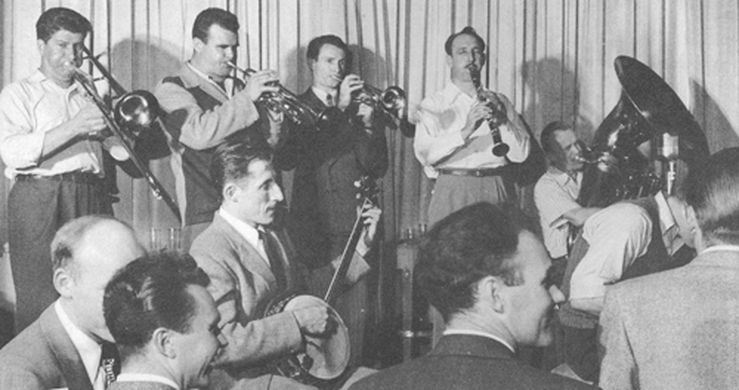
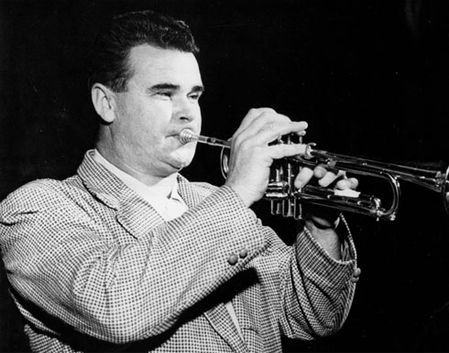 Fortunately, this 1955 recording on a small California label is in good condition. It preserves some of the little-remembered “San Francisco Sound” of the early 1940s. In a time when the swing and big band sounds dominated, a minority of jazzmen sought to revive the more intimate sound of Dixieland. There were three localizes “schools” of this “back to the basics” movement: one in New Orleans, another in Chicago, and a third in San Francisco, lead by Lu Watters and Turk Murphy. The 1941 and 1942 sessions on my disc, recorded on Van Ness Avenue in San Francisco, have Lu Watters and Bob Scobey on cornets, Turk Murphy on trombone, Ellis Horne on clarinet, Wally Rose on piano, Quire Girsback on tuba, Bill Dart on drums, and two banjo players, Clacy Hayes and Russ Bennett. The interplay is between Watters, Murphy and Horne (whose clarinet is particularly sweet). Watters was most influenced by King Oliver’s band, with Louis Armstrong, in its heyday, but there are also echoes of W. C. Handy and Jelly Roll Morton. Some of the material they played was virtually antiquarian even in 1941: they do an excellent, slow-paced version of the Tiger Rag, a piece that can be traced to the French quadrilles of Old New Orleans. The San Francisco sound featured banjo and tuba in the rhythm sections, which played in a 2‑to-the-bar rhythmic style. There was a lighthearted “good time” feeling to it, which distinguishes it from the more plaintive sound of the New Orleans revival.
14652. (Evangeline Walton) Prince of Annwn, the First Branch of the Mabinogion
Posted by Phil Paine
on April 17, 2006
No comments
The Mabinogion is a compilation of Welsh legend that we know from two medieval manuscripts, the Llyfr Gwyn Rhydderch (White Book of Rhydderch) and the Llyfr Coch Hergest (Red Book of Hergest). J. R. R. Tolkien was expert in these sources, and it’s not surprising that there are echoes of the Mabinogion in the Lord of the Rings. Evangeline Walton worked more directly with the Welsh material. Prince of Annwn is pretty much a retelling of the first tale, “Pwyll, Prince of Dyfed”. She attempts to strike a balance between the original mythic style of story-telling and modern novelistic techniques. The result is very satisfying. It doesn’t feel “modern”, but it satisfies the modern taste for narrative surprise and drama. Her vocabulary and phrasing are well chosen: she uses an “elevated”, poetic prose without sounding silly, a very difficult trick indeed.
I’ve read two different translations of the Mabinogion (the Ganz and the Jones & Jones versions), so I’m not sure how it comes across to someone who has never known the mythology. Walton stays reasonably close to the original, though she throws in a few unrelated bits from the Irish epics for dramatic purposes. Welsh mythology is as misty and disconcerting as the Welsh landscape: you can never tell what is supposed to be real or dream, natural or supernatural. I spent a week walking through the Welsh mountains, and I’m still not sure what actually happened to me and what I halucinated. Walton’s fantasy captures that feeling.
Tuesday, April 11, 2006 — A Giant Fence of Fools
Posted by Phil Paine
on April 11, 2006
No comments
The weather is too beautiful for me to take politics very seriously. I’m also too engrossed in finishing my fantasy novel to pay much attention.
An American Senator is interviewed on Canadian television, explaining his plan to build a fifteen-foot high, barbwire-topped wall along the 6416 kilometre (3987 miles) border between the United States and Canada. The interviewer is rendered speechless by incredulity as the Senator expresses his inability to understand why Canadians would take offense at the project. I wonder what will happen in the adjacent New Brunswick and Maine towns where the border runs through the middle of the Public Library and the book check-in desk is in the U.S. and the book check-out is in Canada?
14645. (David R. Row) Executed on a Technicality
Posted by Phil Paine
on April 10, 2006
No comments
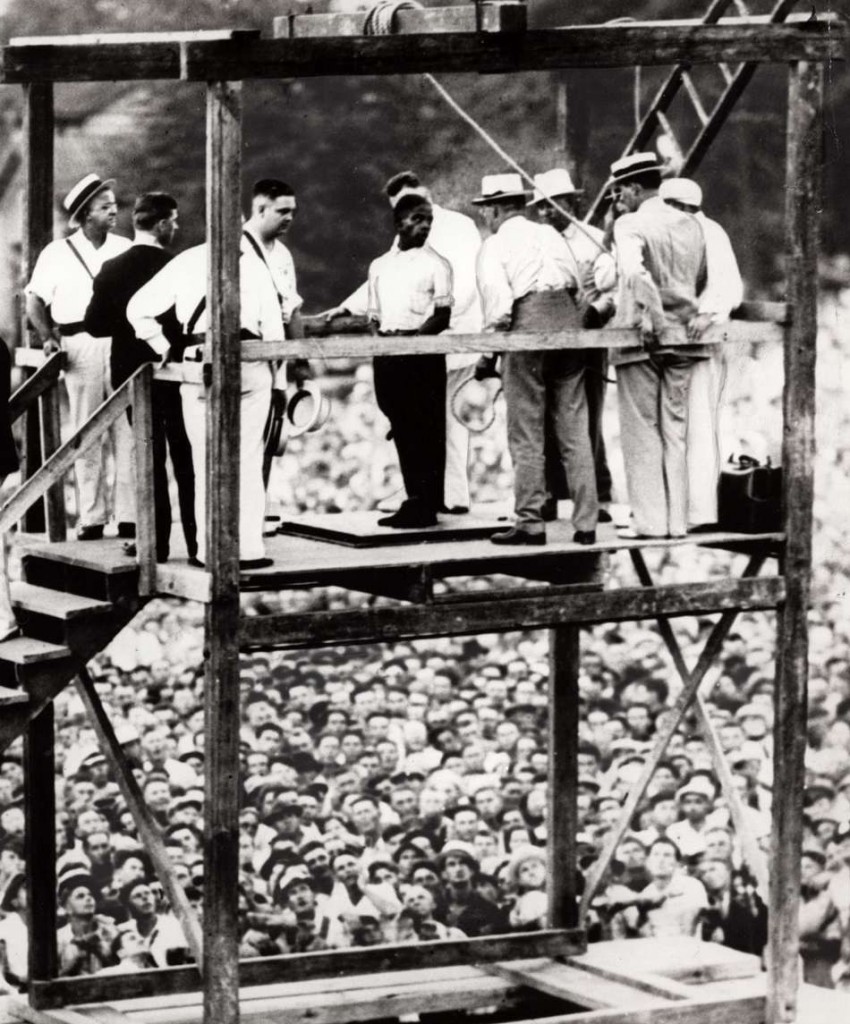
The last public hanging in the U.S., in Owensboro, Kentucky on June 7, 1936
David Row is a defense lawyer in Texas, the American State where the death penalty’s injustice and barbarism are most glaringly evident. The picture of Texas “justice” that he draws makes it clear that there is no more of a judicial system there than in any sleazy Communist dictatorship. Since 1996, the Conservative movement has launched a successful assault on the most fundamental principles of common law and liberty. Row is working from within the system, and within his society, so his approach to the subject seems rather timid to an outsider. In his universe, he is fighting an uphill battle, like a doctor trying to convince a primitive tribe that disease is caused by germs, not witch’s curses. For that is the real situation. Eighty percent of Americans are enthusiastic supporters of the death penalty, not because of any reasoned analysis, but because they are ignorant savages. They do it for the same reason that Aztecs ripped the hearts out of sacrificial victims and the Taliban executed women in football fields. It is in that kind of social environment that the Conservative agenda of destroying freedom and civilization can run rampant. To someone who lives outside this backward world (and outside the rampage of crime and senseless murders that it perpetuates), it is just embarrassing to read a book that shouldn’t have to be written.
14643. (Gwynne Dyer) With Every Mistake
Posted by Phil Paine
on April 8, 2006
No comments
Gwynne Dyer is a Canadian journalist (now based in the U.K.), and an expert on military subjects, who has had a globally syndicated column for many years. I don’t always agree with him, but he is competent, writes honestly, and doesn’t prevaricate. He’s generally a voice of common sense. Unfortunately, for the last decade, his column hasn’t appeared in very many Canadian newspapers. The majority of big Canadian papers have been under the control of the malignant press baron, Conrad Black, and his successor, in recent years. Dyer is persona non grata. This book contains a selection of the columns that most of us, here in his native land, have missed.
Dyer’s strong point is that, unlike most journalists, he knows how the military works, how decisions get made in it, and what war really involves. He also knows something about the culture and history of the world in general. This puts him way ahead of most journalists. He is weaker when trying to second-guess the motives of politicians and the oligarchs who wield real power, a weakness which he very honestly admits. He calls attention to the columns where he didn’t hit the mark. Read more »
Giovanni Bottesini (1821–1889)
Posted by Phil Paine
on April 8, 2006
No comments
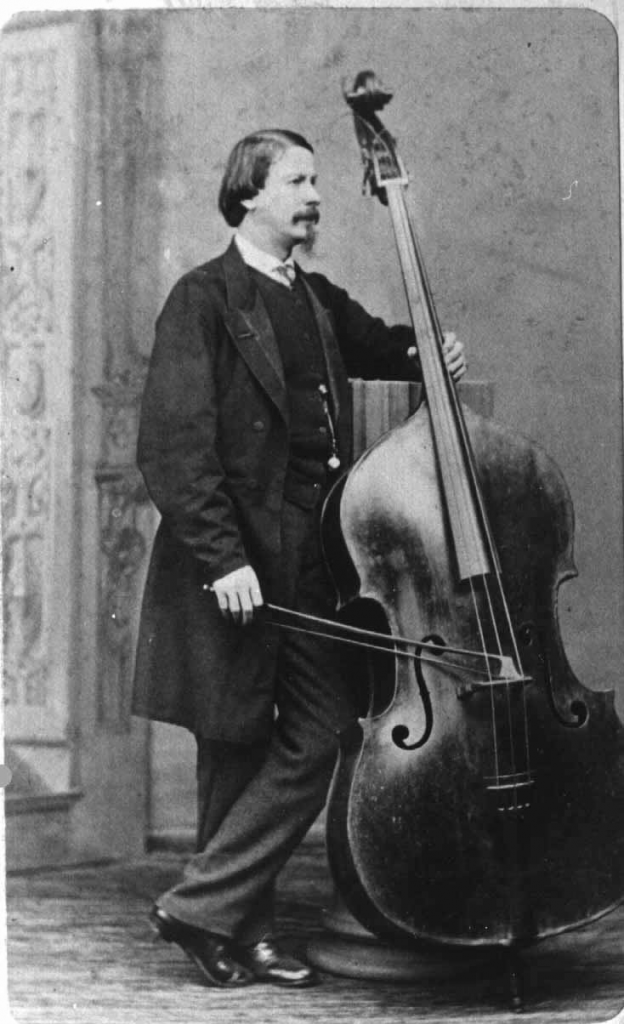 Forgotten by all but concert double-basists, Bottesini was the most renowned soloist and composer on that instrument in the nineteenth century. An Italian from Lombardy, he worked variously in America, Cuba and England. Much of his music sounds like Brahms or Schumann, and not much of it is strikingly original, but most of it is quite pretty. I have twelve pieces, ten ot them slight [an Allegretto Capriccio, an Allegro di Concerto “Alla Mendelssohn” , a Bolero, a Capriccio di Bravura, three Elegies, an Introduction and Gavotte, a Melodia, and a Rêverie, all for Double Bass and Piano]. Two more are fairly serious works. The Concerto #2 in B Minor would be well known if it was for cello. It’s as good as many cello concertos in standard repertoire. Best of all is his Gran Duo Concertante for Violin and Double Bass, which was originally scored for two basses. It is an intelligent work, and I suspect that I would prefer it in its original form. However, the version with violin seems to be the only one available.