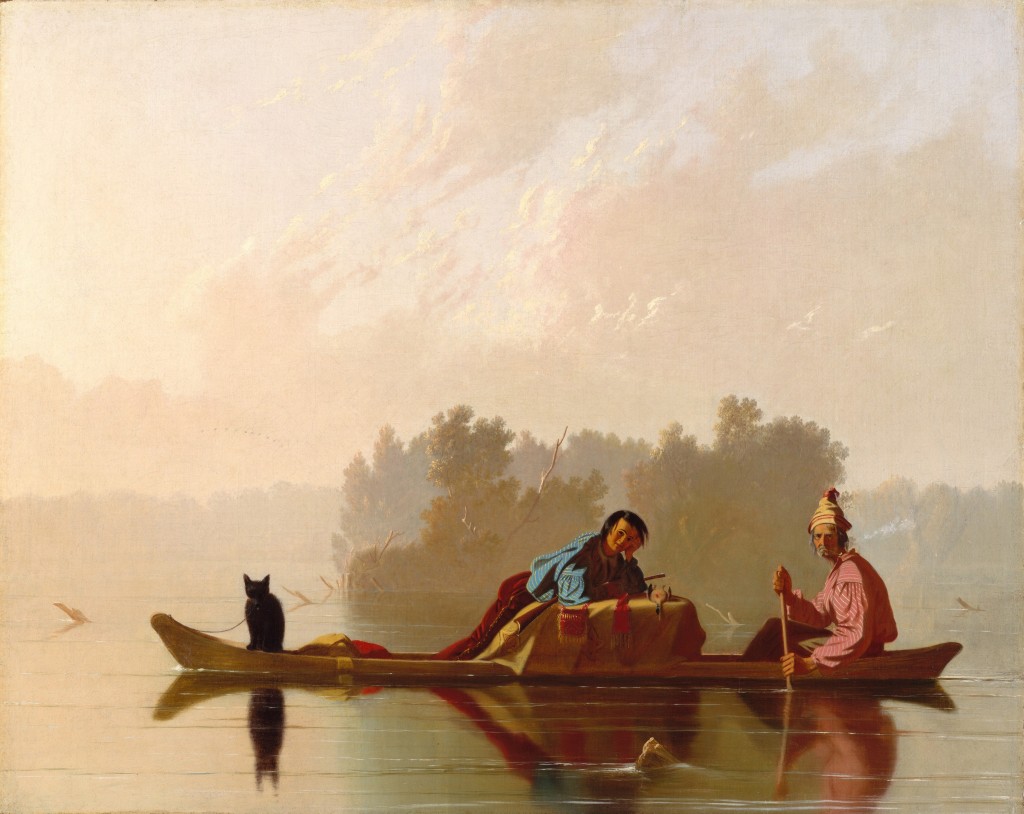
Fur Traders Descending the Missouri, c. 1845 by George Caleb Bingham. It was originally titled “French Trader, Half-breed Son” — Metropolitan Museum of Art of New York City
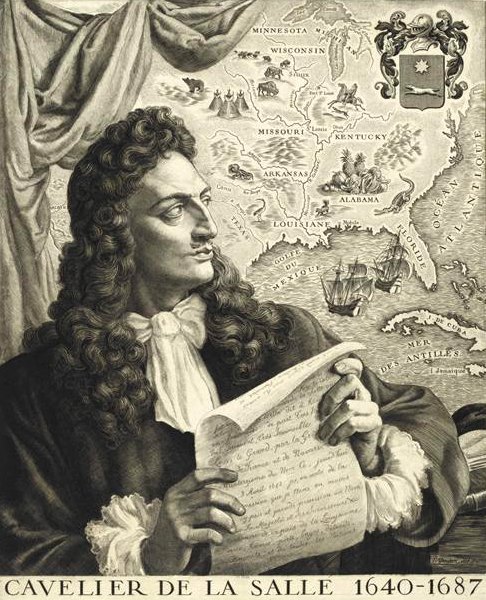
This is not, strictly speaking, a history. It’s more of a meditation on a theme. Marchand, a journalist raised in a New England French Canadian family, retraces the route traveled by Robert de La Salle in the seventeenth century. Along the way, he digs up surviving traces of French America in small towns from Wisconsin to Texas (La Salle was not a small-scale explorer) and contemplates the impact of the French empire in America. He is right, of course, to say that American historians under‑report this era. Apart from the vague impression that the Midwest was explored by General Motors cars, and a horde of mispronounced French place-names, most of it has fallen out of the American historical consciousness.
 As he points out, there was a concerted effort in the Nineteenth Century to view the huge area between the Appalachians and the Rockies as a pristine wilderness, with only a few scattered Indian tribes to be pushed aside by rugged pioneer settlers. In reality, the entire region was a network of stable towns and agricultural settlements. For example, when American troops moved into Green Bay, Wisconsin , in 1816, they found a well-established town of farmers and traders. The French-speaking inhabitants were told that they would not be allowed to engage in trade unless they were American citizens. When they applied for citizenship, most were refused. Those who were allowed to stay in business could no longer engage in free trade, but only deal with the state-supported monopoly of the American Fur Company, which rapidly forced them into bankruptcy. The new regime stripped most farmers of their property, refusing to recognize land titles. Marchand only touches on this briefly, but I am familiar with the process from many historical sources, and what he hints at could be expanded into an entire book. The French-speaking society that stretched from Michigan to Montana to the mouth of the Mississippi was submerged by force and law, as well as by numbers. Those who didn’t vanish into marginal poverty, or abandon their language and religion, fled to Western Canada. There, French-speaking Métis culture shaped Canadian history in dramatic ways. Read more »