(Capra 1936) Mr. Deeds Goes To Town
(McCarey / Marx Brothers) Duck Soup
(Allen 1975) Love and Death Read more »
Monthly Archives: September 2006
FILMS JULY-SEPTEMBER 2006
Posted by Phil Paine
on September 30, 2006
No comments
First-time listening for September, 2006
Posted by Phil Paine
on September 30, 2006
No comments
16362. (Chick Corea) My Spanish Heart
(William Walton) Songs [Benjamin Luxon, baritone & David Willison, piano]:
. . . . 16363. (William Walton) “The Wind From The West“
. . . . 16364. (William Walton) “When As the Rye”
. . . . 16365. (William Walton) “My Gostly Fader”
. . . . 16366. (William Walton) “Lullaby”
Read more »
READING – SEPTEMBER 2006
Posted by Phil Paine
on September 30, 2006
No comments
14749. (Cory Doctorow) Someone Comes to Town, Someone Leaves Town
14750. (Joseph Kage) Chapitre Premier: Esquisses de la vie Canadienne sous Le Régime Français
14751. (David G. Hubbard) The Skyjacker, His Flights of Fancy
(Bernard DeVoto) Mark Twain At Work:
. . . . 14752. (Bernard DeVoto) The Phantasy of Boyhood: Tom Sawyer [article]
. . . . 14753. (Mark Twain) “Boy’s Manuscript” [fragment anticipating Tom Sawyer]
. . . . 14754. (Bernard DeVoto) Noon and the Dark: Huckleberry Finn [article]
. . . . 14755. (Bernard DeVoto) The Symbols of Despair [article]
14756. (Robert Graves) I, Claudius
Read more »
Wednesday, September 27, 2006 — Musharaff Drivel
Posted by Phil Paine
on September 27, 2006
No comments
Pakistani dictator Pervez Musharraf revealed, in an interview with the CBC (Canadian Broadcasting Corp.) exactly how the leadership of the Grand Alliance Against Terrorism sees Canada’s role. With some insultingly snide put-downs, he dismissed any concern in Canada about casualties in Afghanistan as cry-baby weakness. Read more »
Monday, September 25, 2006 — Democracy in Thailand
Posted by Phil Paine
on September 25, 2006
No comments
Soraj Honglaradom, at the Philosophy department of the University of Chulalongkorn University, Bangkok, has graciously allowed me to quote his e‑mail concerning the coup in Thailand:
The coup d’etat was perpetrated by a group of officers who are disatisfied with the Prime Minister Thaksin Shinawatra, who has generated such an intense amount of controversies in Thailand as has never been experienced before. The transition process is going on smoothly and there is no violence. At the time of writing this mail, everything appears calm. The “Reform Group for Democracy under Monarchy”, as the group calls itself, has declared today (Sept.20) to be a holiday and so I am writing this from home. Many people that I know actually welcome the event, as they are fed up with the regime of the Prime Minister. From my past experiences with previous Thai coups, what will happen next is probably that the Reform Group will name an interim Prime Minister. A new charter will be drafted (the much vaunted Constitution of 1997 lasted only nine years), and finally a general election will be called. No one knows exactly when this will happen, but my guess is that we will expect a general election within a year. This is only my guess: things have a way of unravelling themselves in unexpected ways.
Mr. Saroj’s comment rings true to me. It seems to fit the other reports I’ve gotten. Read more »
(Polonsky 1948) Force of Evil
Posted by Phil Paine
on September 23, 2006
No comments
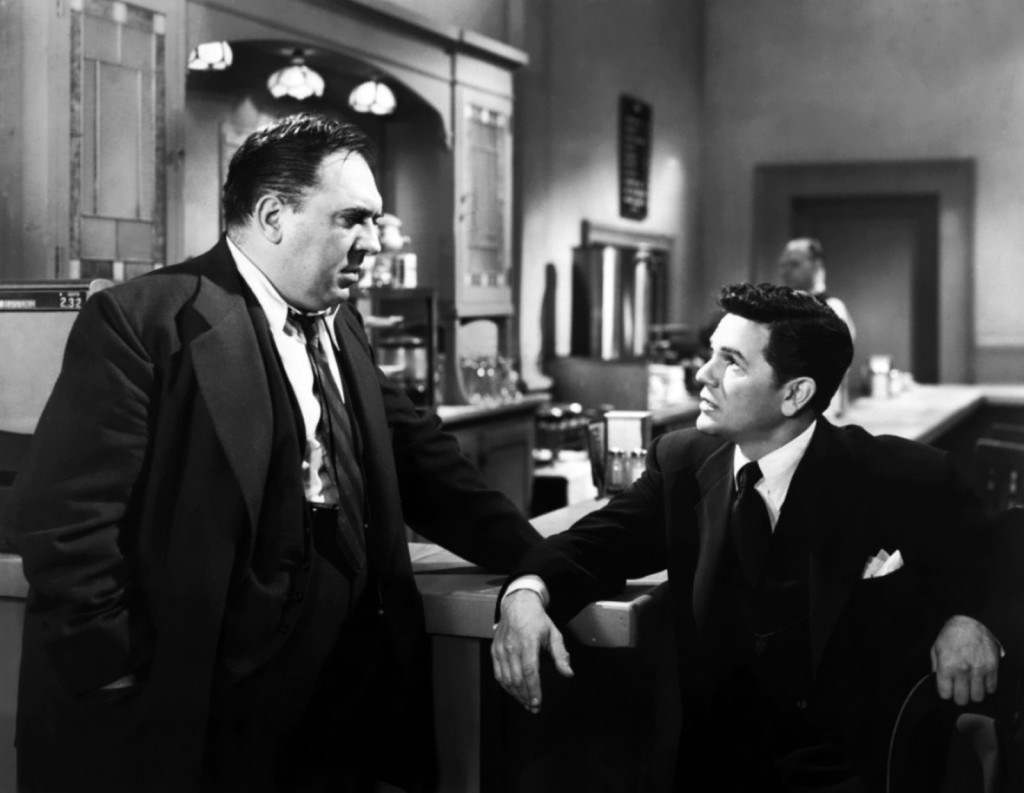 This one is no longer neglected. It is now well-known as a “film noir” gem. IMDB states that “In order to show cinematographer Geprge Barnes how he wanted the film to look, director Abraham Polonsky gave him a book of Edward Hopper’s Third Avenue paintings.” John Garfield is very good in the film, but it is stolen by character actor Thomas Gomez. Pay special attention to the scene where Gomez’s character is “rubbed out” if you want to see script, performance, camera, lighting and editing working in perfect harmony.
14777. (Cyril M. Kornbluth) The Syndic
Posted by Phil Paine
on September 22, 2006
No comments
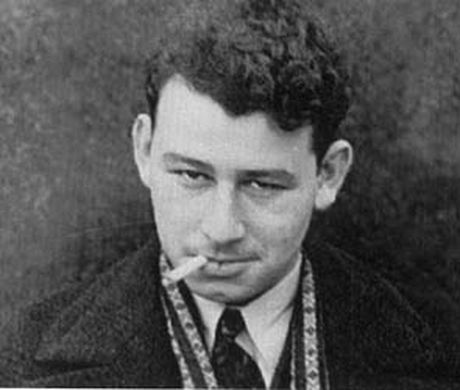 There was something absolutely wonderful about the kind of science fiction that was published in the American SF magazines in the 1950’s. While the “mainstream” fiction writers struggled to obey increasingly rigid notions of “realism” and the short story virtually disappeared as an art form in the literary world, Science Fiction writers flourished in their small ghetto, free to let their imaginations roam, and free to satirize society with infinite jest. That wonderful creative cauldron gave us Theodore Sturgeon, Philip K. Dick, Avram Davidson, Edgar Pangborn, William Tenn, Alfred Bester, and many, many more. These were among the finest writers America ever produced. There was one writer that almost all these men looked up to and admired, and that was Cyril M. Kornbluth. Sadly, his career ended with premature death in 1958, after only seven years of writing. But in those seven years he produced several masterpieces in collaboration with Fredrik Pohl —such as the brilliant satire of advertising, The Space Merchants, and the remarkably prescient Gladiator-at-Law. He also produced several fine novels on his own, much more biting (perhaps because Pohl’s mellower personality influenced the collaborations), as well as a plethora of brilliant short stories. ‘The Little Black Bag’ and ‘The Marching Morons’ are perfect examples of his superb artistry.
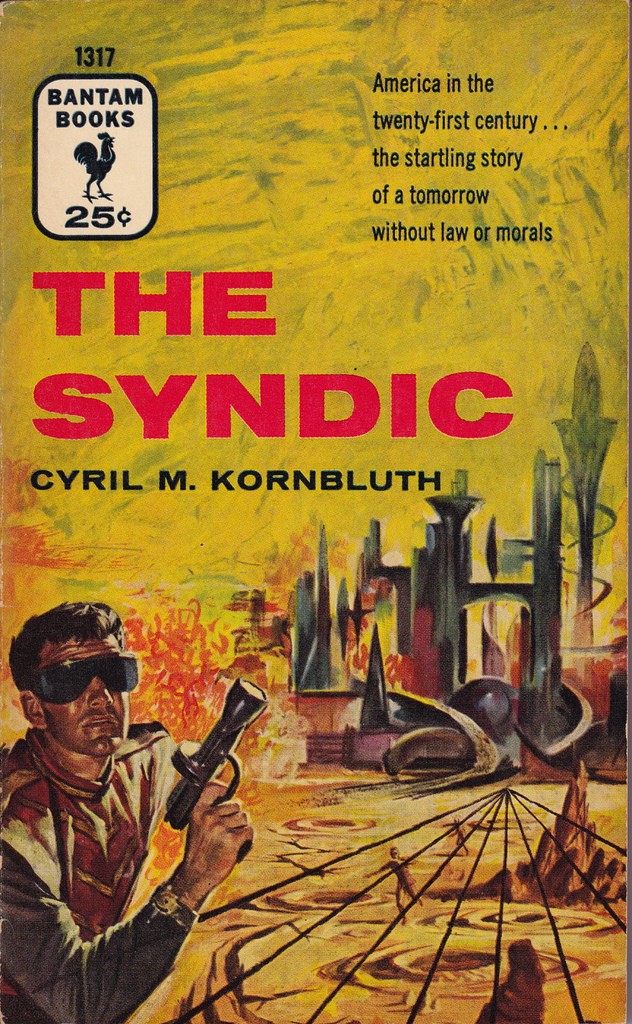 A fine introduction to Kornbluth’s work would be this novel, The Syndic, published in 1953. It posits a future in which governments have collapsed under their own weight of bureaucracy and been replaced by the Mafia. In 1953, it was far-out whimsy. How would an Eastern European read it today? The real pleasure in reading Kornbluth is that his sharp satire is delivered in a crisp, purely colloquial style, as if Damon Runyan where writing sociological Science Fiction. A serious writer, today, would make heavy going of this stuff, stretching it out and filling it with stylistic tricks and learned references. Kornbluth wrote like an experienced barber.… a few deft strokes with a very sharp blade, done like magic, and over before you can catch your breath. Fifty-three years have passed since this novel hit the stands, and it is not quaint. It’s still a good, clean shave.
Wednesday, September 20, 2006 — Anything Except Hunger
Posted by Phil Paine
on September 20, 2006
No comments
A delightful Danish saying, told me by my friend Joan Jacobsen: “Du kan vænne dig til alt, undtagen sult…når først du har vænnet dig til det, dør du af det.” [You can get used to anything except hunger …Once you’re used to it, it kills you.]
Jason Hunter, who visited for almost a week, left this morning. He headed back up north, where he will undertake a vision quest. He will fast for four days in preparation. It will be interesting to see how it affects him. He was good company while he was here. Fortunately, it was possible for him to take the train part of the way. Even the ten-hour journey on Ontario Northland Railway’s Northlander will take him only half of the way home, but it will be much more pleasant than taking buses or hitching rides. The final half, of course, must be done by airplane.
(Kubrick 1958) The Killing
Posted by Phil Paine
on September 20, 2006
No comments
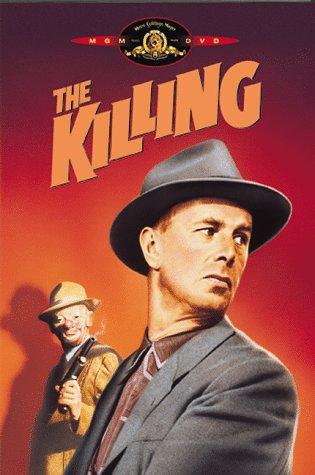 This was Stanley Kubrick’s first feature film, a low budget crime thriller. Apparently the producers thought that its non-linear story sequence would be incomprehensible to an audience, and did not promote it. But there are some very good sequences in this, and the acting, by unknowns and “B” stars (Stirling Hayden, Coleen Gray, Vince Edwards, Elisha Cook), is quite good. Elisha Cook’s performance is particularly impressive.
Tuesday, September 19, 2006 — Turfing Thaksin
Posted by Phil Paine
on September 19, 2006
No comments
The media, at least here in Canada, have been taken completely by surprise by recent events in Thailand. A faction of the Thai military says it has overthrown Prime Minister Thaksin Shinawatra. Presumably, a long sequence of important events led up to this, but none of them attracted the attention of journalists in North America. It might be wise for people here to pay a bit more attention. At place of concentrating on dubious and implausible attempts to bring democracy to places like Afghanistan, we should be more concerned about its precarious position in relatively important places like Thailand. For Thailand is an important country, with tremendous economic potential. It is unique in the region in that it never suffered the experience of colonialism, though it has had to dance nimbly between the pressures brought to bear on it by Britain and France (which had colonies on either side of it), by Japan, America, and China.
Under Thaksin, Thailand seems to have had a thin veneer of democratic process, under which steamed a cauldron of corruption, manoeuvering by the military, and factional disputes. It is not clear to me exactly who wants this sudden military coup, and who opposes it. I simply don’t know enough to have an opinion about Thaksin and his policies. To tell the truth, I’m embarrassed that I know next to nothing about this important country’s politics. Thailand is the kind of country that should be able to find its inner strengths, and establish a working democracy. There is no scarring legacy of colonialism, it is full of enterprising and well-educated people, it has a vigorous cultural life, it has not been torn up by war. But it doesn’t seem to be able to make things work. I’m hoping that some Thai correspondents will give me some insights into this perplexing situation.