Musicians have long been attracted to William Blake’s interconnected poems known as the Songs of Innocence and of Experience. Allen Ginsberg has asserted that a study of the rhyme and meter of the poems reveals that Blake intended them to be sung. They certainly have the feeling of English tavern ballads strangely mutated into moral and metaphysical meditations. This mixture of serious purpose and popular form is exactly the stuff that best suits American composer William Bolcom. Read more »
William Bolcom’s Songs of Innocence and Songs of Experience
Posted by Phil Paine
on February 15, 2010
No comments

First-time listening for January, 2010
Posted by Phil Paine
on January 31, 2010
No comments
21401. (Piirpauke) Kalevala Spirit
21402. (Ismo Alanko Säätiö) Sisäinen solarium [Solarium Within]
21403. (Veils) Nux Vomica Read more »
READING — JANUARY 2010
Posted by Phil Paine
on January 31, 2010
No comments
18426. [3] (Elias Lönnrot) The Kalevala: Epic of the Finnish People [translated by Eino Friberg ;
. . . . . editing and introduction by George C. Schoolfield; illustrated by Björn Landström]
. . . . . [read previously in Kirby (1) and Bosley (2) translations]
18427. [2] (F. R. Kreutzwald) Kalevipoeg: An Ancient Estonian Tale compiled by Fr.R. Kreutzwald ;
. . . . . translation with notes and afterword by Jüri Kurman Read more »
Epp-Karike Jurima-Sonin: Estonian Songs
Posted by Phil Paine
on January 25, 2010
No comments
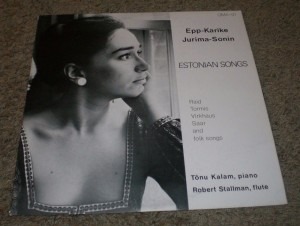
A very precise and pleasant voice sings a selection of Estonian art songs and folk songs. The folk material, on the whole, is more captivating. Jurima-Sonin is an American of Estonian background, known as both a teacher and soloist.
[Note inserted in 2018: Some time after this posting I met my friend Skye Sepp’s mother. We discussed Estonian music, and I mentioned this record. Epp-Karike Jurima-Sonin, it turns out, is her sister! She was married to Ain Sonin (1937–2010), a respected physicist specializing in fluid mechanics. The obviously multi-talented Sepp/Sonin clan originated in Estonia, flourished in Toronto, and spread out tentacles to Boston and San Francisco.]
Ajoy Chakraborty
Posted by Phil Paine
on January 8, 2010
No comments
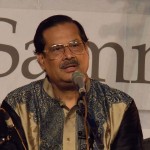 Chakraborty is the outstanding exponent of the Patiala school of North Indian classical singing. The prestigious Patiala Gharana dates from Mughal times, but it has consistently fostered innovation, rather than strict classical orthodoxy. Chakraborty is one of its many stars. I have two pieces sung by him: Abhogi, and a fullkhyalusing the South Indian raga Hamsadhwani. This last has an emotional punch that really got to me, especially at the point of one impossibly long-held note that lifts the piece into sublimity. The tabla and harmonium (perhaps his brother Sanjay?) are aptly understated. Unfortunately, I only have the sound-files, with no production details.
18586. [3] (Edgar Pangborn) Davy
Posted by Phil Paine
on January 5, 2010
No comments
A most pleasurable third reading of an old favourite of mine. Edgar Pangborn’s gentle and humane novels had a tremendous influence on me. The book that really hit the mark was A Mirror For Observers, but the Davystories were almost as good. This novel introduces the character at the age of fourteen, but hops back and forth in time. The background is post-apocalyptic, with the human population of upstate New York and New England reduced to an early Medieval level of technology and the Huly Murcan Church providing what little social cohesion exists. But this is not a remake of Miller’s A Canticle For Leibowitz. Pangborn saw organized religion as more of a repressive and regressive force than Miller did. Nothing rings false in Pangborn’s imagined world. The young Davy is a randy little ragamuffin, and his picaresque progress is more along the line of Fielding than Bunyan. But unlike most picaresque writers, Pangborn never placed sex in opposition to love, or to morality. Rather, he understood that sex stands at the heart of morality. Spider Robinson has remarked that “Edgar Pangborn said again and again in his books that love is not a condition or an event or even a state of mind — that love is a country, which we are sometimes privileged to visit.”
18426. [3] (Elias Lönnrot) The Kalevala: Epic of the Finnish People; 18427. [2] (F. R. Kreutzwald) Kalevipoeg: An Ancient Estonian Tale
Posted by Phil Paine
on January 4, 2010
No comments
As my December reading has concentrated on the related subjects of shamanism, Finno-Ugric linguistics and folklore, it’s appropriate for me to start off the year by re-reading the Kalevalaand the Kalevipoeg. The Finnish Kalevalahas been a constant, haunting presence with me for most of my life, but the less well known Estonian Kalevipoegis something I’ve gotten into more recently. Read more »
(Gaup 1987) Ofelas
Posted by Phil Paine
on January 2, 2010
No comments
 I watched this film in the original Sami language, without any subtitles, but it was not difficult to follow. The period is circa 1000 A.D., and the story portrays an encounter between the nomadic Sami (Lapps) who had inhabited the far north of Scandinavia since prehistoric times and the Chudes, another people who were more technologically advanced (they had crossbows). The encounter is seen from the Sami point of view, and all the dialogue is in Sami, a non-Indo-European language in the Finno-Ugric family. To this day, many Sami continue to live an arctic life-style of reindeer herding and hunting. There customs are so similar to those of the native people of Northern Canada that knowing the language was unnecessary for me. It was easy enough to guess what was happening and what people were saying. The acting is effective, especially that of 15-year-old Mikkel Gaup as the protagonist, a youth who works out a scheme to defeat the invaders and thus earns the position of shaman. The cinematography is crisply beautiful. This is basically another “resistance myth” — a bare bones realistic version of the tale told in fantastic form in Avatar. The title means “Pathfinder”.
Sibelius’ Kullervo
Posted by Phil Paine
on January 1, 2010
No comments
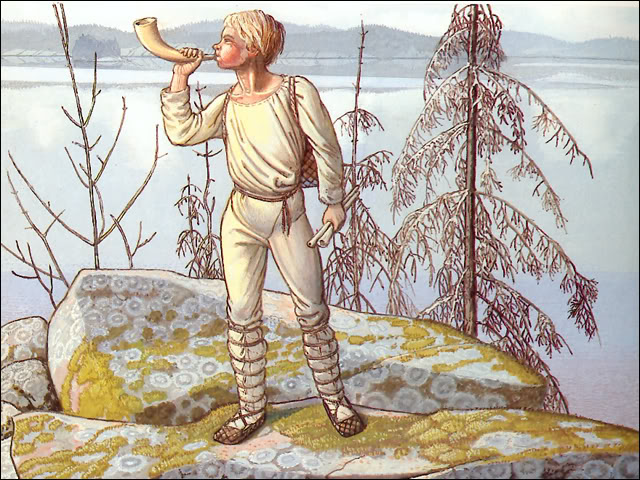 As I’m beginning the year with a re-reading of the Kalevala, the Finnish mythological epic that has haunted me since childhood, it’s logical for me to begin the year’s musical listening with Sibelius’ largest scale work based on it, the spectacular unified sequence of tone poems about the Kalevalahero Kullervo. I have two recordings of Kullervo, Symphonic Poem for Soprano, Baritone, Chorus and Orchestra, Op.7: Jorma Panula conducting the Turku Philharmonic Orchestra, and Paavo Berglund directing the Helsinki Symphony Orchestra. They’re both fine, but I prefer the Berglund. Eeva-Liisa Saarinen’s soprano in it is superb.
Read more »