An entertaining first novel that pulled me in after a few pages and made me want to know the outcome. The rock musician characters make a nice change from the usual cyber-punk heroes, and the music lore feels credible. There are some minor characters too obviously parachuted in for the sole purpose of giving background explanation. Unobtrusively revealing the background has always been a difficult writing problem in SF. The setting is in the near future, with a technology and social history that seems unlikely in so short a time-span, but that’s a quibble. It’s a good, solid SF read, and I’ll seek out the author’s next work.
Somatic Responses: Digital Darkness
Posted by Phil Paine
on September 2, 2009
No comments
Somatic Responses is the tag for two Welsh brothers, John and Paul Healy. Digital Darkness is breakbeat, rhythmic noise, or soundscape, or something like that. I like it. It has interesting rhythmic intricacies, within a relatively slow-paced framework. I particularly liked the strings in “Stranded” and the grim bass line in “Human Bass”. Not something you would play as background or to make yourself feel happy, but stimulating.

First-time listening for August, 2009
Posted by Phil Paine
on August 31, 2009
No comments
20178. (Arcangelo Corelli) Sonata da chiesa in A, Op.3 #12,
20179. (Arcangelo Corelli) Sonata da chiesa in F Minor, Op.3 #9
20180. (Arcangelo Corelli) Sonata da chiesa in B‑flat, Op.3 #3
20181. (Arcangelo Corelli) Sonata da chiesa in G Minor, Op.3 #11
20182. (Arcangelo Corelli) Sonata da chiesa in F, Op.3 #1 Read more »
READING — AUGUST 2009
Posted by Phil Paine
on August 31, 2009
No comments
17961. (David G. Mandelbaum) The Plains Cree ― An Ethnographic, Historical, and
. . . . . Comparative Study
17962. (Jane Jacobs) The Nature of Economies
17963. (John S. Milloy) The Plains Cree: Trade, Diplomacy and War, 1790 to 1870
17964. (Josiah Gregg) Commerce of the Prairies
17965. (Geoffrey Ashe) Camelot and the Vision of Albion
Read more »
Gwa’wina Singers: Rising From the Ashes
Posted by Phil Paine
on August 28, 2009
No comments
Kwakwaka’wakw [Kwakiutl] music in British Columbia comes as a surprise to anyone who is more familiar with the pow-wow music of the rest of Canada. It’s meant to accompany indoor ceremonies and the peculiar dance dramas with elaborate costumes that prevailed on the Pacific coast. Orchestras of log, box, and hide drums are accompanied by a variety of rattles and whistles play with unison chants in Kwak’wala, supplemented by solo “hollers”. It’s the rattles that carry the aura of sacredness. The rhythms are nothing at all like what you would hear on the plains. Some are reminiscent of Japanese forms, like gagaku. I don’t know how this particular album, by the Gwa’wina Singers of Alert Bay, compares to other stuff from the Coast. This whole area of music is unfamiliar territory for me.
Jesse Crawford, Don Baker and Marv Merlin
Posted by Phil Paine
on August 22, 2009
No comments
During the era of silent films, theatre organists were big stars. After the arrival of talking films, most of them lost their jobs, but the best of them found work in other media, or lingered on as names. Such was Jesse Crawford, who followed success as a film organist with success on radio, as a recording artist, and as an instructor. In later years, he became associated with the popular Hammond organs. I have a Decca Vocalion recording, Sweet and Low, of him performing a dozen standard tunes, and another album which he shares with Don Baker and Marv Merlin, called Organ Greats. Baker was a Canadian organist whose career closely paralleled Crawford’s.
This stuff was very popular in the 1950’s, when it was thought of as soothing and mellow, probably providing the equivalent of “lounge” music today. In fact, Baker’s rendition of “The Third Man Theme” is included in Capitol’s “Ultra Lounge” compilation, Organs in Orbit. With the passage of time, this genre has acquired a sort of unintended creepiness. You could use these albums quite effectively as a soundtrack for a David Lynch film.
(Vogel 1959) Space Invasion of Lapland [Rymdinvasion i Lappland] [aka Terror in the Midnight Sun, Horror in the Midnight Sun, or Invasion of the Animal People]
Posted by Phil Paine
on August 21, 2009
No comments
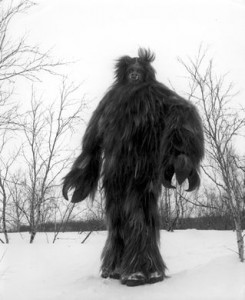 This 1959 low budget science fiction film features aliens (accompanied by a monster that appears to be made of shag carpeting) attacking a Sami village in Swedish Lapland! The film drags boringly for the first two thirds of it’s length, filling time with a lame romance, and lots of scenes of ice skating and skiing. But when the aliens and monster finally appear, there’s lots of fun to be had. The shag carpet monster knocks over tents, and frightens the reindeer, and does the least amount of damage portrayed in any cinematic alien invasion. Some of the camera shots are surprisingly good, as if Svend Nykvist took a day off from Bergman to work for Roger Corman. If you’ve never heard the agglutinative Sami language spoken, you can do so in the one scene where an old man answers questions in it.
(Kjaereng 2005) Canada På Tvers med Lars Monsen
Posted by Phil Paine
on August 20, 2009
No comments
Sami-Norwegian adventurer Lars Morsen travels from Alaska to Labrador by dog sled, canoe, skis, and on foot. The route he takes crosses nothing but tundra, taiga, and boreal forest. That kind of adventure is known as “thru-hiking”, and this is one of the most extreme examples of it. The journey took two years and seven months. There are occasional stops in outposts like Arctic Red River, Churchill, and Mistassini along the way, but mostly he is alone with his dogs. He films himself with a handheld, and talks to himself and the dogs (and the occasional bear), in untranslated Norwegian, but if you’ve spent any time in this kind of environment, you never have trouble guessing what he’s saying. This long documentary (280 minutes — it was split up into episodes for tv broadcast in Norway) won’t be everyone’s cup of tea, but I found it entertaining. But I was entertained by animal behaviour, his bush savvy, and differences in landscape and vegetation that others might not notice or care about. If you like seeing the nitty-gritty of being in the bush, without any extraneous narration, then give it a try.
Wednesday, August 19, 2009 — On Relaxation
Posted by Phil Paine
on August 19, 2009
No comments

I spend most of the day on my feet, walking and carrying things. When I come home, I often put in further hours sitting upright at a computer. So when I finally relax, I want to be horizontal. When I had a standard couch in the apartment, I often found myself drifting to the floor, where I could “gap and stretch”, and feel some freedom. Read more »