There should be no Holy Books. Our species would make a significant step forward if it forsook the habit of declaring books to be sacred scriptures. The belief that certain books aren’t just the writings of human beings, but direct revelations from a divinity, or that they are “sacred” has caused no end of mischief. But I plead my case precisely because I love and respect books. There is some profound wisdom to be found, if one cares to look, in certain books. But there seems, in my view, to be no greater insult to a wise person than to turn their work into a silly magical talisman, to be mindlessly chanted and ranted, rather than read and judged with reason.
Read more »
Tuesday, June 2, 2009 — On Holy Books
Posted by Phil Paine
on June 2, 2009
No comments

First-time listening for May, 2009
Posted by Phil Paine
on May 31, 2009
No comments
19922. (Syd Barrett) You Got It Now [rare European bootleg LP]
19923. (Thomas Tallis) In nomine I
19924. (Thomas Tallis) In nomine II
19925. (Thomas Tallis) A Solfing Song
19926. (Thomas Tallis) Salvator Mundi [version for strings] Read more »
READING — MAY 2009
Posted by Phil Paine
on May 31, 2009
No comments
17662. (Arthur Conan Doyle) The Musgrave Ritual [story]
17663. (Alan Dean Foster) Starman
17664. (John Lorinc) The New City: How the Crisis in Canada’s Urban Centres is Reshaping
. . . . . the Nation
17665. (Russell Shorto) Going Dutch [article]
17666. (Katha Pollitt) Better Living Through Torture [article]
17667. (Steven McKenzie) The Little Ice Age and Scotland [article]
Read more »
Elk Whistle: Still With Us / Wambdi Hokshida
Posted by Phil Paine
on May 25, 2009
No comments
Elk Whistle [aka Elk Whistle Singers] hale from Regina, Saskatchewan. This album would be classed as “pow pow contemporary” rather than “traditional”, sung in the Northern Style, with considerable improvisational freedom. It’s an example of the fine material being released by Saskatoon-based Turtle Island Music.Outstanding is the lead-in “Victory Song”.
Star Trek (Abrams 2009)
Posted by Phil Paine
on May 14, 2009
No comments
I saw the new Trek opus with artist Taral Wayne, in a theatre filled, for some reason, with Russians, who laughed and cheered whenever the character Chekov spoke. I later learned from a Russki friend that the actor, Anton Yelchin, though himself a born Russian, was giving the character a broad Polish accent! I was actually rather pleased with the film, which managed to strike a balance between providing something new and remaining within the Sacred Canon, and though the plot and events were ludicrously implausible, the humour and enthusiasm with which the actors portrayed their roles made one forget it. An alternate time-line gave license for the deviations from the back-history implied in the previous films. Leonard Nimoy performed with remarkable dignity.
Monday, May 12, 2009 — Two Places On King Street
Posted by Phil Paine
on May 12, 2009
No comments
Almost every day, I walk past two spots of historical interest on King Street, here in Toronto. They are only a block apart, but they represent the moral nadir and zenith of the city’s history.
The first is only a dusty bronze plaque mounted on the side of an old office building. It marks the place where, in 1798, Toronto’s first jail was built. Since it was known as the “old log jail”, we can guess the kind of public structures that graced the streets of what was then known as “Muddy York,” and reclaimed its Iroquoian name of Toronto only in 1834. The plaque makes note of the fact that the first execution took place on October 11th, 1798, when one John Sullivan was hung by the neck until dead, for the crime of stealing a note worth approximately one dollar. Read more »
Sibelius Symphony #1
Posted by Phil Paine
on May 11, 2009
No comments
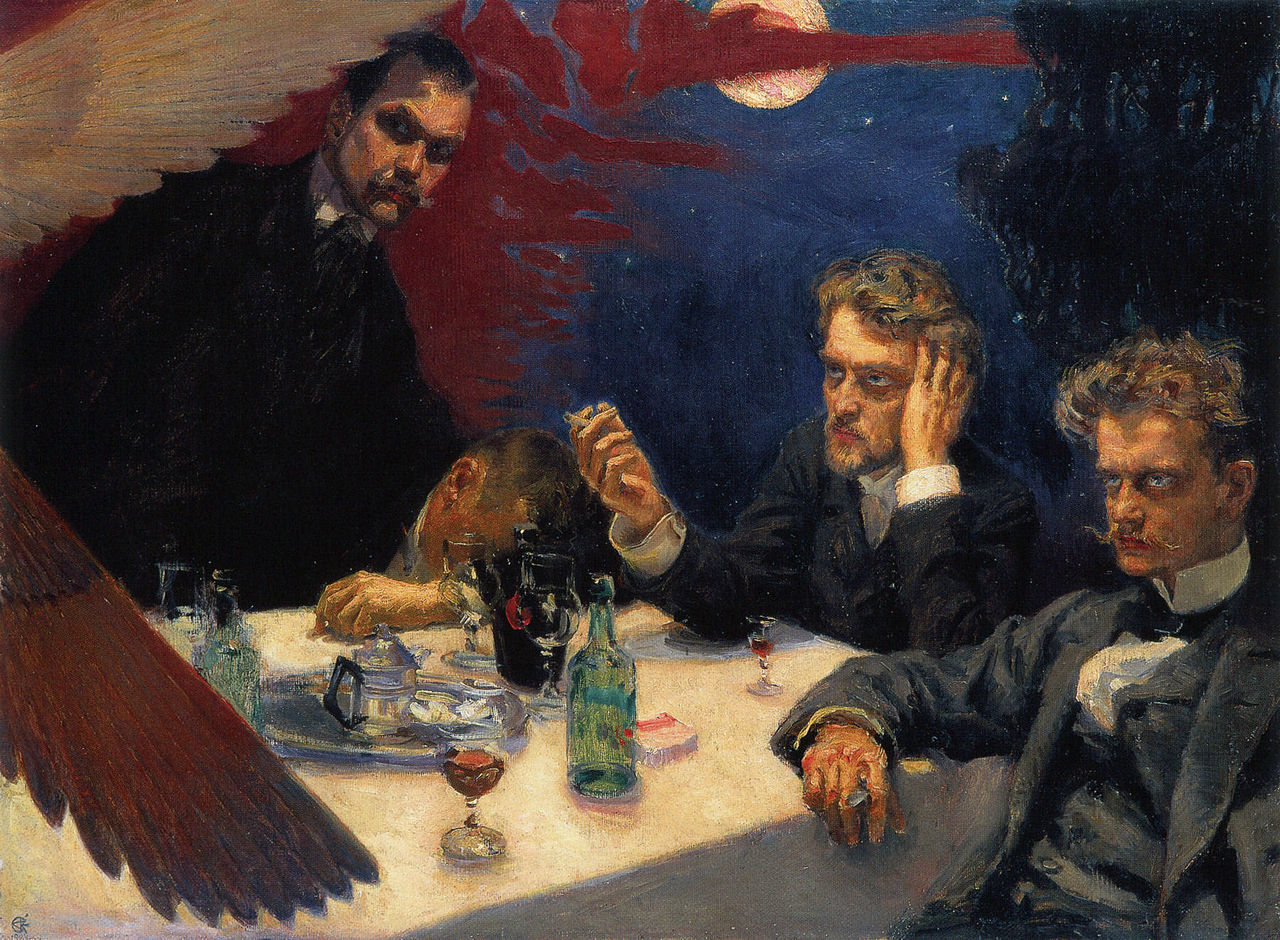
Akseli Gallen-Kallela’s painting Symposiummade in 1894. Symphony #1 was completed in 1899. From left: Akseli Gallen-Kallela, Oskar Merikanto, Robert Kajanus and Jean Sibelius. They were a clique of young bon vivantsin Helsinki. Sibelius had already developed his trademark scowl. Kajanus would conduct the symphony.
Jean Sibelius’s Symphony No. 1 in E minor, Opus 39 was written in 1898, and first performed the next year. Sibelius was aged 33, but he had been composing seriously for less than ten years. The seven symphonies constitute a corpus of work that begins with the conventional symphonic form and gradually evolves into an entirely different approach. Standing at the beginning of this process, the First is essentially conventional in form. Its resemblance to Tchaikovsky’s symphonies is so obvious that most listeners will spot it instantly, but it also displays many of Sibelius’ distinctive mannerisms. Read more »
Pluxus: Solid State
Posted by Phil Paine
on May 7, 2009
No comments
This Swedish electronic group is yet another example of musicians delighting in “retro” electronic sounds generated by old equipment. The beeps, blips, and spacey sounds that embarrassed the previous generation of electronicists now seem cool again, especially if they can be mixed with contemporary samples. Getting it to work — to make music that appeals to the ear, can be tricky. I would say that this album, released in 2006 and re-released in 2008, does so about half the time, notably with the skitter beat 2 (“Perm”), the strangely folky 3(“Bootstrap’) and 4 (“Kinoton”) with the only vocals, which make a nice sequence, but less so with the remaining tracks.
17671. (Frank Tallis) Fatal Lies
Posted by Phil Paine
on May 6, 2009
No comments
This is a well-written mystery novel, with a very lean prose style and direct, sequential plotting. Murder and mayhem in a Viennese military academy, 1903. Detectives improbably using psychoanalytic techniques to solve the mystery, but, hey, that’s the conceit of the tale. Music everywhere, pastries, waltzes, and absynthe bubbling on the spoon. Tallis’ insertion of piquant historical details is carefully calculated to please the reader — never too much at a time, never too didactic. The decaying polyglot Austro-Hungarian Empire is the perfect background for the thriller and murder mystery writer, especially with our retrospective fascination with its sexual and psychopathelogical obsessions. Even old Kraft-Ebbing turns up in a toast.