Two interesting items over at Muhlberger’s Early History. One discusses the peculiar psychology of Canadian historians who can’t quite make themselves believe that Canadian history is worthy of being discussed in a world context, and, react to the thought with the titters of Victorian spinsters spotting a naked bottom. [ The French Revolution and Canada — laughable?] .Then he discusses Senator Romeo Dallaire’s comments. blasting our government for its hypocritical and immoral policy regarding Omar Khadar, the Canadian child soldier long held at Gitmo against all standards of law and decency. [Rule of law and human rights — only when convenie…] Spot on. I, too, looked on with disgust as our morally puny Secretary of State, Jason Kenney (Conservative) gave a fatuous lecture on the nature of evil — to a man whose personal knowledge of genocide, and whose ethical credentials stand as far above him as the Hubble Telescope stands above an ant on the shore of the Dead Sea. When Mr. Kenney spouted the predictable “the end justifies the means” claptrap beloved by scoundrels, Dallaire looked him straight in the eye and said: “If you want a black and white, and I’m only too prepared to give it to you, absolutely. You’re either with the law or now with the law. You’re either guilty or you’re not.”
Wednesday, May 14, 2008 — Steven Muhlberger on Canadian Historians; Romeo Dallaire
16217. (Bonnie Murray) Li Paviyóñ di Michif
This is a children’s book published in the Michif language. It’s quite a rarity, since less than a thousand people can speak the language. But the Métis community in Manitoba is determined to pass the language to the next generation. Michif is one of the most peculiar languages on the planet. It developed in Western Canada among the Métis people, and it combines a basically Cree grammar and verb system with many French nouns, adjectives and prepositions. A few stray English and Gaelic terms are in there, too. It does not follow the pattern of any other known creole, pidgin, or trade language. For example, it retains intact the extremely complex Cree verb morphology, which is the sort of thing that’s usually the first to go in a mixed language. Michif is a linguistic puzzle, without obvious parallel in any other linguistic or social situation. The only other language that is similar is Bungee, spoken by a very few Métis, in which Gaelic replaces French as the main source of nouns and adjectives. There are some people known to have been perfectly fluent in both Michif and Bungee — for example, James Isbister, a farmer in Saskatchewan who was selected as one of the four delegates (along with Gabriel Dumont) to recall Louis Riel from Montana to represent the Métis, was known to be fluent in both Michif and Bungee, as well as Cree, English, French, Gaelic, and the completely unrelated (and notoriously difficult) Dené language.  Read more »
(Ceylan 2002) Uzak [Distant]
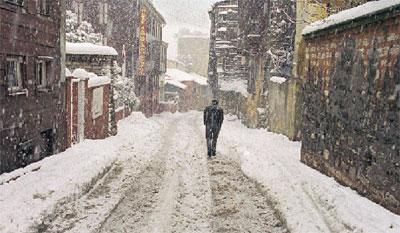 This is a slow-paced psychological drama, stylistically influenced by Tarkovsky. It holds attention because the acting is superb, the psychological nuances realistic. One scene, for example, involving a lost watch, stands out for the fine-tuned performances of the two lead actors, Muzaffer Ozdemir and Emin Toprak. Sadly, Toprak died in a car crash shortly after learning he had received his award at Cannes. The cinematography is first rate, with Istanbul buried in snow forming a grey backdrop to the claustrophobic interior shots and tightly repressed relationships of the characters. It’s a grim film, but the sympathy of the script makes this tolerable to the viewer, and the camera conveys both the beauty and the bleakness of a Turkish winter.
Monday, May 12, 2008 — What Is Progress? What Is Progressive?
In a speech, today, Canada’s Prime Minister, Stephen Harper outlined his plan to force our country down the same path to bankruptcy and self-destruction that the United States has relentlessly pursued over the last generation. It’s first purpose is to destroy our domestic industry (especially in Ontario) and reduce us to abject submission to “Big Energy”, the global communism of oil sheiks, dictators and multinational gangsters. It’s secondary purpose is to escalate economically paralyzing military spending, and make us even more available as mercenary canon fodder to our global masters. Canada’s industrial base is rapidly disintegrating. Just today, the closure of another major industrial facility in Ontario was announced. Canada’s currently “strong” economy is being propped up by oil and gas production, and prosperity is confined to the exportable resource regions. Oil, gas, mining. The Conservative regime is forcing us back into the pathetic “hewers of wood and drawers of water” status that it took us a century of struggle to free ourselves from. The decade of balanced budgets and surpluses generated by Liberal governments has been canceled out ― pillaged by the Conservative regime ― and we will soon be plunging into debt. This is the result of importing the obnoxious, freedom-hating Conservative ideology that has crippled and dishonoured the United States ― an ideology that would far more accurately be named “Neo-Communism”. Read more »
16215. (Edward J. Vajda) Yeniseian Peoples and Languages; 16216. (Edward J. Vajda) Ket
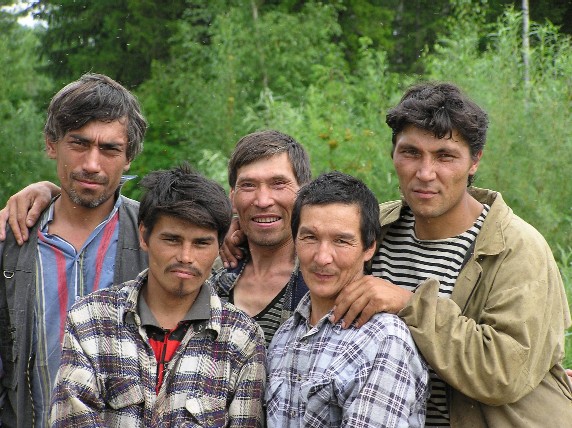
Some modern Ket men.
Back in the mid-1980’s, I became very interested in the native cultures of Siberia, partly because they have many similarities with the native cultures of northern Canada. I went so far as to correspond with several people in Siberia, something which was just then beginning to be possible. This was necessary, because there was then very little information available in English or French about this region, most of which had been sealed off by the Communist regime for most of the century. Some very nasty things happened there, not the least of which was the wholesale suppression and destruction of native cultures. I dug up the small number of relevant books and articles that I could, but there wasn’t much to be found. Read more »
The Alternate World of Zarzuela
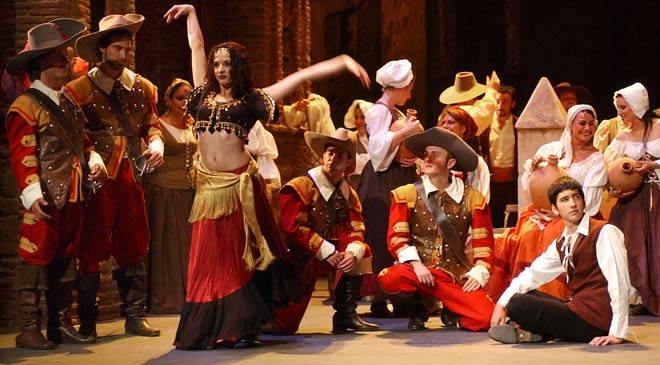
Spain and Catalonia have always stood apart from the mainstream of European culture, doing things after their own fashion. Among these distinctions was their fondness, over several centuries, for zarzuela, an alternative to Opera, with its own styles and conventions. While zarzuelas were staged as early as the mid-seventeenth century, they reached their apogee of popularity and artistic glory in the early 20th century, and were still going strong decades after opera had ceased to be broadly popular. There are distinctive styles of zarzuela sung in Catalan (sarsuela) and in Basque (zartzuelak). The romanzasof this kind of music-drama are the equivalent of opera’s arias.
(Hernández 1999) Lisboa [Lisbon]
A well-crafted suspense film employing some of the formulas of Hitchcock. Despite the title, it’s a Spanish film. The main character is a Portuguese video distributor, on a car trip from Spain, going home. He picks up a mysterious woman, and gets tangled in a web of murder. Well-trodden material, but director Hernandez handles it well, and the oddly low-key ending is original.
16200. (Peter Bellwood) The First Farmers
I’ve been reading everything I can find on this subject for months, now, and this is by far the best book I’ve seen. It is modifying some of my views, and re-enforcing others. It will take me some time to absorb and reflect on the material, here, so I will not leap to a conclusive judgment until it has been well-mulled.Whatever your views on the subject of the neolithic transition to agriculture, this book is essential reading. It brings together the main blocks of evidence (from archaelogy, linguistics, genetics, paleoclimatology, skeletal anthropology, plant and animal biology) in a balanced and systematic way. In most cases, Bellwood lets the evidence speak for itself, and draws conclusions only when they seem compelled by the facts. I think he is missing a major theoretical element, if my hunches remain consistent with the evidence as it stands. But I think this will require more saturation in the existing literature, before I start mouthing off. I’m an amateur and an outsider. This can be an advantage, in certain circumstances, as the history of science has shown, but it is also very easy for an amateur to drift into crankery — which I hope never to do.
(LaBute 2006) The Wicker Man —- ludicrous remake
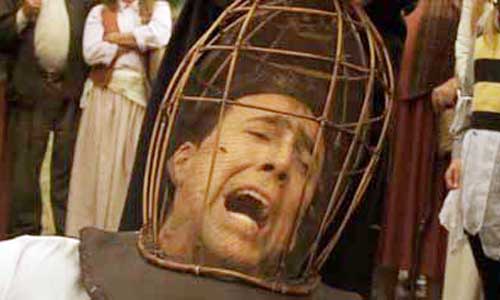
“Oh, no! Not the BEES!!”
Okay, I’ve finally seen it. When I heard there was an American remake of the classic 1973 British filmI knew it would have to be bad. When it came out, everyone who saw it assured me that it was not just terrible, but an absolute atrocity. But still, I was not prepared for how unbelievably bad this film is. It’s sickeningly, loathsomely, horribly, hideously, insultingly bad. Not even the hilarious sight of Nicholas Cage punching an Evil Wiccan Feminist while dressed in a bear suit can make it seem charmingly bad, like an Ed Wood movie, or Robot Monster. The insult to the original film is simply too monstrous to permit that kind of pleasure. This was made by morons who understand nothing. The best way to watch it, if you must, would be to be dead drunk, stoned out of your mind, or, better yet, in a clinical coma.
16197. (Frances Stonor Saunders) The Devil’s Broker ― Seeking Gold, God, and Glory in 14th Century Italy
This is a very well-written study of the role of the English condottieriwho were the Haliburton Gang of fourteenth century Italy. It focuses on the character of John Hawkwood, a minor English knight who rose to leadership among the mercenary armies that were cast loose on France and Italy, when the Hundred Years War entered a lull. Saunders’ prose is excellent, and evocative, her grasp of the evidence is strong, and she has a common-sense vision of the real life behind the documents. Read more »